
How do I add a person's languages, skills and interests?
Short answer
In Stakeholders, search and select the person, press + Add Information, choose Skill, Interests or Languages, and search and select one.
Before you start
You need to be signed in to GilbApp on a computer, with the person's card in a vault you can write to, such as your own vault. The answer on adding a person as a stakeholder shows how to make one. The pictures show a made-up person on a test site; your screen shows your own name and address.
Words used here (8)
- Skill
- A Skill is something a person can do, such as nursing or selling, named from a shared catalogue; it is not a diploma.
- Interest
- An interest is a topic a person cares about, follows or wants to learn, as distinct from a skill they can do.
- GilbApp
- GilbApp is the app, opened in a web browser at https://gilb.com/app, where you open, fill and share your vaults.
- record
- A record is one piece of data with its own address, such as a person, a place, a thing or a note.
- online card
- An online card is the card a person keeps about themselves on GilbPlatform; others see only what the person shares with them.
- GilbPlatform
- GilbPlatform is the service that keeps people's and organisations' data in vaults, each at its own web address.
- field
- A field is one named fact on a record, such as its title or a due date; its name comes from GilbVeda.
- contact language
- A Contact language is the language a person wants to be contacted in, for the messages, calls and documents others send them.
Steps
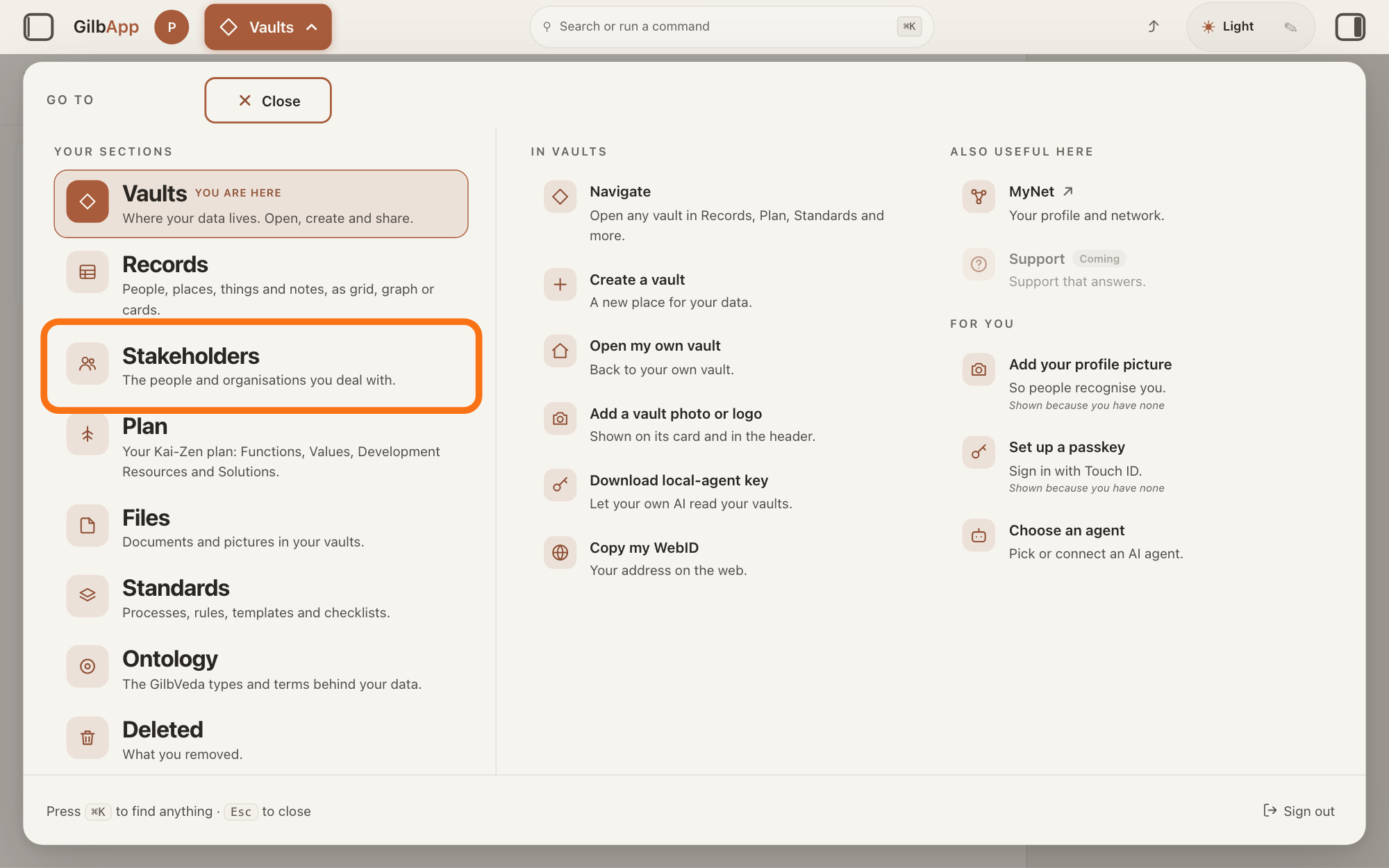
Press Main menu at the top left and choose Stakeholders.
Press Main menu, next to your profile picture at the top left, and under YOUR SECTIONS choose Stakeholders. A stakeholder is a person, group or system that cares whether a Value goes up or down.
Show as text
At the top left, press "Main menu" (it shows the name of the section you are in). In the panel headed "GO TO", look under "YOUR SECTIONS" and press "Stakeholders", "The people and organisations you deal with.", outlined in orange.
More about this
The button shows the name of the section you are in, such as Vaults. A panel headed GO TO opens; Stakeholders reads The people and organisations you deal with. You can also press the Stakeholders button on the card of a vault (the place where a person or a group keeps their records) in Vaults. The screen lists your stakeholders and has the views Grid, Graph, Both and Card. The list also holds organisations, systems and groups; the TYPE column says which are Person.
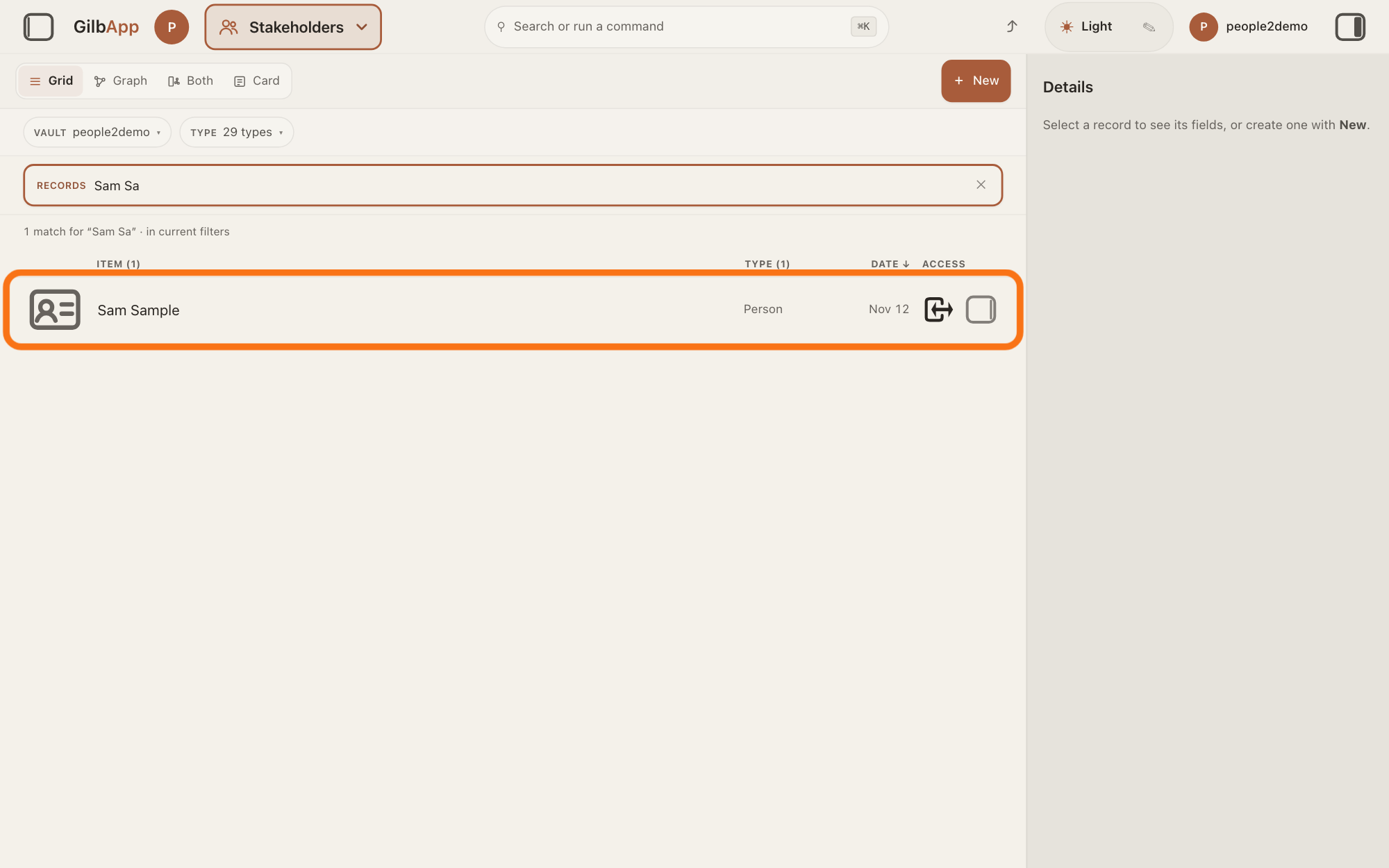
Search and select the person in the list.
Type a word of the person's name in the search box marked RECORDS above the list, and click the person in the list. The person's card opens in the middle of the screen, and the right pane, headed Actions, holds what you can do with it.
Show as text
In the box marked "RECORDS" above the list, type the person's name or its first letters until the line under the box reads "1 match" and only their row is left. Press that row, outlined in orange, to open their card.
More about this
The box shows Search in current filters…, because the list holds only stakeholders; the answer on avoiding adding the same person twice shows more about the search. GilbApp shows only the kinds of information the card already holds; a kind with nothing in it is not drawn. If you can only read the vault that holds the card, the card has no Edit and no + Add Information, and nothing on it can be changed. You do not need the right pane here.
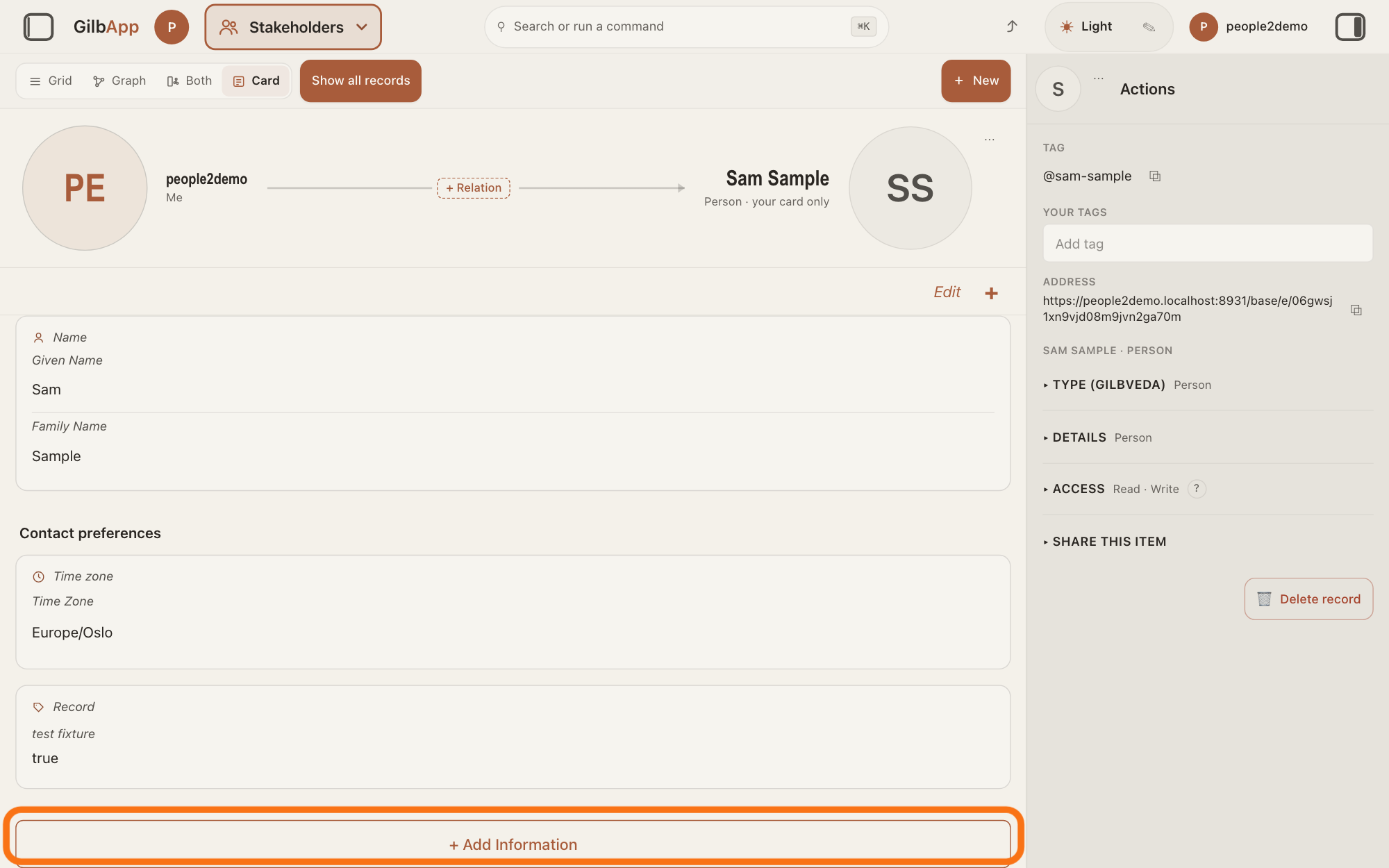
Press + Add Information.
Scroll down to the foot of the person's card and press + Add Information. A list headed Add information opens over the whole window.
Show as text
The person's card opens in the middle. Scroll to the foot of the card and press the wide button "+ Add Information", outlined in orange. At the top of the card, under the name, it says "Person · your card only".
More about this
The list holds only the kinds of information the card does not show yet, under headings such as Connection points and Skills and interests. The + beside Edit at the top right of the card opens the same list; its Search box narrows the list, and Cancel closes it. Below the button, a card not yet connected to the person's own online card, the card a person keeps about themselves on GilbPlatform, has Find their online card; you do not need it here.
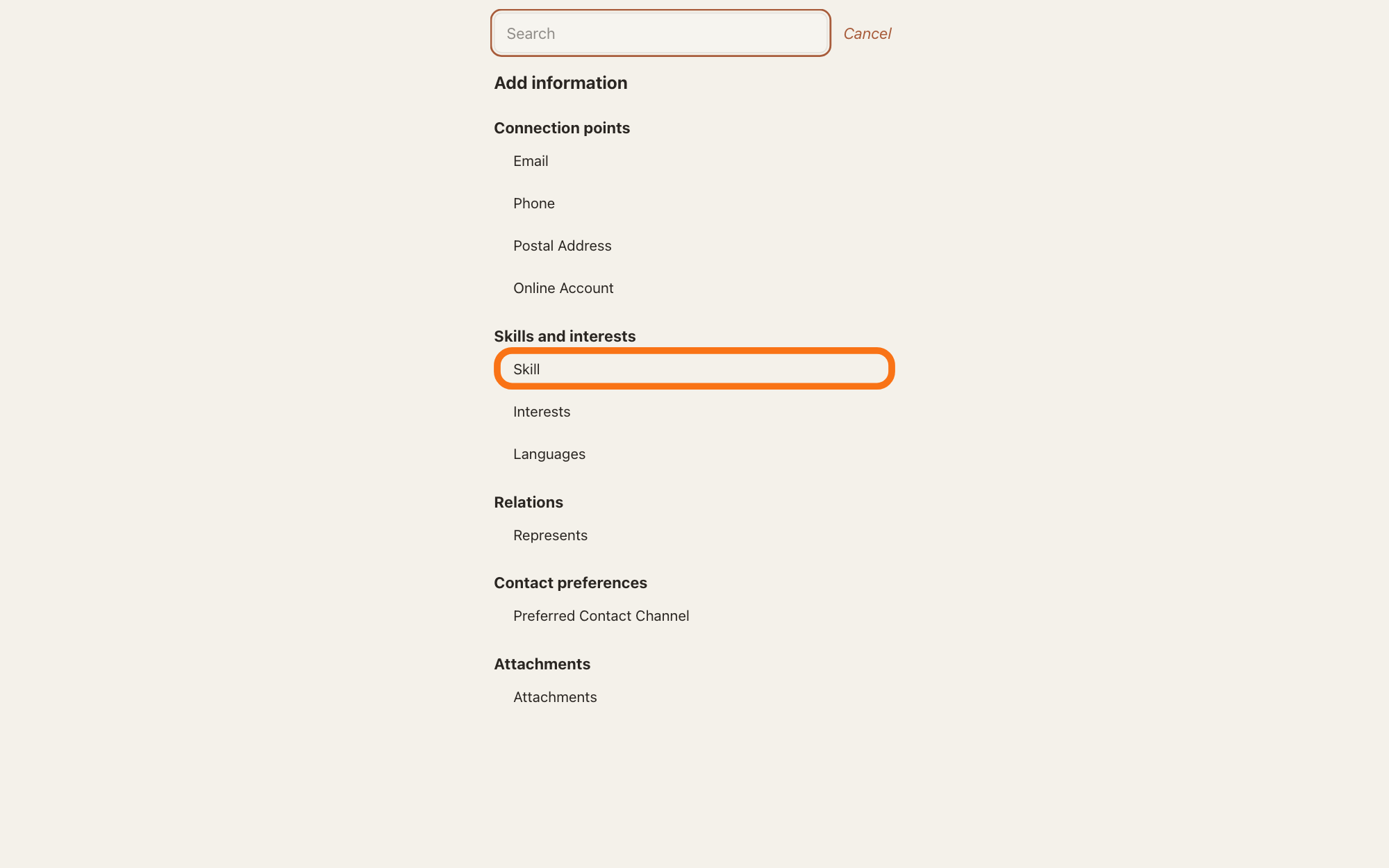
Under Skills and interests, choose Skill.
In the list, under Skills and interests, choose Skill. The card shows a frame headed Skill, and a window headed Add skills opens with the cursor in its search box.
Show as text
The list headed "Add information" covers the window. Under the heading "Skills and interests", press "Skill", outlined in orange. "Interests" and "Languages" are listed below it.
More about this
The card is now in edit mode: Edit at the top right reads Done, and the card says Editing. Changes save as you leave a field. The name Skill comes from GilbVeda, the shared list of terms, so it can change. If Skill is not in the list, the card already shows a skill, or it offers none: press Edit, then press ⊕ Add skills in the frame Skill.
Search and select the skill.
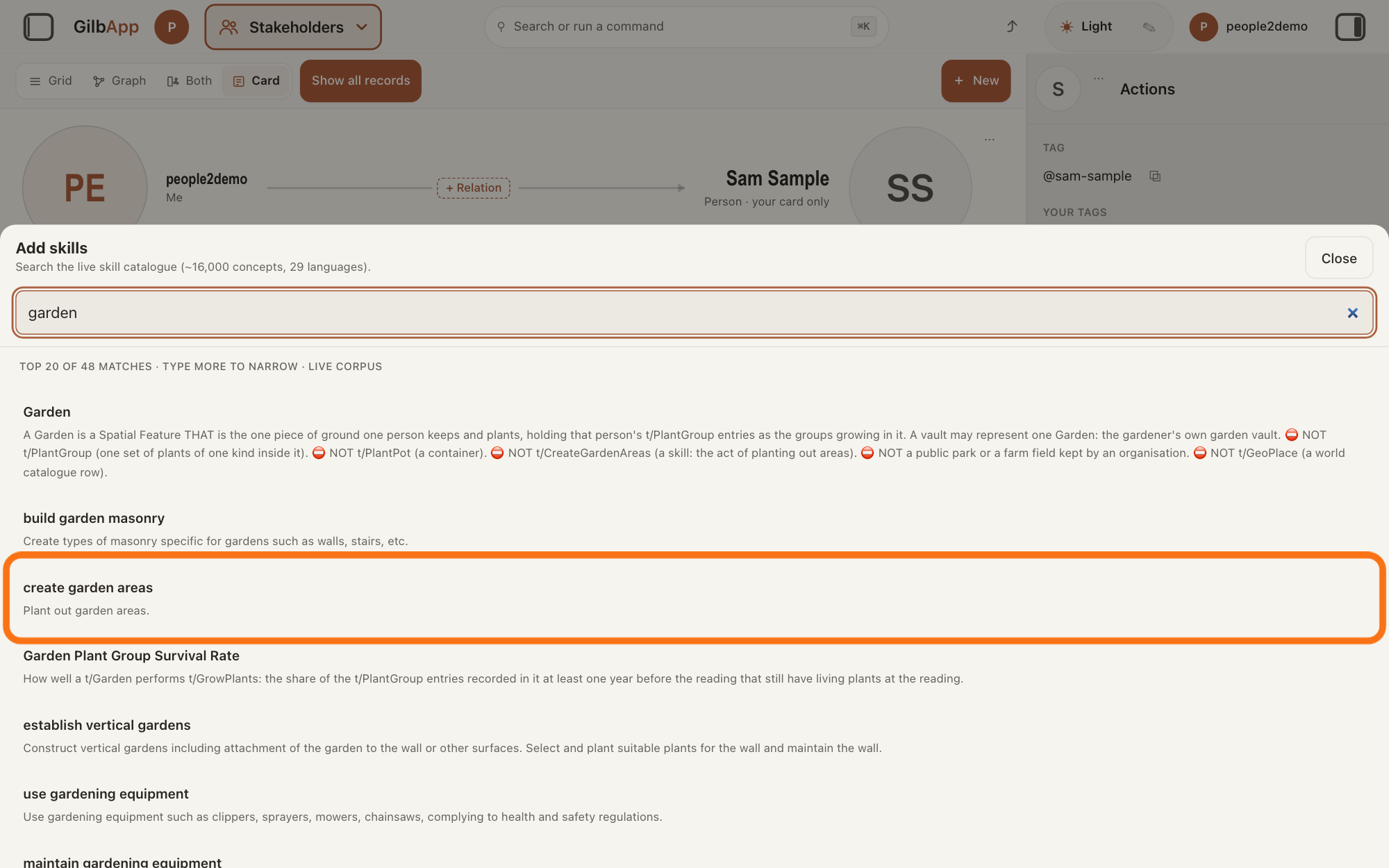
Type a word for the skill, at least two letters, in the box that shows Search skills (e.g. sykepleie, krankenpflege, phonetics)…, and select the skill in the list. The window closes and the card shows the skill, saved.
Show as text
A window headed "Add skills" opens from the bottom: "Search the live skill catalogue". Type a word in its search box; the matches are listed with their meanings. Press the skill you want, here "create garden areas", outlined in orange.
More about this
A skill here is something the person can do, not a diploma. Skills come from a shared catalogue, so you choose one and cannot type your own; the window says Search the live skill catalogue (~16,000 concepts, 29 languages). and a word in another language finds the same skill. Each line shows the skill's name and what it means. No skills match and what you typed means none matched. Before you type, the window offers example words you can press. A skill already on the card is not offered again. Close at the top right closes the window and adds nothing.
If you want, type a note under About this skill.
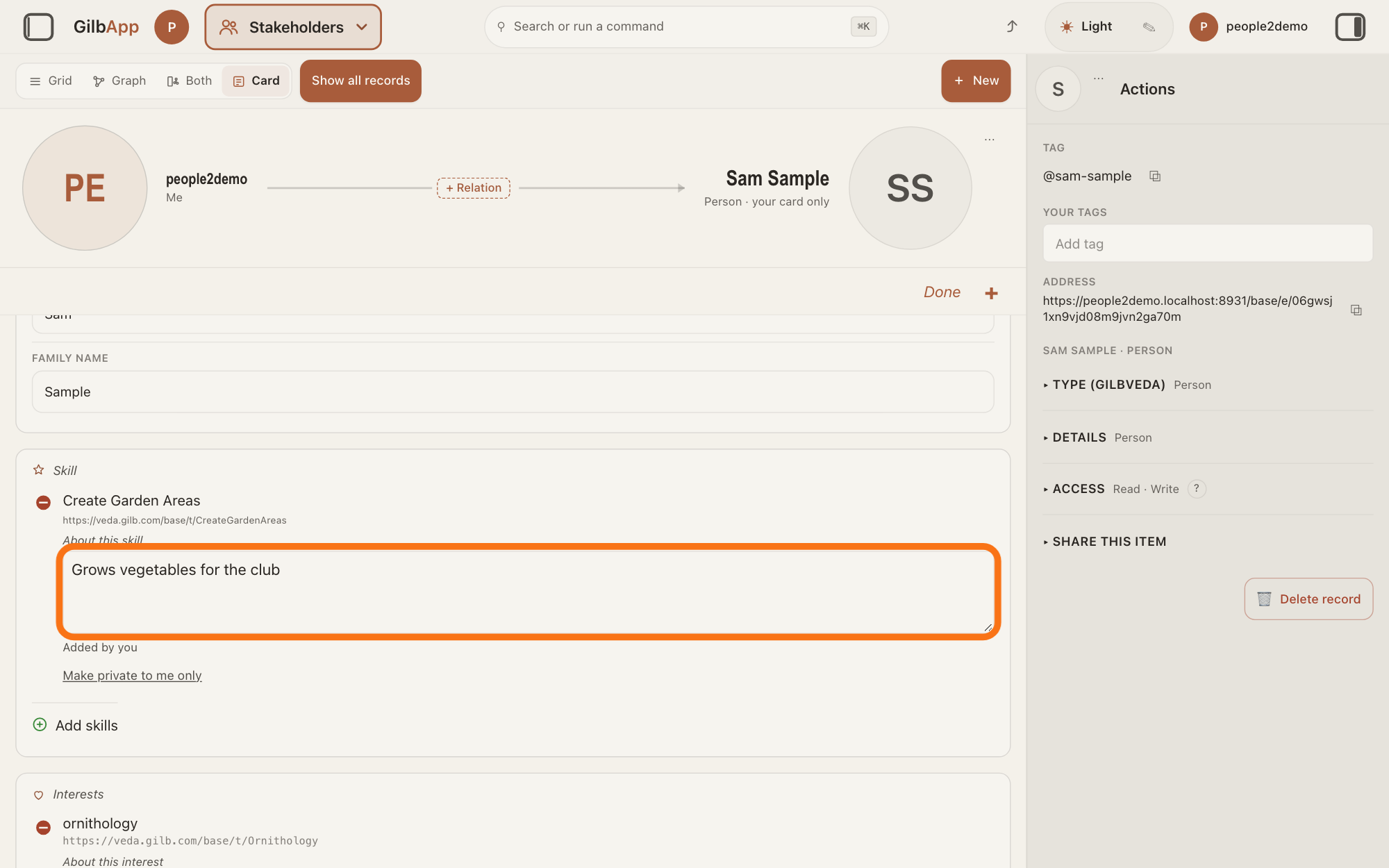
Under the skill, click Add a note about this skill and type what exactly the person can do, such as the level or an example. Click outside the box to save it.
Show as text
The skill now shows in the "Skill" frame of the card, with its GilbVeda address under it. Under "About this skill", type a short note in the box outlined in orange; it saves when you leave the box.
More about this
The box shows Go into more depth — level, context, examples…, and Saving… shows while it saves; Escape throws away what you typed. Under a note you added the card says Added by you. Everyone who may read the vault that holds the card sees the note; Make private to me only under it keeps it for you alone, and the card then says Only you see this; Everyone in this vault shares it again. The skill itself cannot be made private. In edit mode the red round minus sign at the left of a skill removes the skill and its note at once.
Press + Add Information again and choose Interests.
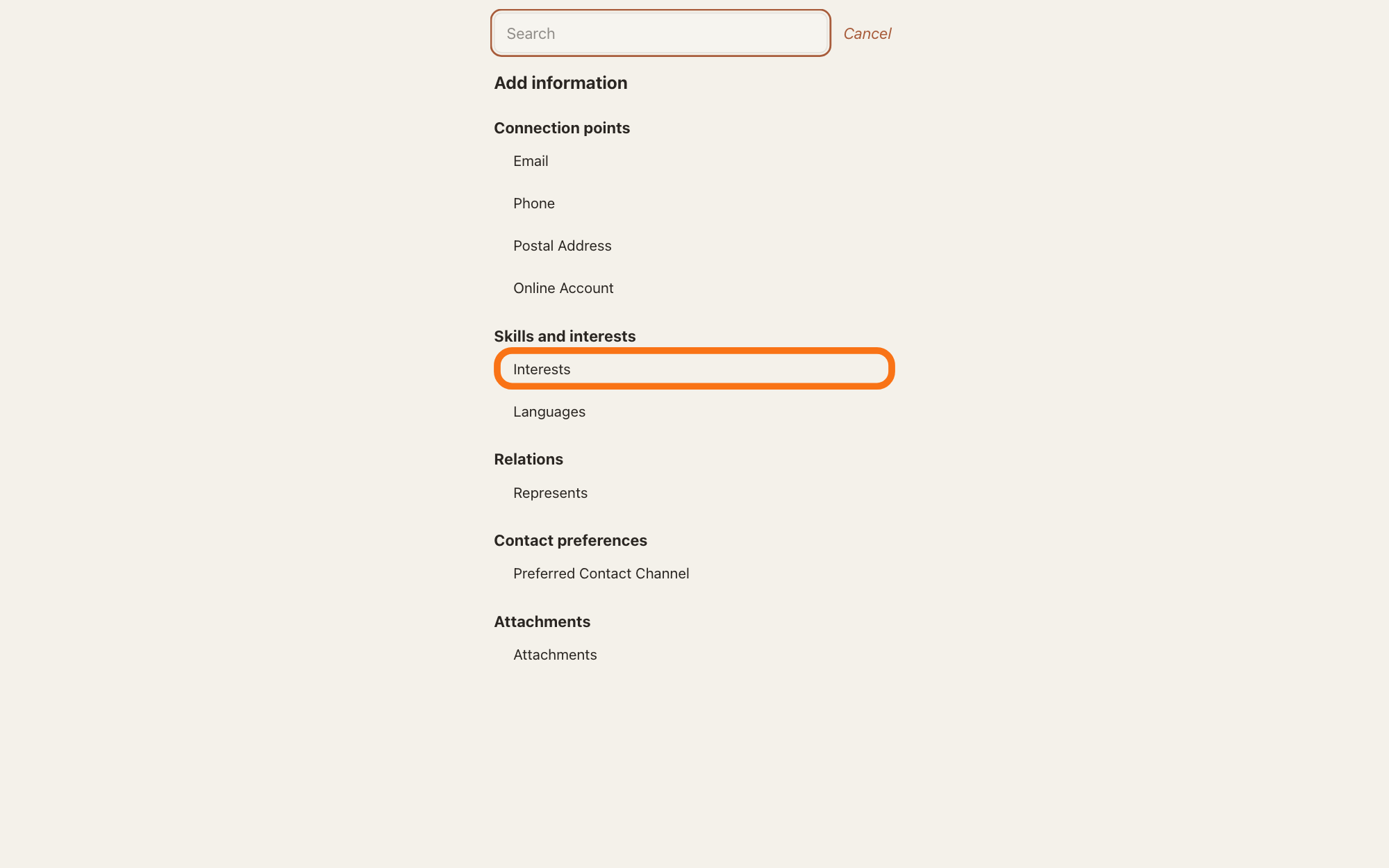
Press + Add Information at the foot of the card again, and under Skills and interests choose Interests. A window headed Add interests opens, with the cursor in a box that shows Search interests….
Show as text
Press "+ Add Information" again. "Skill" is no longer listed. Under "Skills and interests", press "Interests", outlined in orange.
More about this
An interest is a topic the person cares about, follows or wants to learn, not a skill they can do. The + beside Done at the top right opens the same list. If Interests is not in the list, the card already shows an interest, or it offers none: press Edit, then press Add interests in the frame Interests.
Search and select the interest.
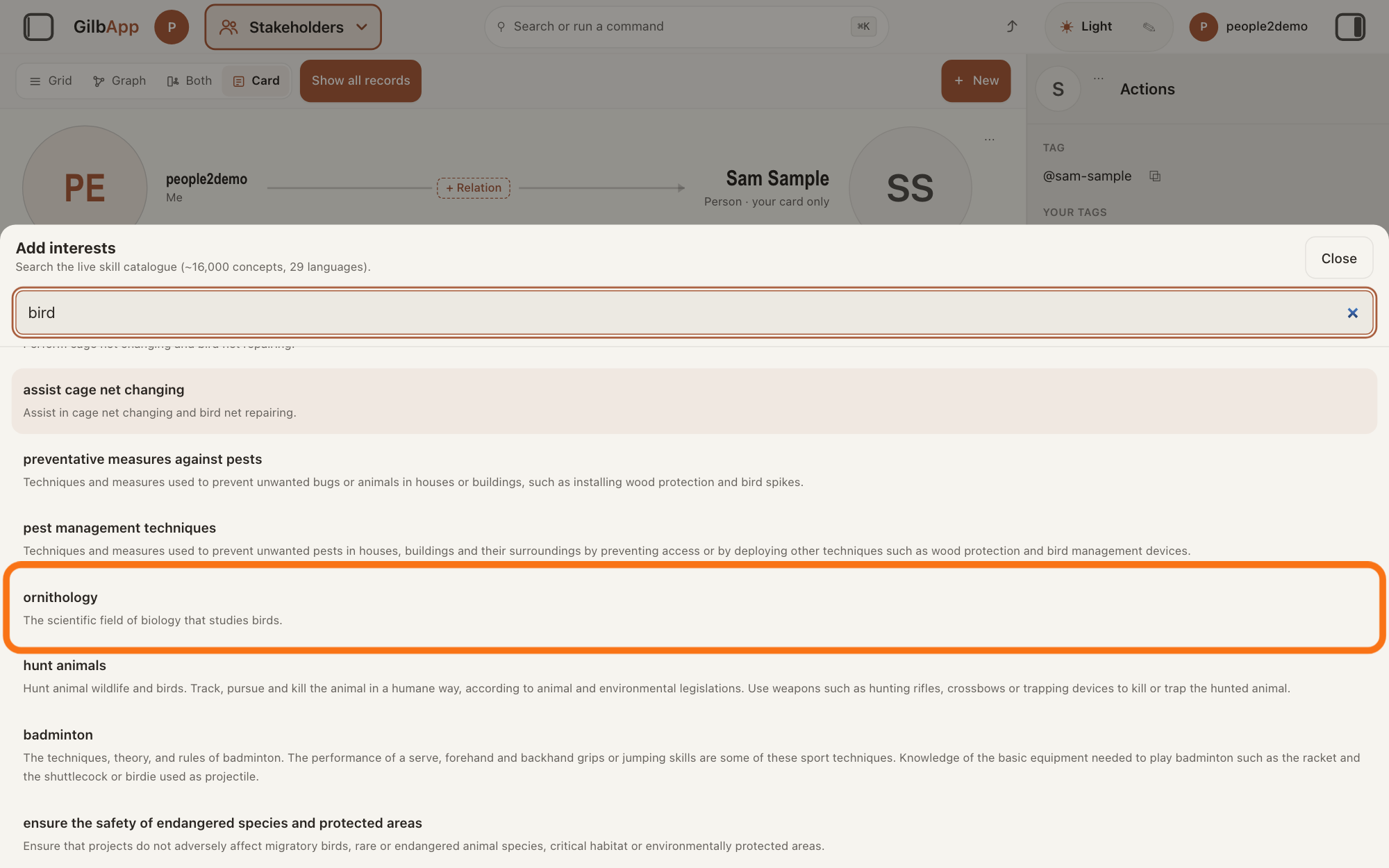
Type a word for the topic, at least two letters, and select it in the list. The window closes and the card shows it under Interests, saved.
Show as text
In the window headed "Add interests", type a word in the search box. Look through the matches and press the one you mean, here "ornithology", "The scientific field of biology that studies birds.", outlined in orange.
More about this
Interests come from the same shared catalogue as skills. Under each interest, Add a note about this interest takes a note, as for a skill. Make private to me only under an interest you added keeps the interest itself for you alone, and the card then says Only you see this. In edit mode the red round minus sign at its left removes it at once. If an interest is not added, the card says This interest was not added. Try again.
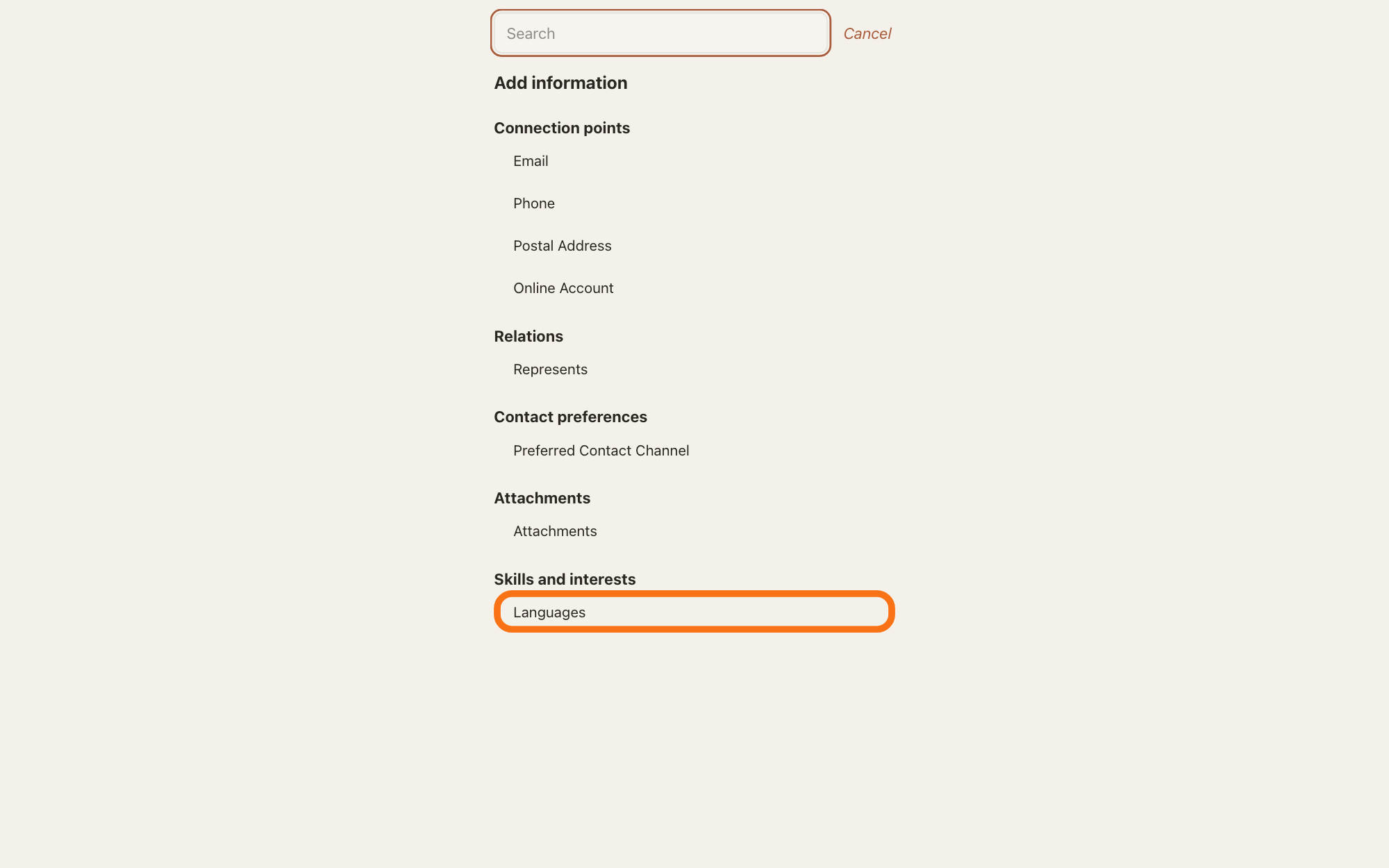
Press + Add Information again and choose Languages.
Press + Add Information at the foot of the card again, and under Skills and interests choose Languages. The card shows a frame headed Languages with a box that shows Search for a language, and the cursor in it.
Show as text
Open "+ Add Information" once more. Only "Languages" is left under "Skills and interests", now near the foot of the list. Press it; it is outlined in orange.
More about this
While the frame has no language yet, it says Share the languages you use. The + beside Done at the top right opens the same list. If Languages is not in the list, the card already shows a language, or it offers none: press Edit, then press Add languages in the frame Languages.
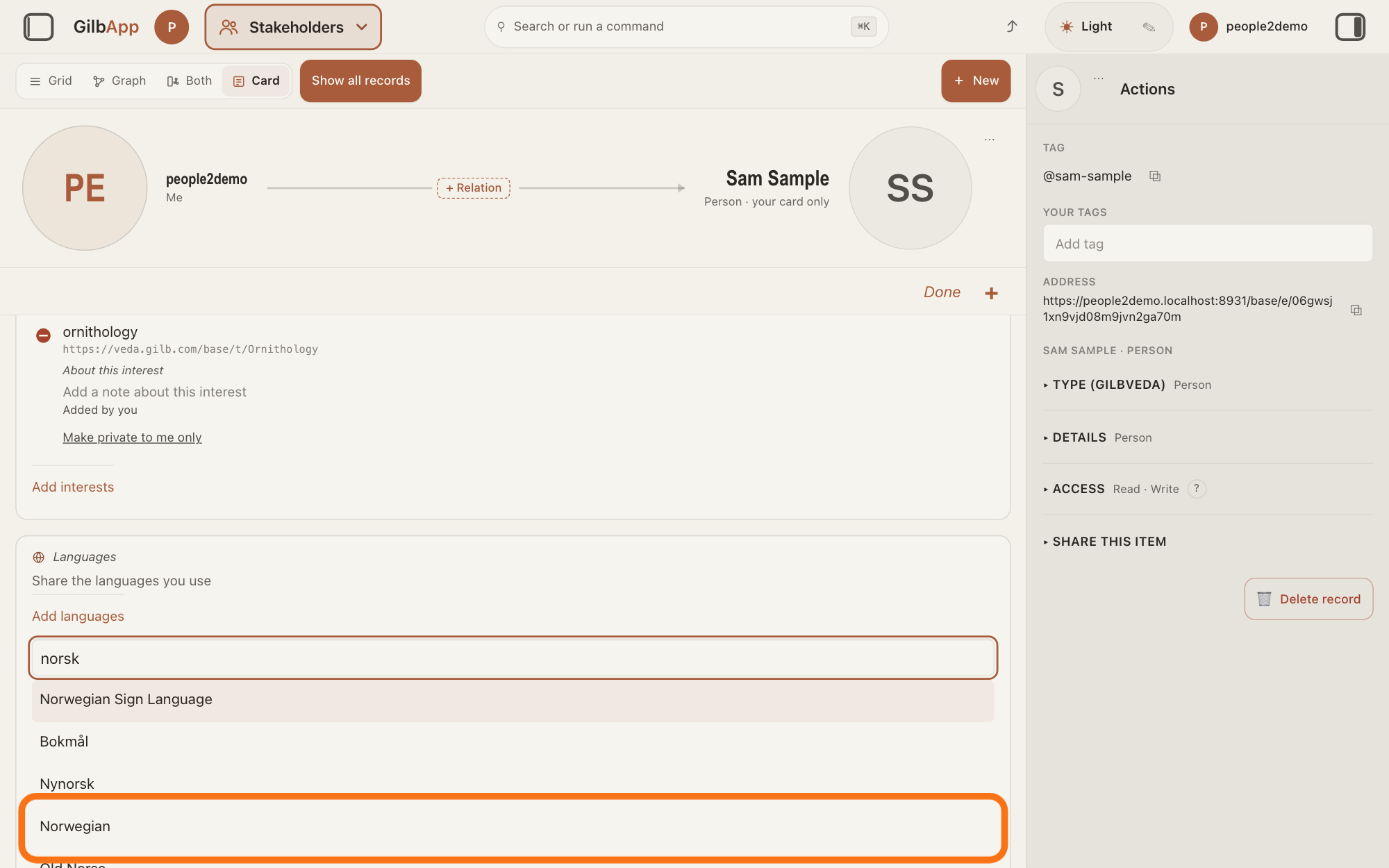
Search and select the language.
Type at least two letters of the language's name, such as norsk or English, and select the language in the list. The card shows the language with a flag, saved.
Show as text
The "Languages" frame opens with the line "Share the languages you use" and a box. Type the language, here norsk, and press the right match in the list below; "Norwegian" is outlined in orange.
More about this
Languages come from a shared language list; No match for and what you typed means none matched, and Cancel closes the box. In edit mode, Make contact language under a language marks it as the one the person wants to be contacted in, and the card then shows Contact language under it. Press the flag to choose another country's flag for it. Added by you, Make private to me only and the red minus work as for an interest. When you have finished, press Done at the top right of the card; what you chose is already saved.
Deeper
Also asked:
I added skills and languages to my own card in GilbApp, but MyNet does not show them. Why? What you add on your own card in GilbApp stays there: "Skills, interests, languages and employment shown here are only here, not on your MyNet card." To show them in MyNet, press Edit in MyNet and add them there.
A skill is kept on the person's card itself. Each note, interest and language is kept as its own record about the person, in the vault that holds the card. Everyone who may read that vault sees them, unless you used Make private to me only. What you add here does not change anything the person keeps about themselves on GilbPlatform.
Interests and languages are offered where the card offers skills, and only if you have a vault of your own; without one the card does not offer them. Which kinds of information a person's card offers, and their names, come from GilbVeda, the shared list of terms, so they can change without a change to GilbApp.
This answer is written for a computer screen.
Source: GilbApp af0f04ee838a4d55887d2ff1f72edd49a4ff7ca0 (https://gilb.com/app/version.json, built 2026-11-09, read 2026-11-10). RecordDetail.tsx:736-760 (Skill found by the GilbVeda term a:skill), :1581-1617 (Skill, then Interests and Languages in the same place: drawn where the card has skills); CardGroup.tsx:24 (skill, interest, language under Skills and interests). SkillRows.tsx:1-26 (notes in the vault that holds the record); ContactRows.tsx:13-22 (a skill is picked, never typed; its note on its own held claim; removing the skill removes it), :251-266 (a pick is saved at once; no duplicate), :405-415 (picker), :428-441 and :520-545 (note, Added by, visibility), :600-627 ('⊕ Add skills', data-card-add); mynet/SkillPickerSheet.tsx (Add skills / Add interests, catalogue line, Close, placeholders, Keep typing, No skills match, examples, cross-language line, result rows with name and meaning); lib/mynet/skills/searchSkillsRemote.ts:38 (2 characters); mynet/SkillDepthNote.tsx:30-125 (About this skill, Add a note about this …, placeholder, blur saves, Escape, Saving…); InterestRows.tsx (Interests, Add interests, note, Added by, visibility, red minus, not added message, no own vault); HeldVisibilitySwitch.tsx:1-49 (shared with everyone who may read the vault by default; Make private to me only; Only you see this; Everyone in this vault); AddedByLine.tsx (Added by you); LanguageSection.tsx (no own vault; Added by and visibility per language); mynet/LanguagesCard.tsx:100-265 (Languages, Share the languages you use, flag button, Make contact language, Contact language, Saving…, Add languages); mynet/LanguageEntryPicker.tsx (Search for a language, 2 characters: lib/mynet/languages/searchLanguagesRemote.ts:20); PickerBox.tsx (No match for, Cancel). lib/mynet/heldnote/heldDetailMark.ts:1-12 (a held detail is seen by everyone who may read the vault by default; private: only the adder; the platform's tier gate hides it from co-members and read-only grantees). GilbPlatform 4d008a55 src/authz/audience-tier.ts:21-27 (deny only where a tier row exists and the reader is outside it; an untiered entity keeps the vault's reach). GilbVeda read publicly 2026-11-10: a:skill 'Skill' ('A competence or skill a person claims or demonstrates — a label for capability, not a formal credential.'), a:topicInterest ('A TOPIC A PERSON IS INTERESTED IN — something they care about, follow or want to learn — as distinct from a skill they can perform.'), a:contactLanguage ('THE LANGUAGE A PARTY WANTS TO BE CONTACTED IN').
Checked against GilbApp d529620.