
How do I change the product while a project runs?
Short answer
Press Main menu, choose Choose an agent, choose Kai-Zen - Master Agent of Planning, type the change, press Send, then give your go.
Before you start
A project Kai-Zen set up for you, and your own AI, Claude Code or Grok, connected in GilbApp's chat. The pictures show a made-up person on a test site; your screen shows your own name and address.
Words used here (6)
- agent
- An agent is your AI following one written procedure, its standing instructions, for one kind of work.
- Kai-Zen
- Kai-Zen is the planning agent: it finds out what you want, chooses the way, hands the work to other agents and reports back.
- project
- A project is work to bring about a change you want, such as a new app or a better way of doing something.
- GilbApp
- GilbApp is the app, opened in a web browser at https://gilb.com/app, where you open, fill and share your vaults.
- Jackfruit
- Jackfruit is the vault agent: it finds, reads, writes and links records in your vaults, and makes new vaults for you.
- GilbPlatform
- GilbPlatform is the service that keeps people's and organisations' data in vaults, each at its own web address.
Steps
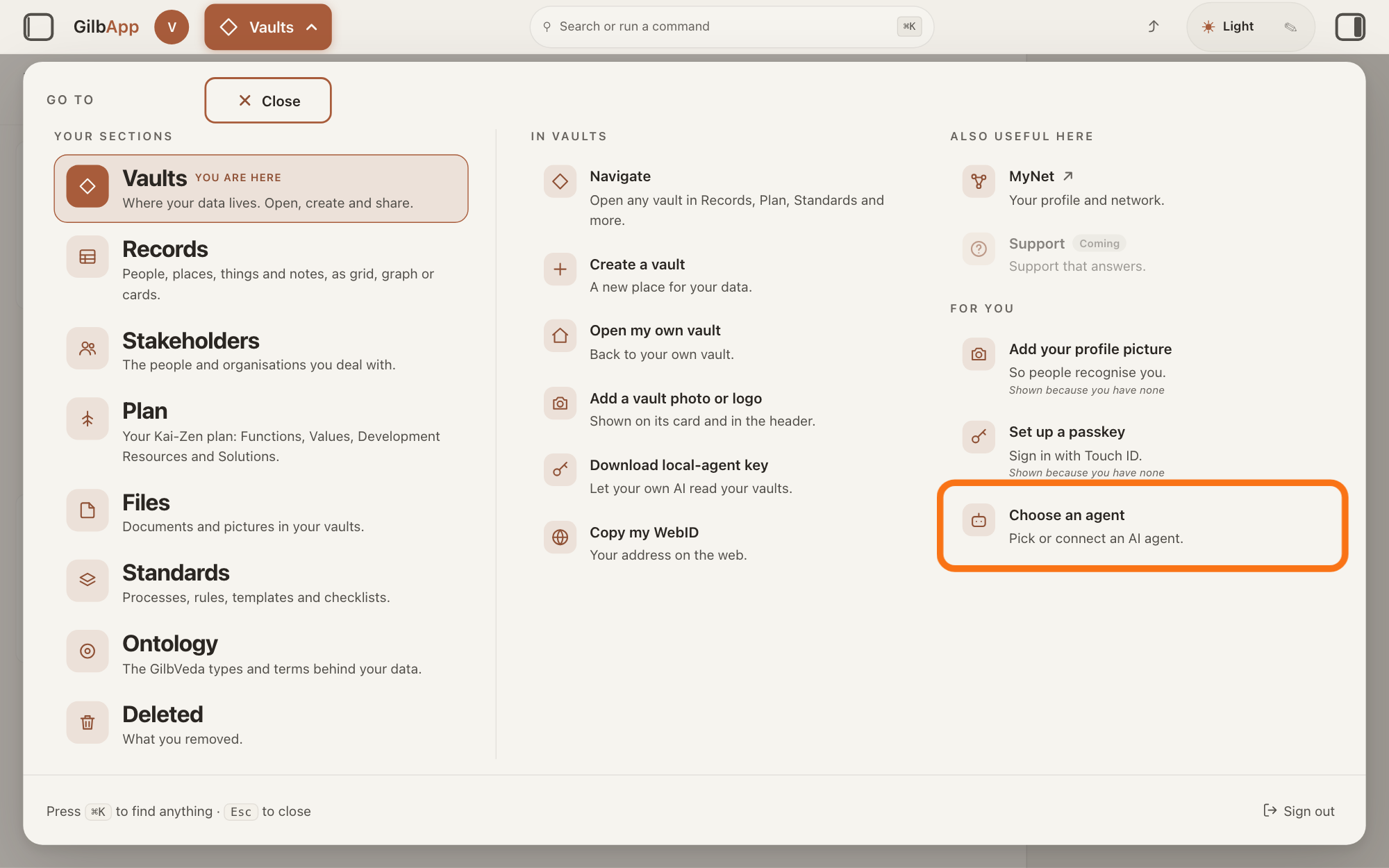
Press Main menu at the top left and choose Choose an agent.
Press Main menu, next to your profile picture at the top left, and under FOR YOU choose Choose an agent (Pick or connect an AI agent.). The button shows the name of the section you are in, such as Vaults. GilbApp opens the left pane, where you chat, and puts the cursor on the agent list at the top of it.
Show as text
The panel headed "GO TO" is open. In the right-hand column under "FOR YOU", the outlined row reads "Choose an agent" and "Pick or connect an AI agent." Click it; the chat opens in a pane on the left.
More about this
The square button at the far left of the top bar also shows or hides the left pane. You can also search for Choose an agent in Search or run a command.
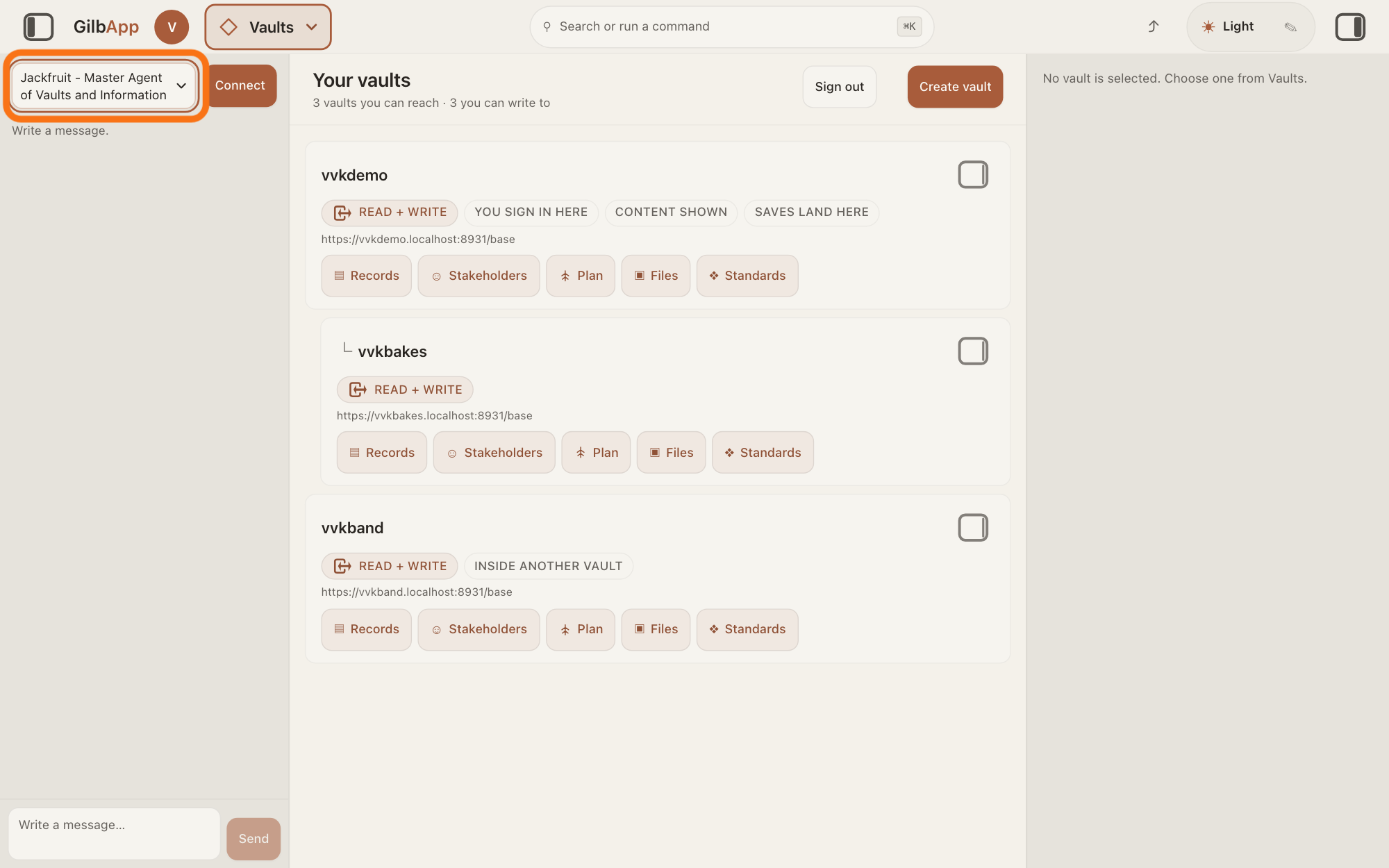
Choose Kai-Zen - Master Agent of Planning in the agent list.
Press the agent list at the top of the left pane and choose Kai-Zen - Master Agent of Planning. Each agent has its own chat, and the list shows which one you are in.
Show as text
The chat is open in a pane at the left. At the top of that pane the outlined agent list reads "Jackfruit - Master Agent of Vaults and Information", the first pick; the "Connect" button sits to its right. Click the list to choose another agent.
More about this
A new chat starts on the first agent in the list, Jackfruit - Master Agent of Vaults and Information. The list comes from GilbPlatform each time the chat opens. GilbApp keeps your choice for this browser tab. While an agent is answering, the list is greyed out.
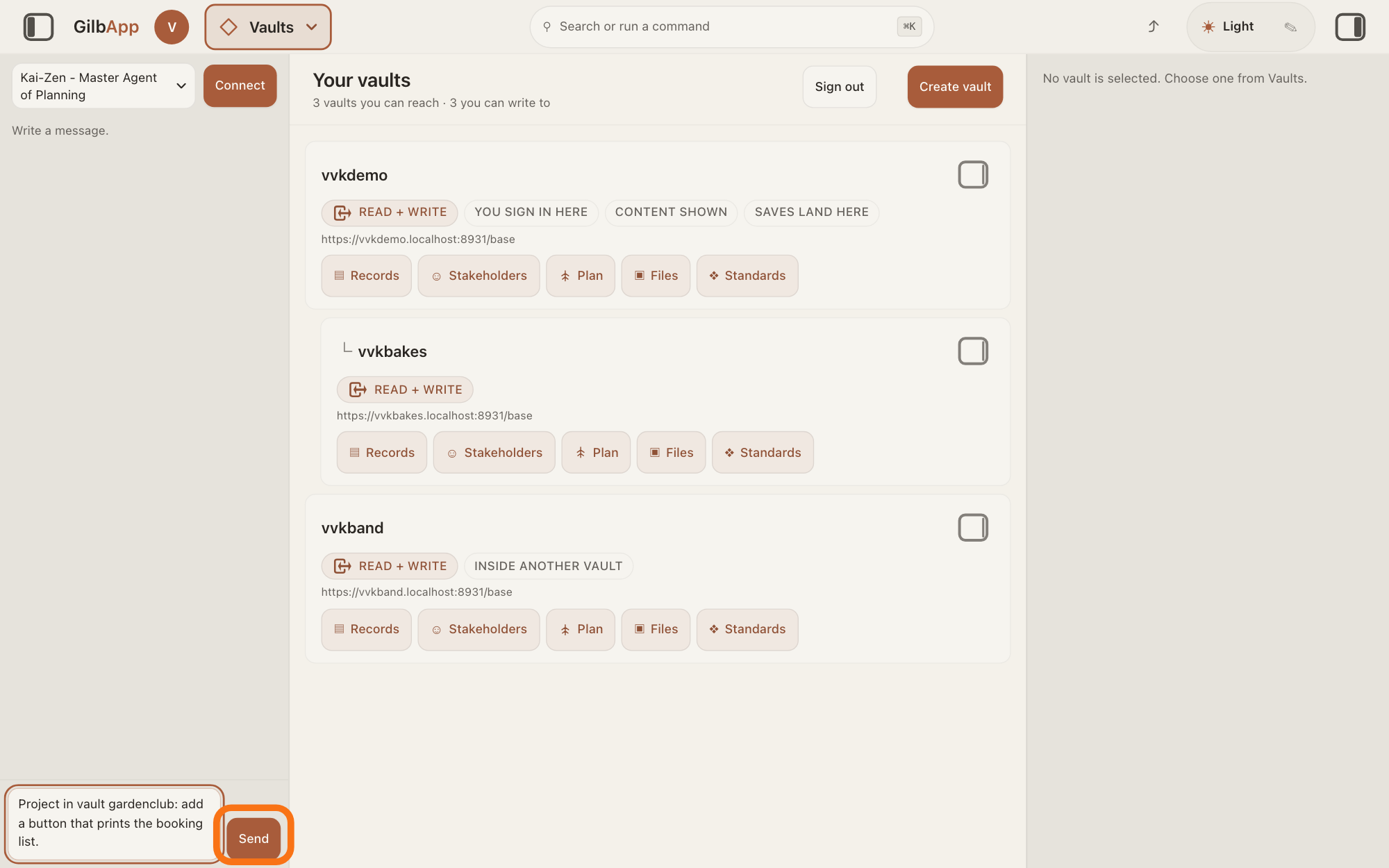
Type the change in Write a message… and press Send.
In Write a message…, name the project's vault and the one change you want, such as a new button, then press Send. Kai-Zen writes the change as one Solution, how a Function (what a system does) gets done, and says what is left out.
Show as text
The agent list at the top of the chat reads "Kai-Zen - Master Agent of Planning". At the bottom, a change is typed in the box: a button that prints the booking list. The outlined "Send" is to the right of the box. Press it.
More about this
Return also sends; Shift and Return starts a new line. If you do not say where the project is kept, Kai-Zen looks for it in the vaults you can reach; if several fit, it asks which one. Before it does anything, it reads the project's setup, its specs, the requirements written in its plan, and its last round of delivery. While it works, the pane says The agent is writing…, then Ran and the name of each tool it uses, and Send reads Queue. Then it asks all its questions about the change in one message; the answer on answering Kai-Zen's questions shows how to reply. For example:
Project in vault gardenclub: add a button that prints the booking list.Type your go in Write a message… and press Send.
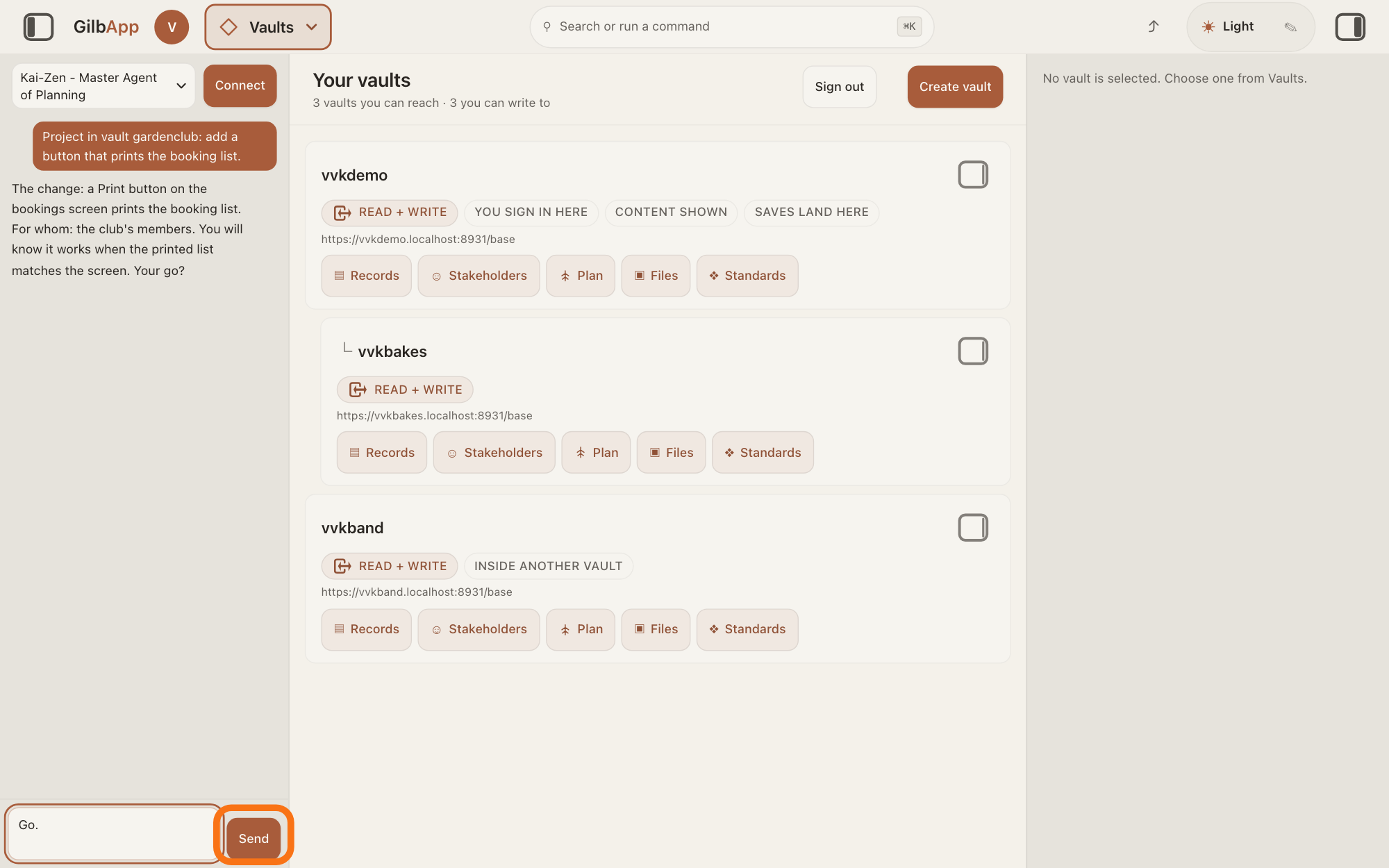
When the change is agreed, Kai-Zen writes it as a short outcome statement, what changes, for whom and how you will know it works, and asks for your go once. Type your go and press Send; that go is the approval for the change itself.
Show as text
The chat shows your request and Kai-Zen's answer: "The change:", "For whom:", how you will know it works, and "Your go?". "Go." is typed in the box at the bottom, and the outlined "Send" is to its right. Press it to give your go.
More about this
Kai-Zen has the change built after your go. Then it puts it live; it puts nothing live without your go, and the answer on how Kai-Zen puts a change live tells when it stops to ask. When the change is live, Kai-Zen asks you to check it live: send back, in the same box, what is wrong, and it fixes it, puts it live again and asks again, until you approve. For example:
Go.
Deeper
Also asked:
What if I change my mind? Tell Kai-Zen in the chat what you now want. A change you name is shaped with you, built only after your go, and the plan is updated; to drop a part, name it and say it should be taken out.
How do I add something I forgot while building? Name it to Kai-Zen in the chat as a change, such as a new button. It asks its questions in one round, asks for your go once, has only that change built and checked, puts it live with your go, and updates the plan.
Can I change a big part of my project safely? Yes: Kai-Zen asks for your go before anything is built, has only that change built, checked and tested, and puts it live only with your go. To be safer, first take a copy of the project's vault.
Can I drop a part I no longer want? Yes: tell Kai-Zen in the chat which part, and say it should be taken out. The change is shaped with you, done only after your go, and the plan is updated.
A change you name, such as a new button, is a change to the product: Kai-Zen shapes it with you, has only that change built and checked, puts it live, has you check it, and updates the plan. A request can ask for more than one thing; Kai-Zen does them in this order: the change to the product, the change to a spec, the re-planning, the delivery, the report. The answer on continuing a project with Kai-Zen lists them.
Before its questions about the change, Kai-Zen writes the change as one Solution and says what is out. It then lists every Value the change touches: the change's own, and those of Agent.Architect, the agent that keeps the Values that span the whole project in every decision, of Agent.Scaling, the agent that checks what was built, and of the builder's style guide. A Value is a perceived benefit, measured as a number. An agent is your AI following one written procedure, its standing instructions, for one kind of work.
Those Values shape its one round of questions. In the same message it suggests where else the same change could be made, and better ways to get what you want, with why. It agrees the change from your answers, then asks for your go once, as step 4 shows.
After your go, Kai-Zen hands the agreed change to the builder for the project's kind, Agent.Coder for an app on GilbPlatform, and has only this change built; anything else it sees, it notes and does not do. With it Kai-Zen sends the project's constraints, the things that must be done because a named person requires them, and it first adds the Reuse constraint if the project does not have it yet; the answer on reusing a Solution or a Constraint tells more. If the builder reports a gap in a spec, the answer on what happens when a spec has a gap shows what Kai-Zen does.
Then Kai-Zen has the build checked by Agent.Scaling and tested by the builder's tester, Agent.Tester for an app on GilbPlatform, not the agent that built it, against the Values it listed, with a saved PASS or FAIL. If the builder has no tester, Kai-Zen says so. Then it puts the change live and asks you to check it, as step 4 says.
Last, it updates the specs: the Solution, the Functions it serves, and each touched Value's Status (where it stands now). In its final report it asks what else you want done.
A big change. Every change, big or small, goes the same way: Kai-Zen asks for your go once before anything is built, has only that change built, checked and tested, and puts it live only with your go. To be safer with a big change: first take a copy of the project's vault, the place where its records are kept, if you hold Control on it, as you do on your own, as the answer How do I download a copy of my vault? shows; ask for the change as a trial first, as Can I try an idea on the side without changing the main app? shows; and if it goes wrong, ask your AI to undo it, as Can I undo what I've built, or go back to an earlier version? shows.
Dropping a part. To drop a part you no longer want, such as a screen or a feature, name it to Kai-Zen the same way and say it should be taken out: taking it out is a change like any other. The standards describe no separate way to drop a part.
A change you name runs these steps, not a round of delivery: Kai-Zen picks no step for it. To have the next step of the plan delivered instead, the answer on picking the next step shows how to ask, and the answer on how Kai-Zen runs a whole delivery cycle explains a round.
GilbApp has no control that changes the product: you ask Kai-Zen in the chat. GilbApp's chat does not reach the files on your computer unless you choose a code folder while Claude Code is connected; otherwise code kept there needs Claude Code in Terminal. The answer How do I let my AI build in a folder on my computer from GilbApp's chat? shows how. From GilbApp's chat Kai-Zen works only with the vault, unless you choose a code folder while Claude Code is connected; otherwise a project kept in a folder on your computer needs Claude Code in Terminal. In Claude Code in Terminal you can ask the same way. Start Claude Code, type this line with your own short name, the one you gave your AI when you connected your computer, and press Return:
/mcp__gilb-<short name>__agent
Then say which project and what change you want, and press Return.
This answer is written for a computer screen.
Source: GilbApp af0f04ee838a4d55887d2ff1f72edd49a4ff7ca0 (https://gilb.com/app/version.json read 2026-11-10, buildTime 2026-11-09.522Z, dirty false); code read (no checkout). Steps 1 and 2: identical to, (sectionMenuList.ts:330, LeftRegion.tsx:16-20, AgentSelector.tsx:15-16, :57-79, chatAgents.ts:67-75, as cited there). Steps 3 and 4: AgentChat.tsx:1046 (Write a message…), :1063 (Send/Queue), :711 (Return sends unless Shift), :545, :553, :888 (The agent is writing…, then Ran <tool>). No GilbApp control changes the product (the code shows: none). Standards read 2026-11-10, all 200: Kai-Zen.Existing (K 06gdzjejg5x8b83g86xrn7hwjc) Read, Evaluate (order), Update (such as a new button); Kai-Zen.Update (K 06ge3we3c5vp17asc9343b6b58) Entry.Project, Entry.Change, Scope (Write the change as one Solution. Say what is out), Values (its own, the architect's, scaling, and the builder's style guide), Shape (one round, "suggest the same change to Y and Z where X changes, and better ways to get what they want, with why"), Go ("short, clear outcome statement: what changes, for whom, and how you will know it works. Ask the requester for go once. That go is the one approval for this change"), Build (After go ... Build only this change. Note anything else you see; do not do it; SpecGap; Constraints; Reuse), Check ("against the Values from step 2 ... not the agent that built it ... saved PASS or FAIL. If the builder has no tester, say so"), Live, Human, Record, Next, Exit.Done; Kai-Zen.GoLive (Ask, Deploy); Kai-Zen.HumanCheck (Ask, Fix); Kai-Zen.AskRules (One, Form, Stop); Agent.Architect role (inventory row KeepWholeProjectValues). Also: Agent.Scaling. Kai-Zen.Update (Scope, Go, Build: Build only this change, Check, Live), Proc_v_Rollback (undo only when the person asks). Live answers, sentences shared: Can my AI break or delete my data? How do I stay safe? (a copy before a big change); Can I try an idea on the side without changing the main app?; Can I undo what I've built, or go back to an earlier version? Code-folder exception: GilbApp 49b1ae53 (https://gilb.com/app/version.json, read 13 November 2026), src/components/agent/AgentChat.tsx:677-692 and :1084-1090 (Choose a code folder, Code in, Claude Code only); live answer How do I let my AI build in a folder on my computer from GilbApp's chat?
Checked against GilbApp d529620.