
How do I delete a standards document?
Short answer
Press Main menu, choose Standards and the standard, press 🗑 Delete process and Confirm delete; it is kept, not erased; GilbApp cannot restore it.
Before you start
You need to be signed in to GilbApp on a computer, with a standard in a vault you can write to, such as your own vault. The pictures show a made-up person on a test site; your screen shows your own name and address.
Words used here (6)
- GilbApp
- GilbApp is the app, opened in a web browser at https://gilb.com/app, where you open, fill and share your vaults.
- record
- A record is one piece of data with its own address, such as a person, a place, a thing or a note.
- entry condition
- An entry condition is something that must be true before a process may start; a process starts only when its entry conditions hold.
- exit condition
- An exit condition is what must be true before a process may finish; when it is true, the process hands back.
- agent
- An agent is your AI following one written procedure, its standing instructions, for one kind of work.
- GilbPlatform
- GilbPlatform is the service that keeps people's and organisations' data in vaults, each at its own web address.
Steps
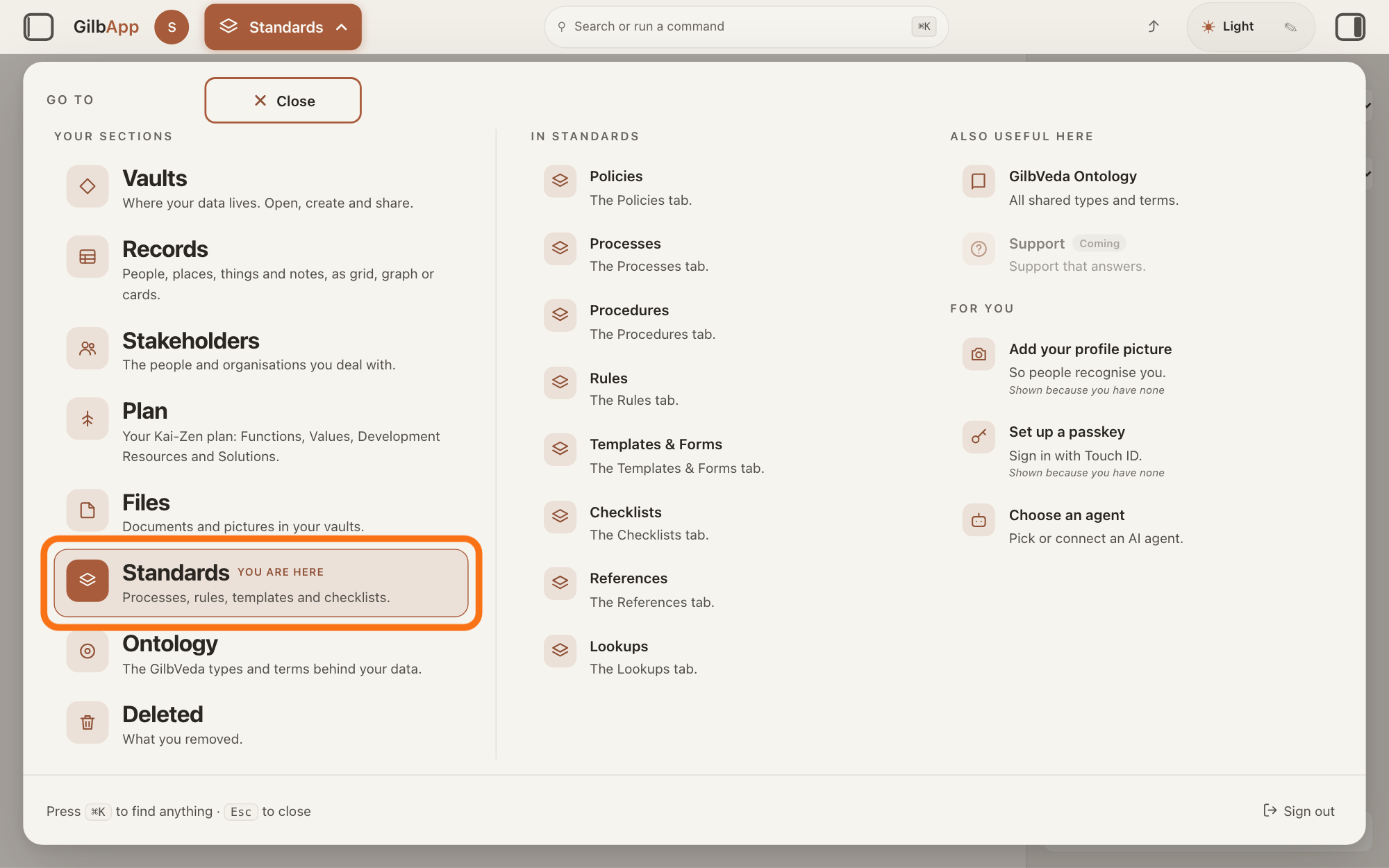
Press Main menu at the top left and choose Standards.
Press Main menu, next to your profile picture at the top left, and under YOUR SECTIONS choose Standards. The button shows the name of the section you are in, such as Vaults.
Show as text
The panel headed "GO TO" is open over the Standards screen. In the left column under "YOUR SECTIONS", the row "Standards" marked "YOU ARE HERE" is outlined. Press it to go to the Standards screen.
More about this
A panel headed GO TO opens; Standards reads Processes, rules, templates and checklists. Standards opens on the vault you picked in Vaults, or on your own vault if you picked none; a vault is the place where a person or a group keeps their records. It opens on the tab Processes, with Process chosen in the row under the tabs. A process is a standard that holds work: entry conditions, steps in order, and exit conditions; a standard is a written procedure, rule set, form or other guide that people and agents follow as they work. On the right, VAULT changes the vault, STANDARDS GROUP shows only the standards of one group, and + New group, shown only where you may write in the vault, makes a group; you need none of them here.
Choose the standard in the list.
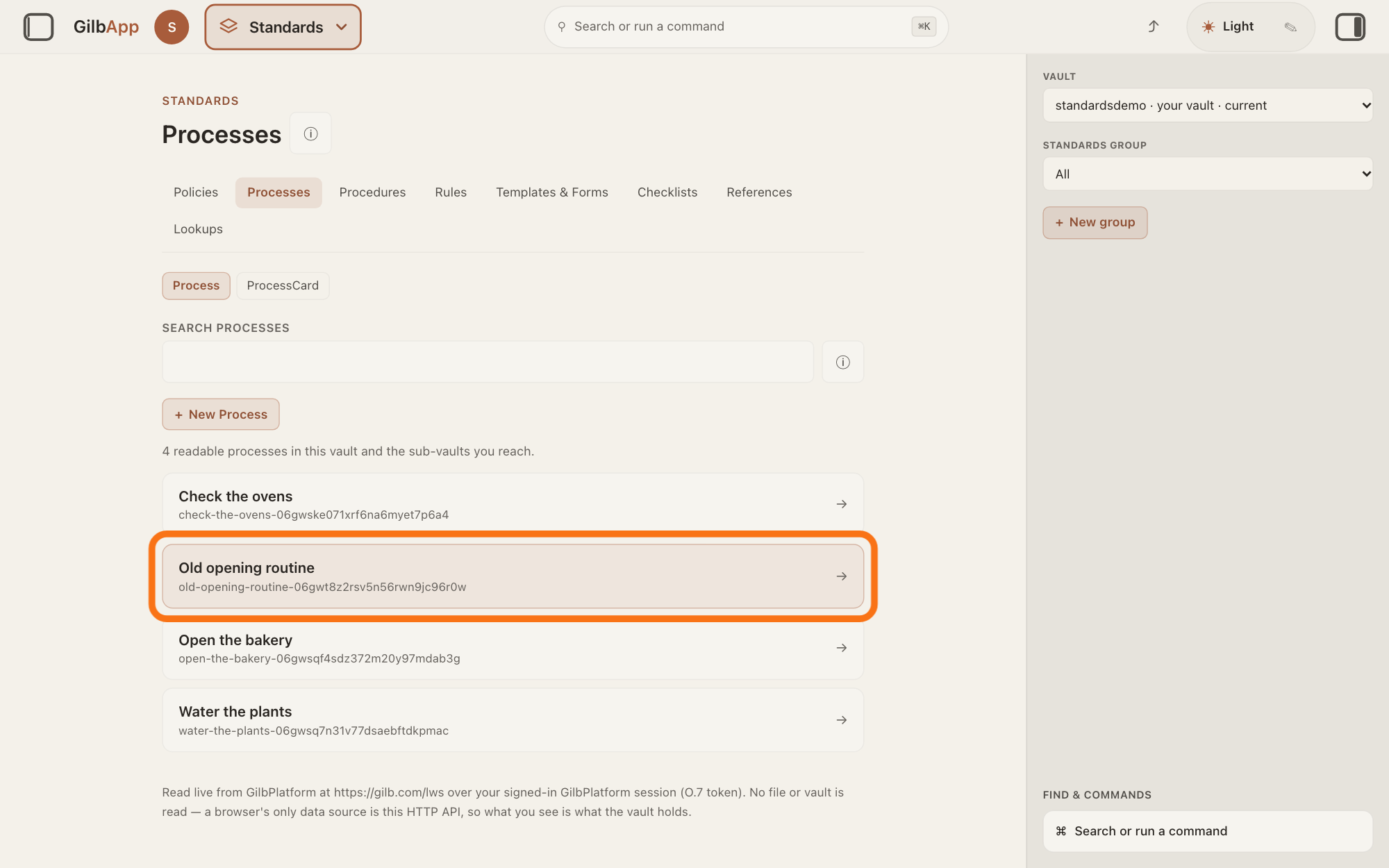
Click the row of the standard you want to delete, such as a process under the tab Processes. It opens in the middle; a process shows the cards Entry conditions, Steps and Exit conditions, from top to bottom.
Show as text
In the middle, the list says "4 readable processes in this vault and the sub-vaults you reach." The row Old opening routine is outlined. Press the row of the standard you want to delete.
More about this
Each row shows the standard's name and, under it, the last part of its address. If the list is long, type a word of the name in the box under SEARCH PROCESSES. The other tabs, such as Rules or Checklists, list other kinds of standard and open the same way. + New Process makes a new process; the answer on writing a new standard shows it. ← All processes, at the top of an open process, brings the list back.
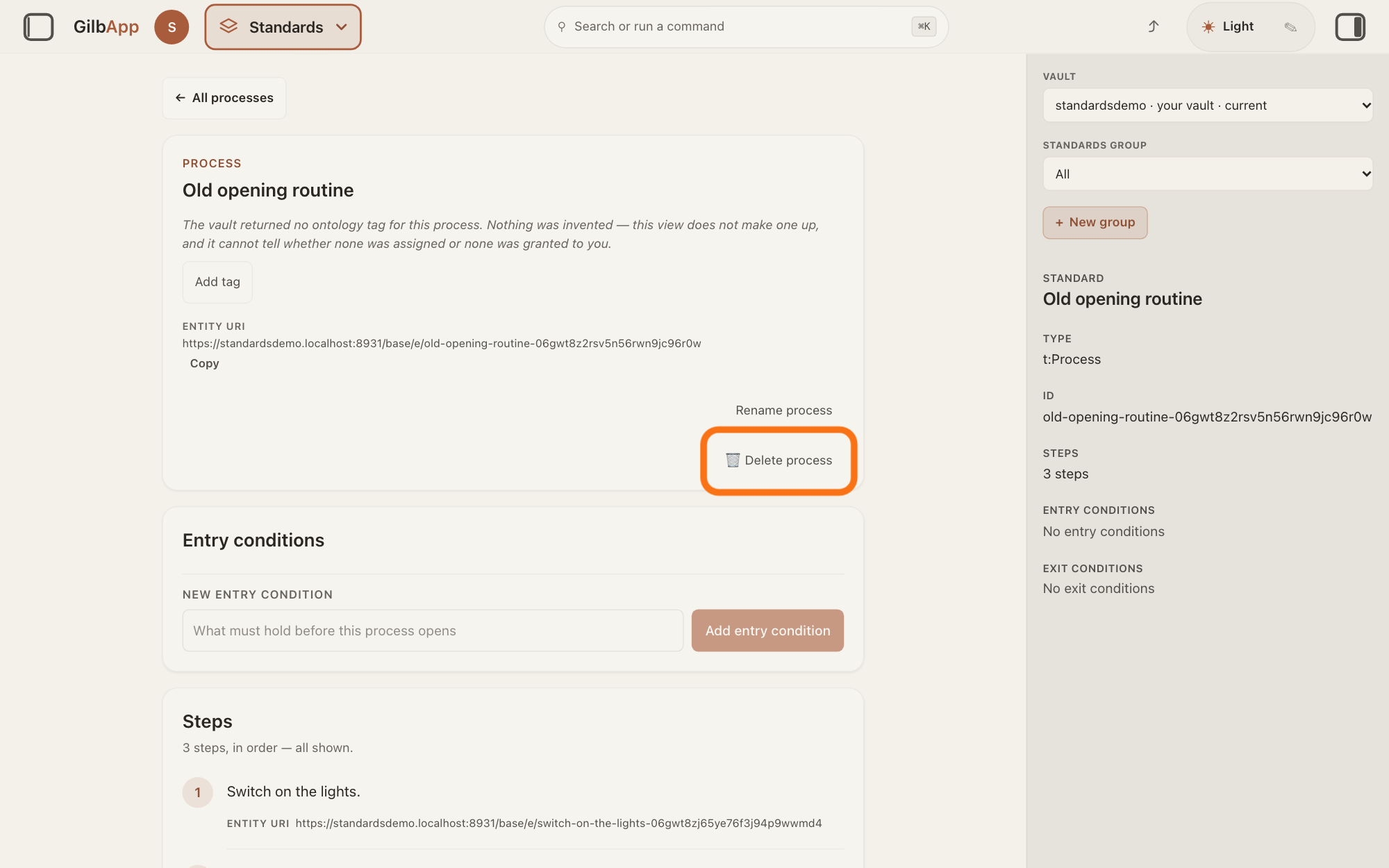
Press 🗑 Delete process under the standard's address.
Press 🗑 Delete process in the standard's card at the top, below Rename process. Nothing is removed yet: GilbApp asks Delete with the standard's name, and says what goes with it, such as This process and its 3 steps are removed from this vault.
Show as text
The process Old opening routine is open. In its card, under the "ENTITY URI" and "Rename process", the outlined button "Delete process" with the bin sign is at the right. The right pane says it has 3 steps. Press it.
More about this
While it counts it says Counting what this process holds…. The question also says 🔴 This cannot be undone from this app — there is no undo and no trash. Nothing in GilbApp can bring the standard back; the part below tells what GilbPlatform can do. On another kind the button names it, such as 🗑 Delete rule document, and its rules go with it. A process's entry and exit conditions go with it too. Keep process closes the question and removes nothing.
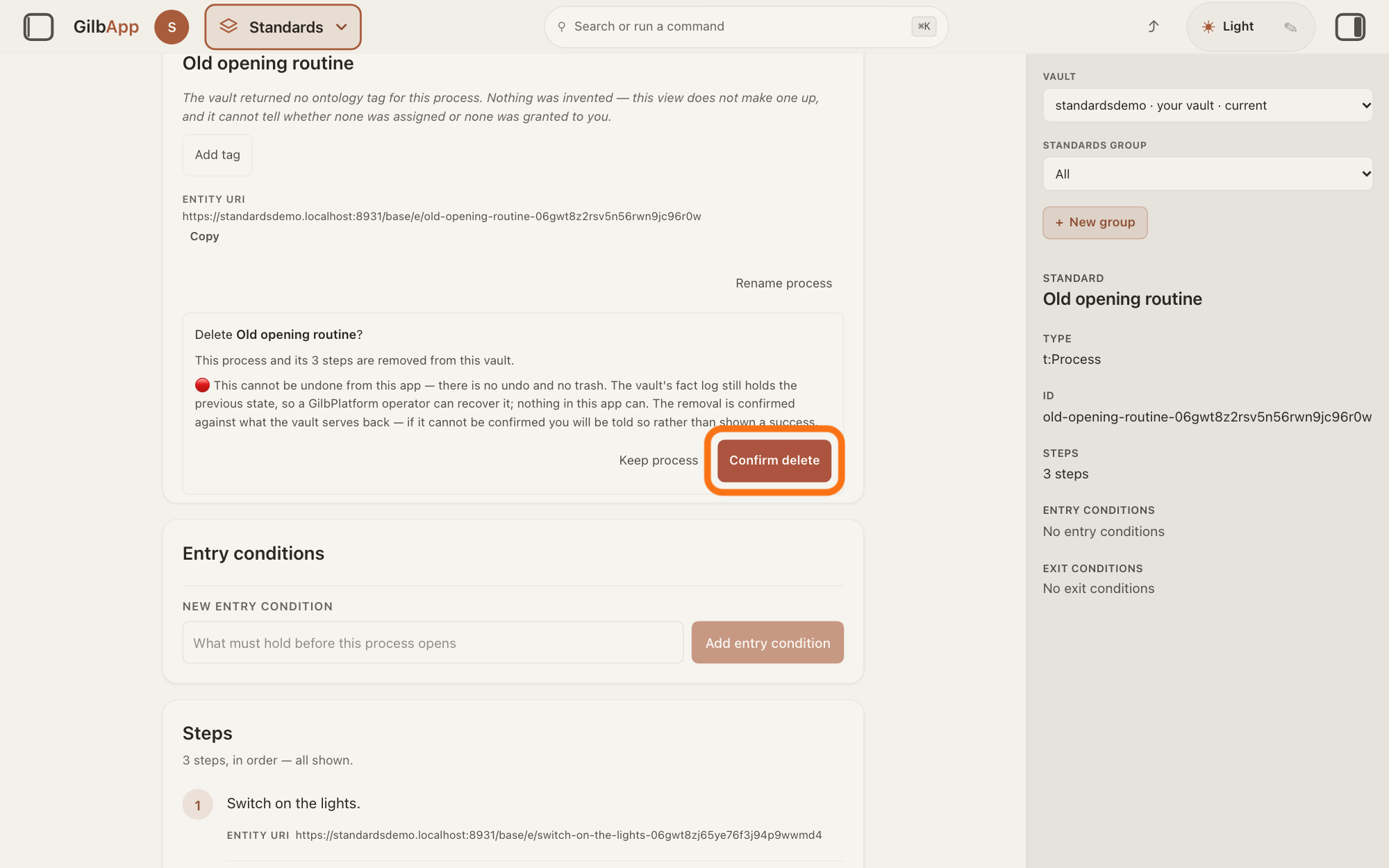
Press Confirm delete.
Press Confirm delete. It reads Deleting… while GilbApp removes the steps one by one and then the standard; then GilbApp goes back to the list of standards.
Show as text
In the card a box asks "Delete Old opening routine?" and says "This process and its 3 steps are removed from this vault." A red dot warns that it cannot be undone from the app. The outlined button "Confirm delete" is next to "Keep process".
More about this
If it cannot finish, the box says Not deleted — and why, and the standard stays. In GilbApp today the box may also say "Not deleted — The delete was sent, but this vault still serves this process back with its content intact" when the delete did work: GilbPlatform still answers for a deleted record and marks it as ended. Reload the page to see what the vault holds. If it stopped part way, the steps it removed before it stopped stay removed, and the message says how many. If GilbApp could not read all the steps first, it removes nothing. A deleted standard is gone from the list and from LOOK UP in the hand-off boxes.
Deeper
Deleting ends a record; it does not erase it. GilbPlatform keeps the record's address and its history, and an ended record cannot be changed. That holds for the standard and for each of its steps, rules or other points, each a record of its own.
GilbApp has no button to bring a deleted standard back. GilbPlatform can: writing a record again in full, with all its fields, at its own address makes it live again, in the vault it was in. Links the delete closed stay closed and must be made again. Programs do this through GilbPlatform's interface for developers; the developer guide's section on ended records and bringing one back, at https://appbuilder.gilb.com/base/e/06gkzpws11z7ba2q7s9qns17h0, shows how. A standard and its points come back one record at a time.
Only someone who may write the standard can delete it; GilbPlatform refuses anyone else, and the box then says Not deleted — and why. In the Kai-Zen method an agent changes a standard only with the go of a person who may write in the vault the standard is kept in, and Jackfruit, the vault agent, ends a record only when you ask it for that record, and names it first.
A hand-off in another standard that pointed at the deleted one keeps its link; change that standard too, as the answer on linking standards with hand-offs shows.
This answer is written for a computer screen. In a window narrower than 840 pixels, such as a phone, the side panes are hidden and the right pane is Detail in the bar at the bottom.
Source: Re-checked 2026-11-11: live GilbApp is now ebd9415e7a90de8c289eaa7bb02f40c8ee80cf79 (https://gilb.com/app/version.json) and GilbPlatform 498d29a0dec9a15d167f4b6b5d731382a6bcede0 (https://id.gilb.com/version). the diff from af0f04ee to ebd9415e touches no file this page cites (src/components/process, RightRegion.tsx, gilbAppMenuRows.ts, the standards libs unchanged; processHooks.ts, records.ts and AppShell.tsx change only request headers and a palette note); the diff from 4d008a55 to 498d29a0 changes sign-in, DPoP and grant slices, not the write gate or deletes. Line numbers above hold at ebd9415e. GilbApp code read (these files unchanged at ebd9415e). Step 3: StandardsDocumentActions.tsx:127-252 (🗑 Delete {documentLabel}, confirm Delete <title>?, This {documentLabel} and its {n} {unit}s are removed from this vault., Counting what this {documentLabel} holds…, the 🔴 sentence word for word, Keep {documentLabel}, Confirm delete, Deleting…, Not deleted — ), :254-294 (below Rename …); ProcessViewer.tsx:2009-2022; standardsFamilies.ts:214-216, :315-317 (process/step, rule document/rule); conditions are members of a:entryCondition / a:exitCondition on the process record itself (processTypes.ts:562-568). Step 4: standardsDocumentDelete.ts (units first, one DELETE each; a truncated or unreadable unit list refuses with nothing removed; a stop part way says how many were removed and that it is not undone; the document is then deleted and re-read to confirm); StandardsSection.tsx:1068 (onDeleted → back to the list); records.ts deleteRecord (DELETE /lws/r/:id). GilbPlatform 4d008a55 (unchanged in 498d29a0 for src/lws): src/lws/crud.ts:632-720 lwsDelete (retracts the current facts, ends the relations the record fills a role in, stamps it ended; nothing erased), as run 10h read it for; routes.ts:822-827 (write gate). Developer guide Dev.Guide.EndAndRevive and Dev.Guide.Overview as quoted in run 10h (End: The record keeps its id and its history. Nothing is erased.; Revive: a full PUT at the same id makes it live again). Standards: GilbPlatform.StandardRules.Owner. Also: Jackfruit.End.
Checked against GilbApp d529620.