
← Back to How do I update a Value's Status?
How do I set a Goal and a Tolerable level?
Short answer
Press Main menu, choose Plan, search and select the Value, press Edit, press Goal under Levels, type the number, press Tolerable, type its number.
Before you start
You need to be signed in to GilbApp on a computer, with a vault you can write to, such as your own vault. The Value needs a Scale with Better chosen, as the answer on defining a Value's Scale shows; the pictures also show a Status number in its Levels. The pictures show a made-up person on a test site; your screen shows your own name and address.
Words used here (6)
- GilbApp
- GilbApp is the app, opened in a web browser at https://gilb.com/app, where you open, fill and share your vaults.
- Kai-Zen
- Kai-Zen is the planning agent: it finds out what you want, chooses the way, hands the work to other agents and reports back.
- record
- A record is one piece of data with its own address, such as a person, a place, a thing or a note.
- short name
- A short name is the one word you give one AI on one computer, such as gilb-example; it keeps that AI's key and tools apart.
- field
- A field is one named fact on a record, such as its title or a due date; its name comes from GilbVeda.
- project
- A project is work to bring about a change you want, such as a new app or a better way of doing something.
Steps
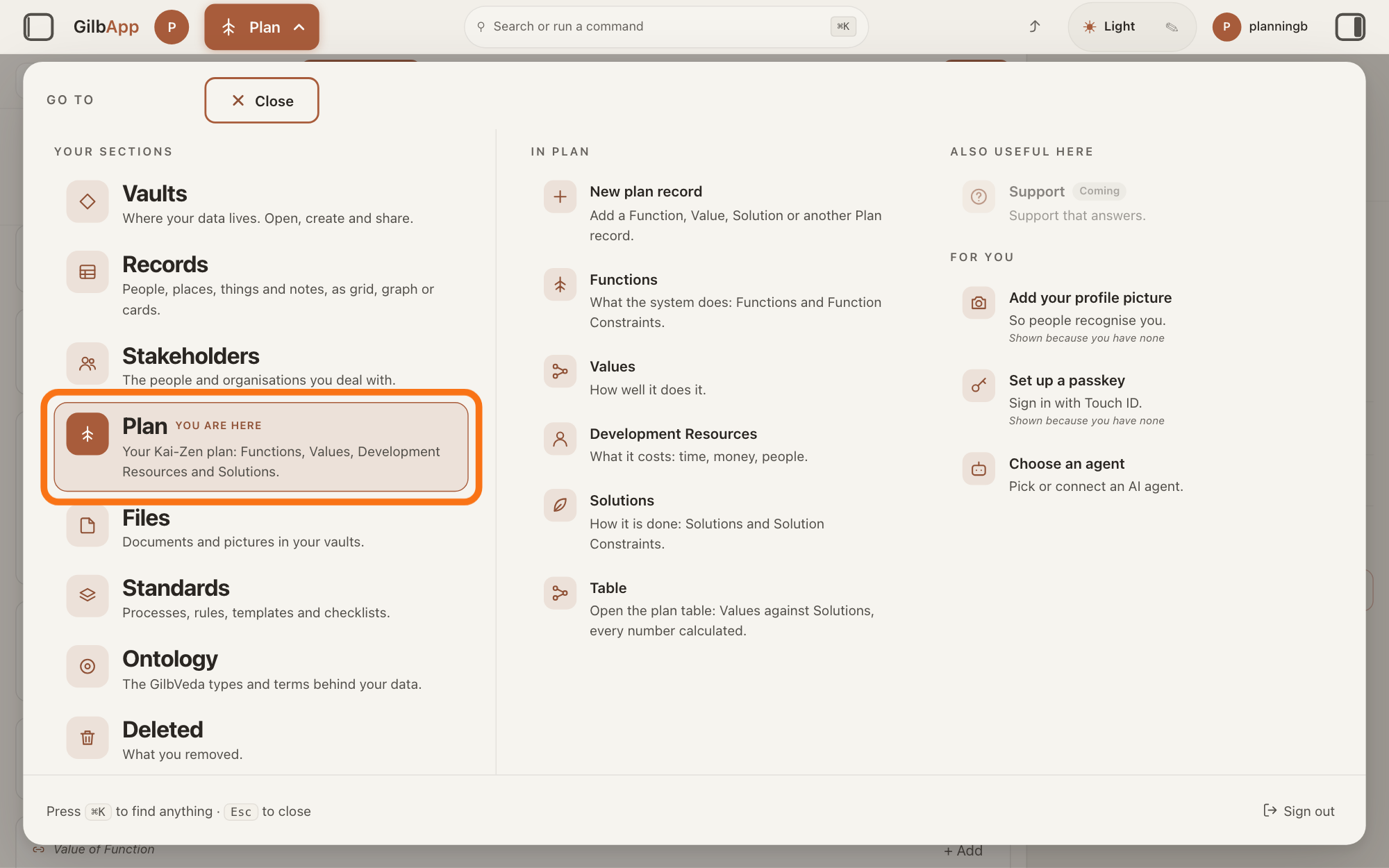
Press Main menu at the top left and choose Plan.
Press Main menu, next to your profile picture at the top left, and under YOUR SECTIONS choose Plan. The button shows the name of the section you are in, such as Vaults.
Show as text
In the GO TO panel that opens from "Main menu" at the top left, look under YOUR SECTIONS on the left. The outlined row is "Plan", marked "YOU ARE HERE", with the line "Your Kai-Zen plan: Functions, Values, Development Resources and Solutions." From another section, press it to open the Plan screen; here it only closes the panel.
More about this
A panel headed GO TO opens; Plan reads Your Kai-Zen plan: Functions, Values, Development Resources and Solutions. You can also press the Plan button on the card of a vault (the place where a person or a group keeps their records) in Vaults. The Plan screen lists your plan records and has the views Grid, Graph, Both and Card.
Search and select the Value in the list.
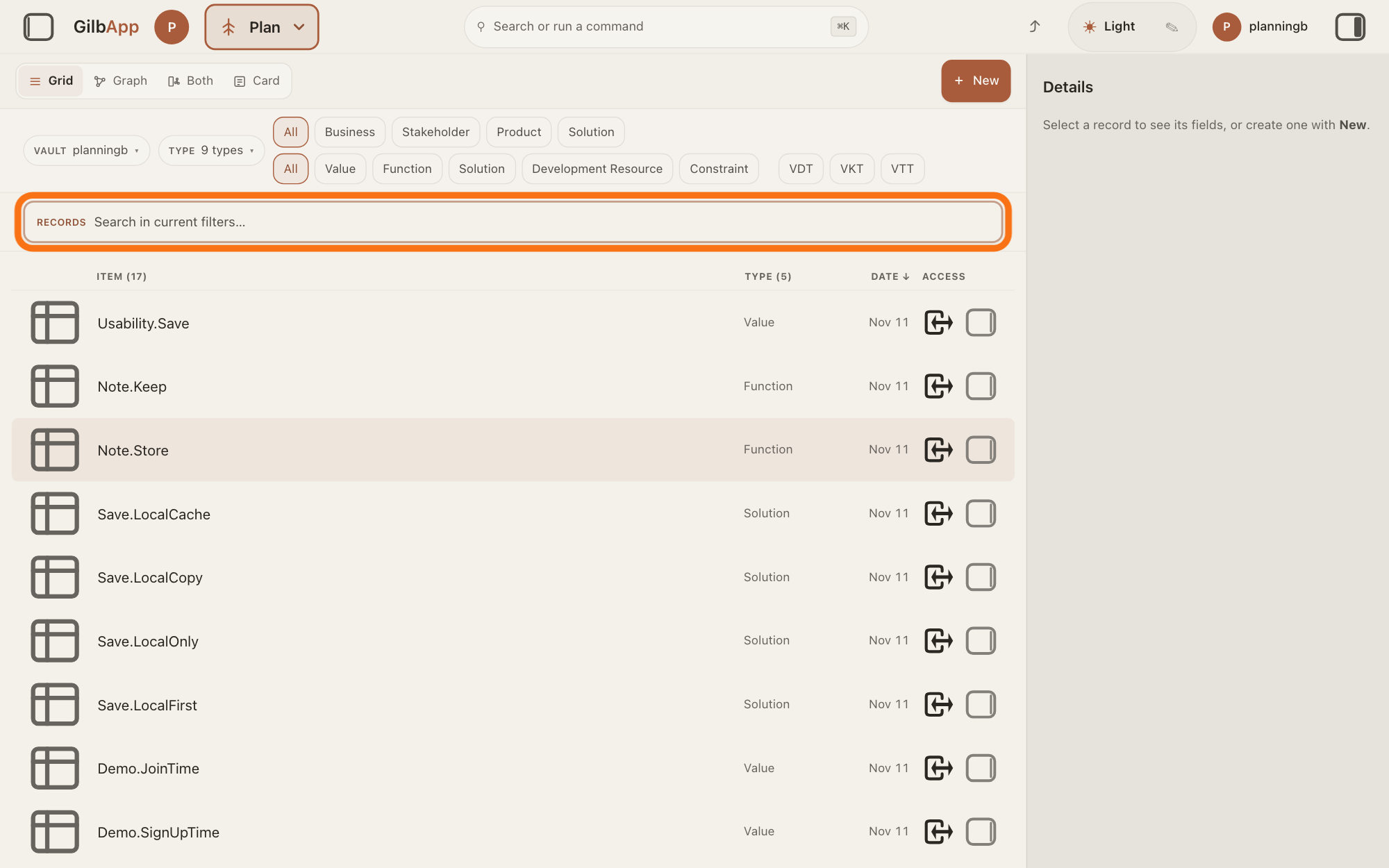
Type part of the Value's tag (its short name) in the search box and select the Value in the list. A Value is a perceived benefit, measured as a number.
Show as text
Look above the list on the Plan screen, under the type filters. The outlined box starts with "RECORDS" and reads "Search in current filters…". Click in it, type the tag of the record you want, and select it in the list.
More about this
The search box shows Search in current filters… while a filter is on, and Search your vault… otherwise. The button Value in the row of kinds shows only Values.
Press Edit.
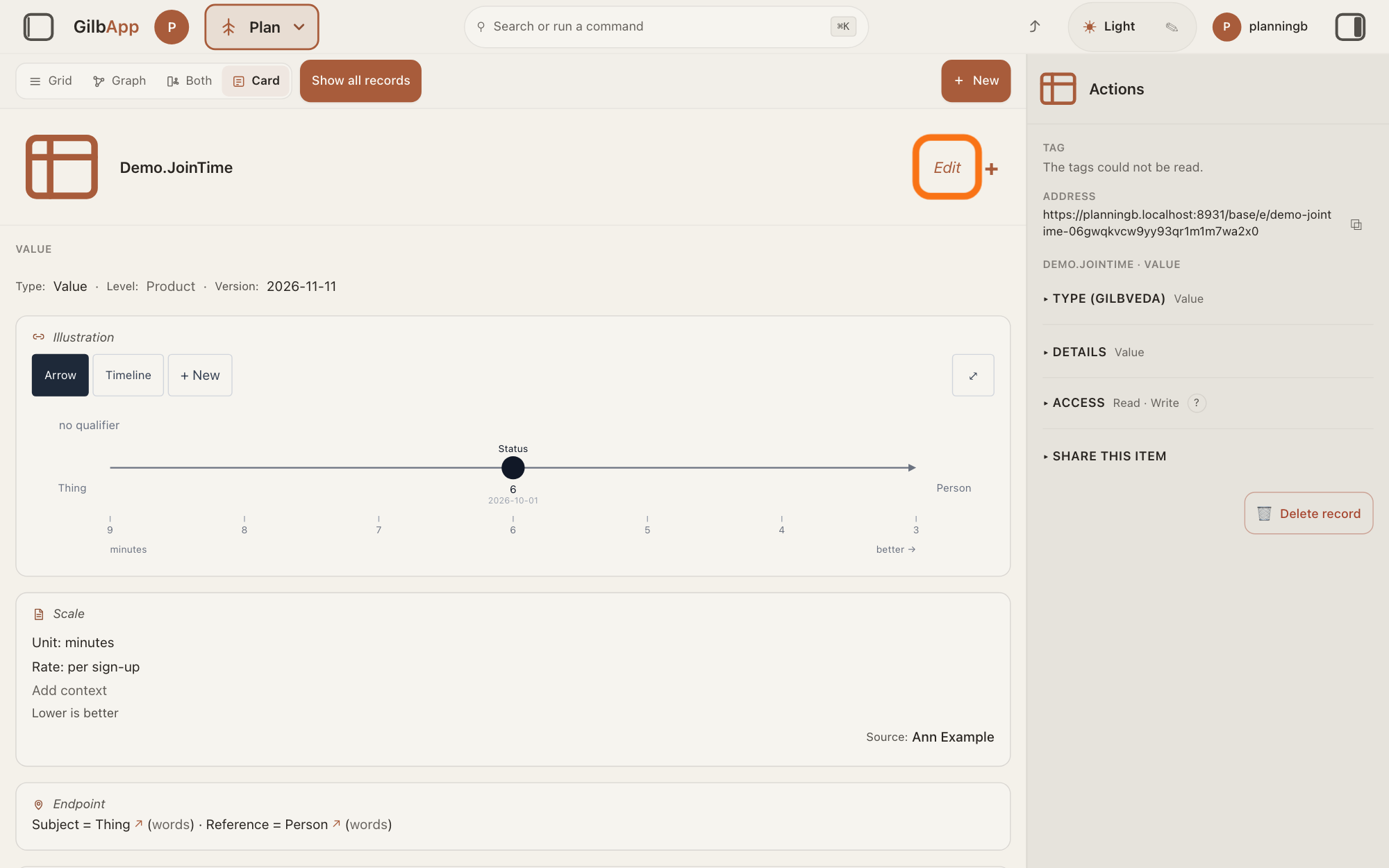
At the top right of the Value's card, press Edit. The button then reads Done.
Show as text
The Value's card is open, not in edit mode. Its "Illustration" shows only "Status" on the arrow, so no Tolerable or Goal is set yet. At the top right, the outlined word is "Edit". Press it.
More about this
The card says Editing. Changes save as you leave a field. There is no Save button. Beside Done, a + does what + Add Information at the foot of the card does; you do not need it. The card shows Edit only to a person who may write in its vault. + Level also works without Edit: it opens a panel with the same kinds as buttons, and the new row shows Add value, which you press to type the number. Edit is clearer, because the number box is then ready at once.
Under Levels, press Goal beside + Level.
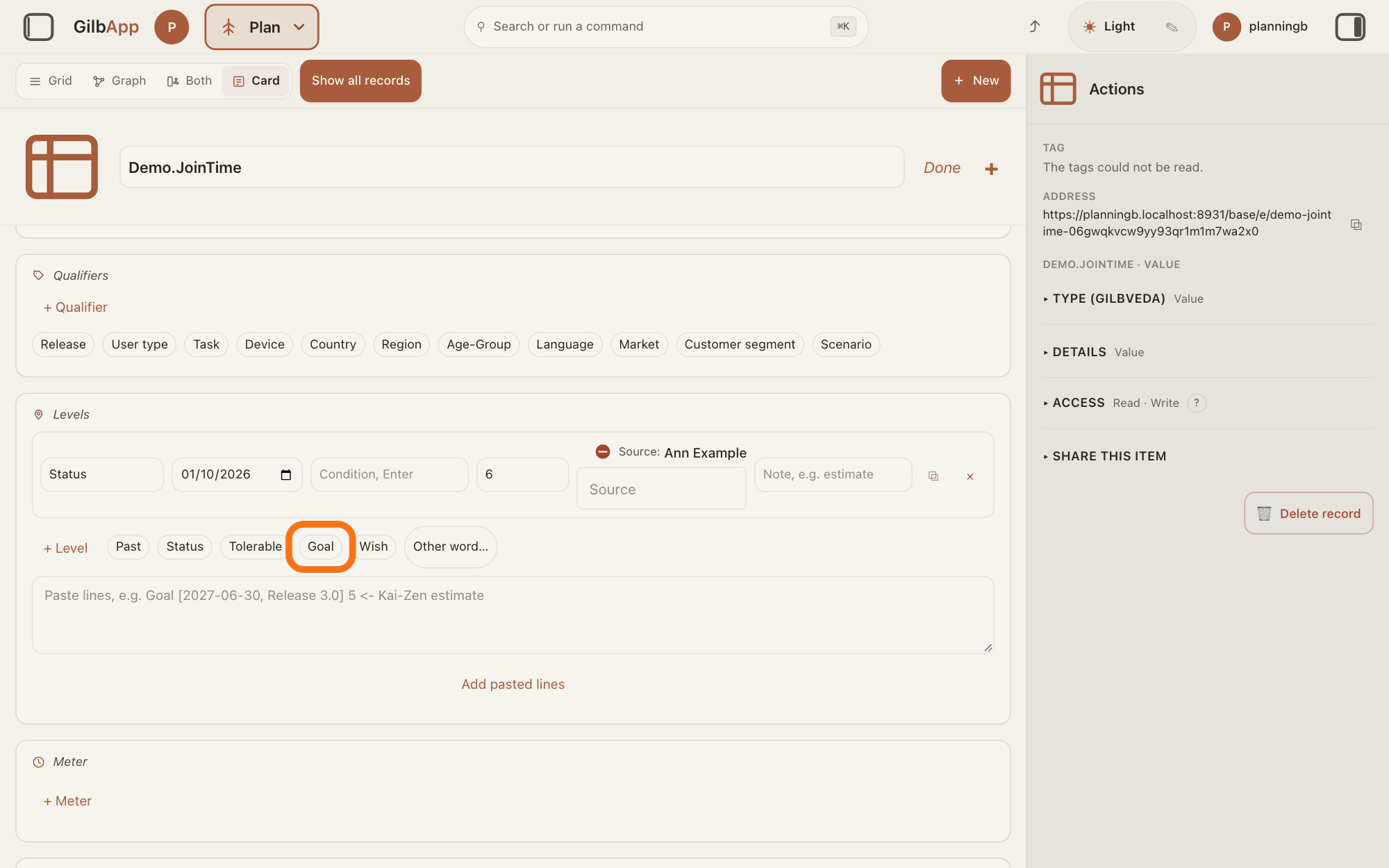
Under Levels, press the button Goal beside + Level. A new Goal row appears, with its number box ready to type in.
Show as text
In edit mode, scroll to "Levels". Under the one "Status" row is a line of buttons starting with "+ Level". The outlined one is "Goal", between "Tolerable" and "Wish". Press it, not "+ Level".
More about this
The buttons are Past, Status, Tolerable, Goal and Wish, then Other word…. + Level opens a menu of the same kinds, but in GilbApp today choosing from it can end edit mode, so press the button. The new row has no date yet. It copies the qualifier choices and conditions of the latest level. Other word… opens a box that shows Other word, Enter for a word of your own. Below is a box that shows Paste lines, e.g. Goal [2027-06-30, Release 3.0] 5 <- Kai-Zen estimate and the button Add pasted lines, which works only after you paste. You need none of them. Edit can also show blank rows Status, Tolerable and Goal among the filled ones. You can type the Goal in its blank row instead; leave a blank Status row empty.
Type the Goal number in the new row and press Enter.
Type the number you plan to reach in the new Goal row and press Enter. Goal is the success limit: that number or better is success.
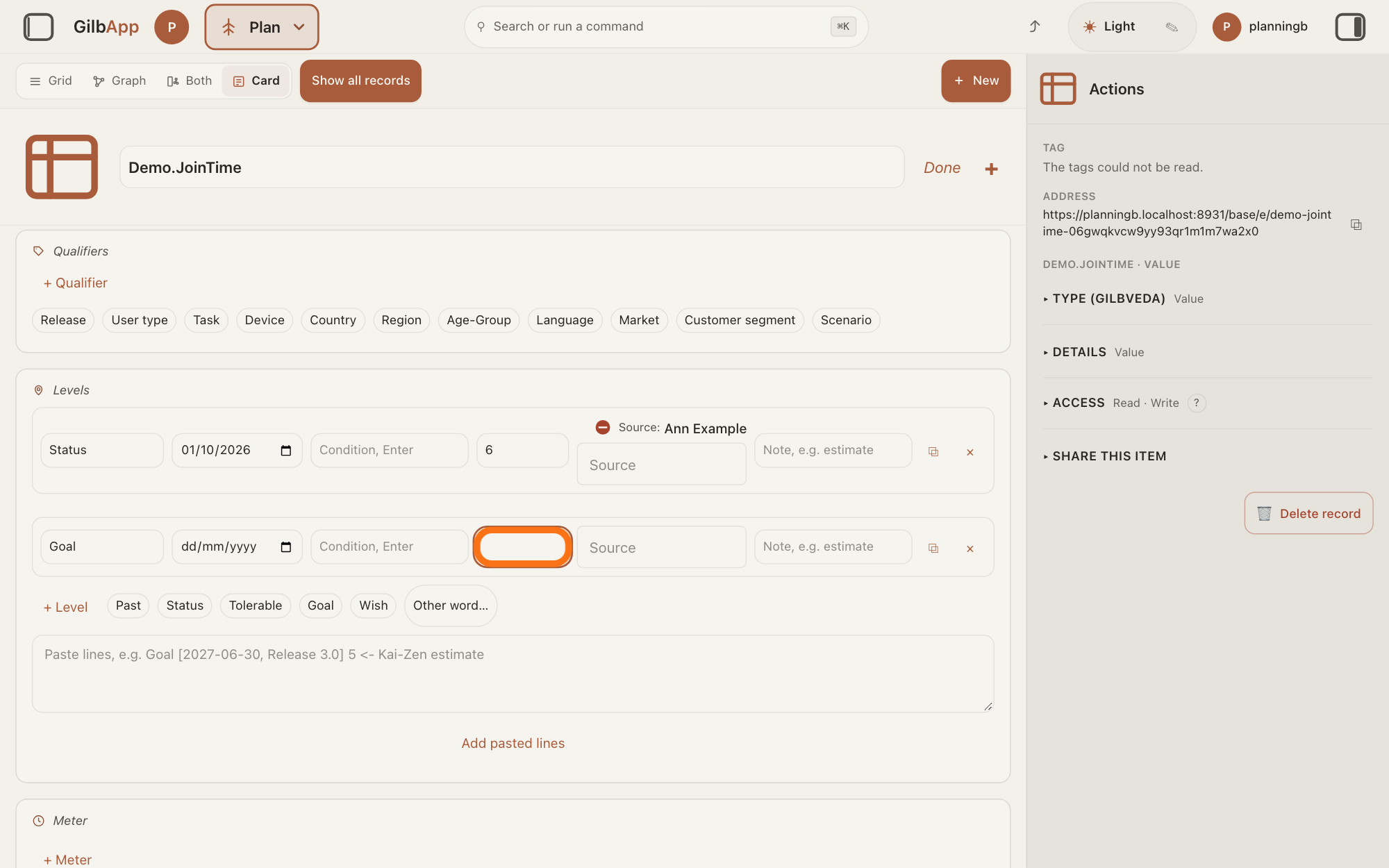
Show as text
A new row appears under the "Status" row; its first box reads "Goal" and its date box shows "dd/mm/yyyy". The outlined box is its empty number box. Type the Goal number and press Enter.
More about this
The first box of the row holds its word, Goal. Use one plain number, counted in the unit of the Scale, the ruler the Value is measured on. Clicking away saves it too; there is no Save button. Text such as 5-10 is kept as typed, but it is not one number, so Impacts cannot use it: they work their % from one Status, one Tolerable and one Goal. A Source box says who said the number, and the box that shows Note, e.g. estimate takes a short note; both are optional. ⧉ copies the row's qualifiers to a new level and × removes the row; you need neither.
Type the date in the Goal row's date box.
In the date box of the Goal row, type the date by which the number is to be reached. A level holds only at its date and its condition.
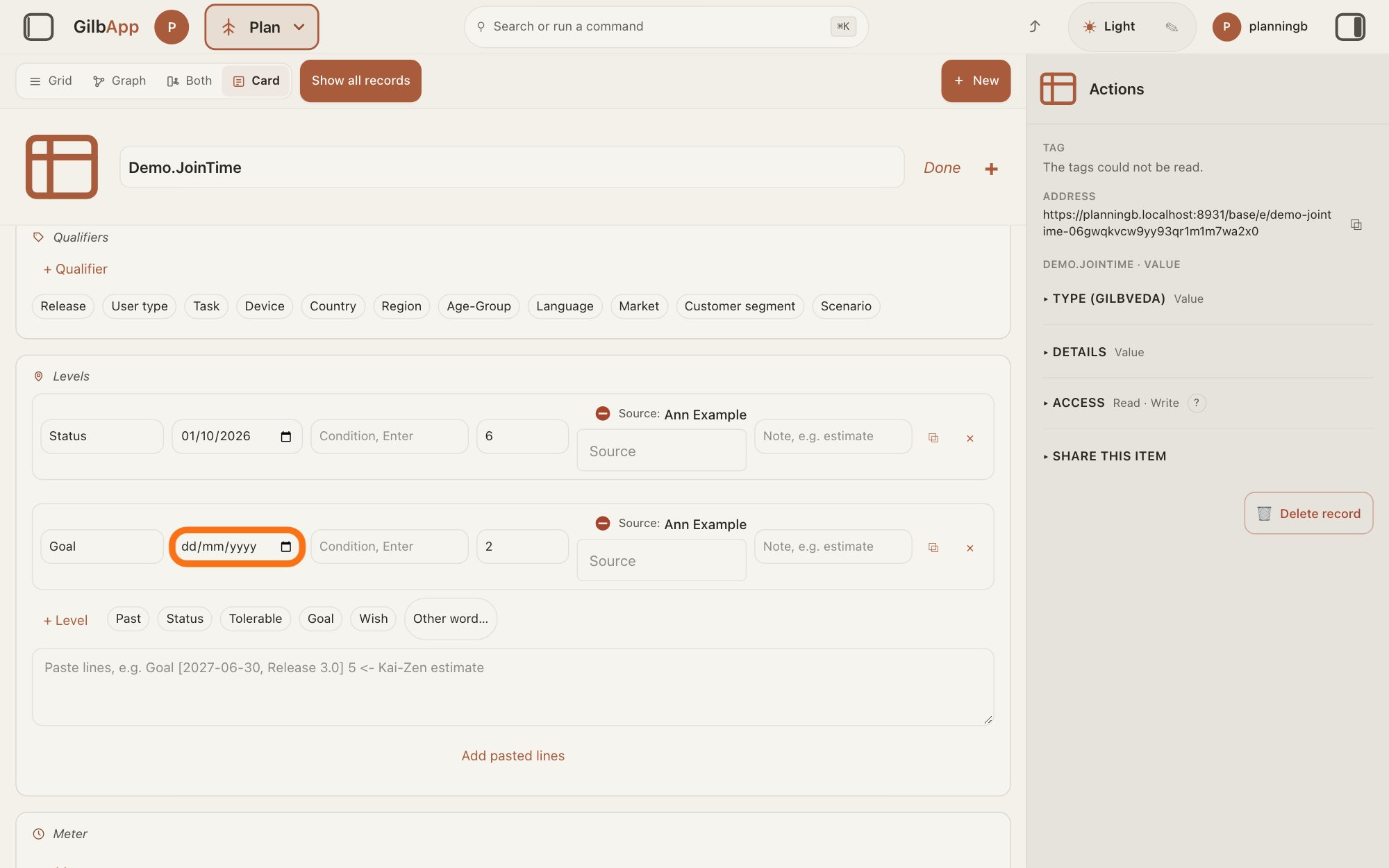
Show as text
The "Goal" row now holds its number and its source. The outlined box is the row's date box, still "dd/mm/yyyy". Type the date by which the Goal should be reached.
More about this
If the number holds only in one case, such as Release 3.0, type it in the box that shows Condition, Enter and press Enter; × beside a condition removes it. For a Scale with qualifiers, the row also shows a box for each, to say which case the number is for. One side shows only when Better is Target range; Deeper, below the steps, says how to use it. Compare a Status only with a limit valid at the same date and condition. The date is not needed to save, but a Goal without one counts in Impacts only when it is the only Goal.
Under Levels, press Tolerable beside + Level.
Under Levels, press the button Tolerable beside + Level. A new Tolerable row appears, with its number box ready to type in.
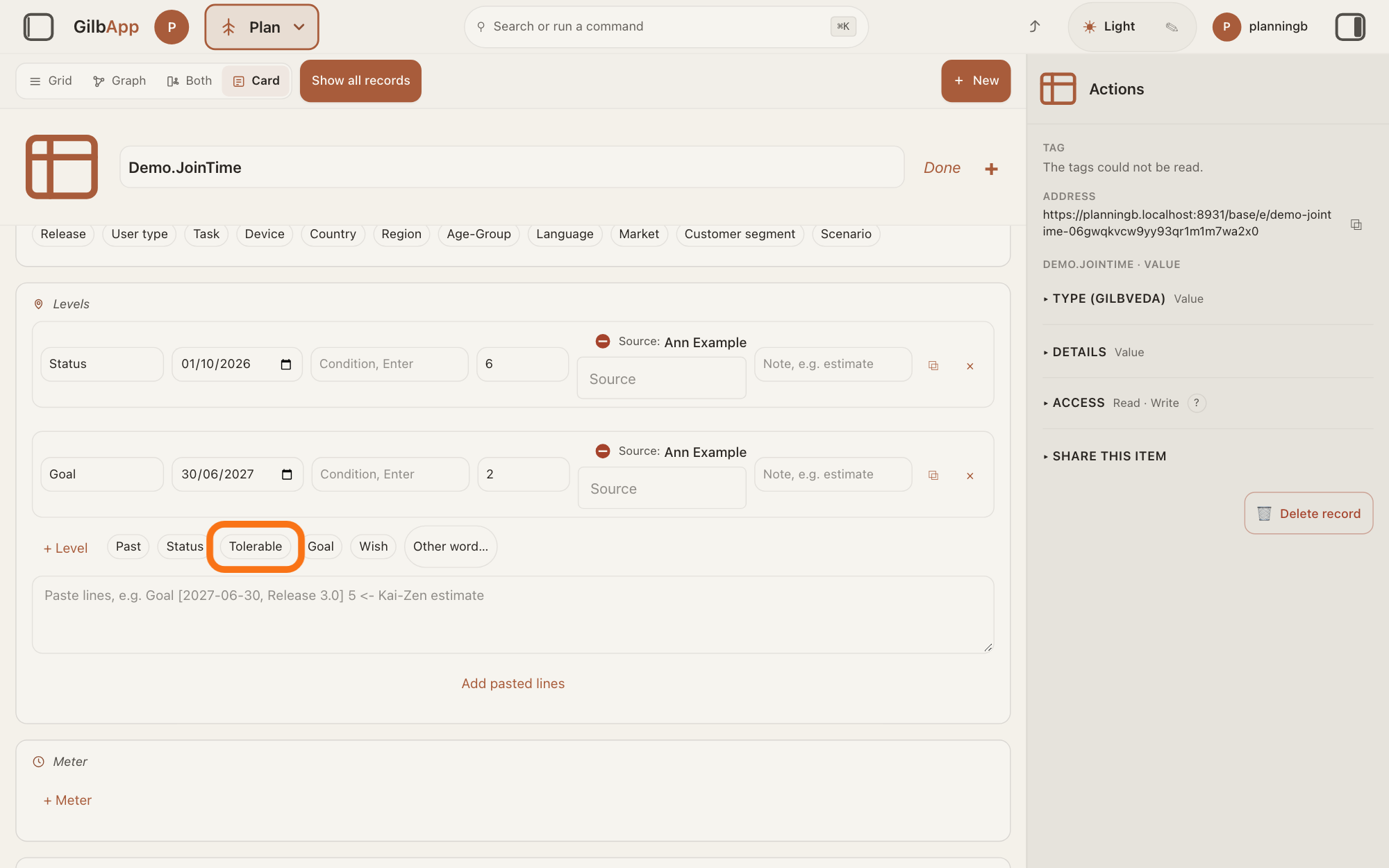
Show as text
The "Goal" row now has its date and number. In the line of buttons under the rows, the outlined one is "Tolerable", between "Status" and "Goal". Press it.
More about this
It copies the qualifier choices and conditions of the latest level, which is the Goal when its date is the latest, but not the date. You can type the Tolerable in a blank Tolerable row instead, if one shows.
Type the Tolerable number in the new row and press Enter.
Type the survival limit in the new Tolerable row and press Enter. Worse than this number, the whole project is expected to fail because of this one Value alone.
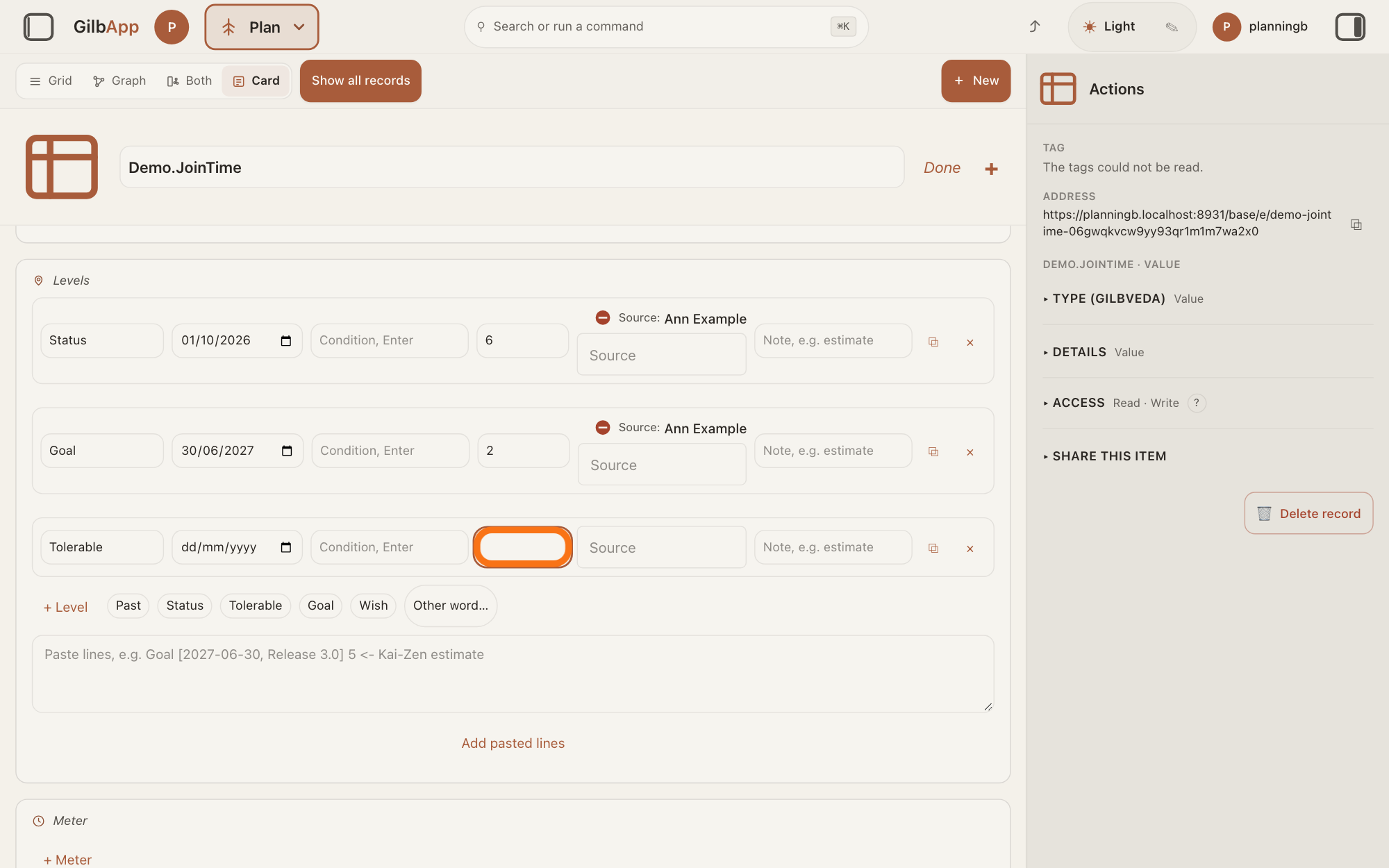
Show as text
A new row appears with "Tolerable" in its first box, below the "Goal" row. The outlined box is its empty number box. Type the Tolerable number and press Enter.
More about this
To find it, ask at what level the system will die, the product fail in the market, or the whole project fail, because of this one Value alone. It is not a bad state; it is death, so it is usually much worse than people first guess. With Lower is better, Tolerable is a higher number than Goal; with Higher is better, a lower one. Example: for Quick sign-up, in minutes per sign-up, lower is better: Goal 2, Tolerable 10.
Type the date in the Tolerable row's date box.
In the date box of the Tolerable row, type the date from which it holds. A Tolerable dated in the future is not valid yet: if the Status is still worse than it on that date, the project is expected to fail then.
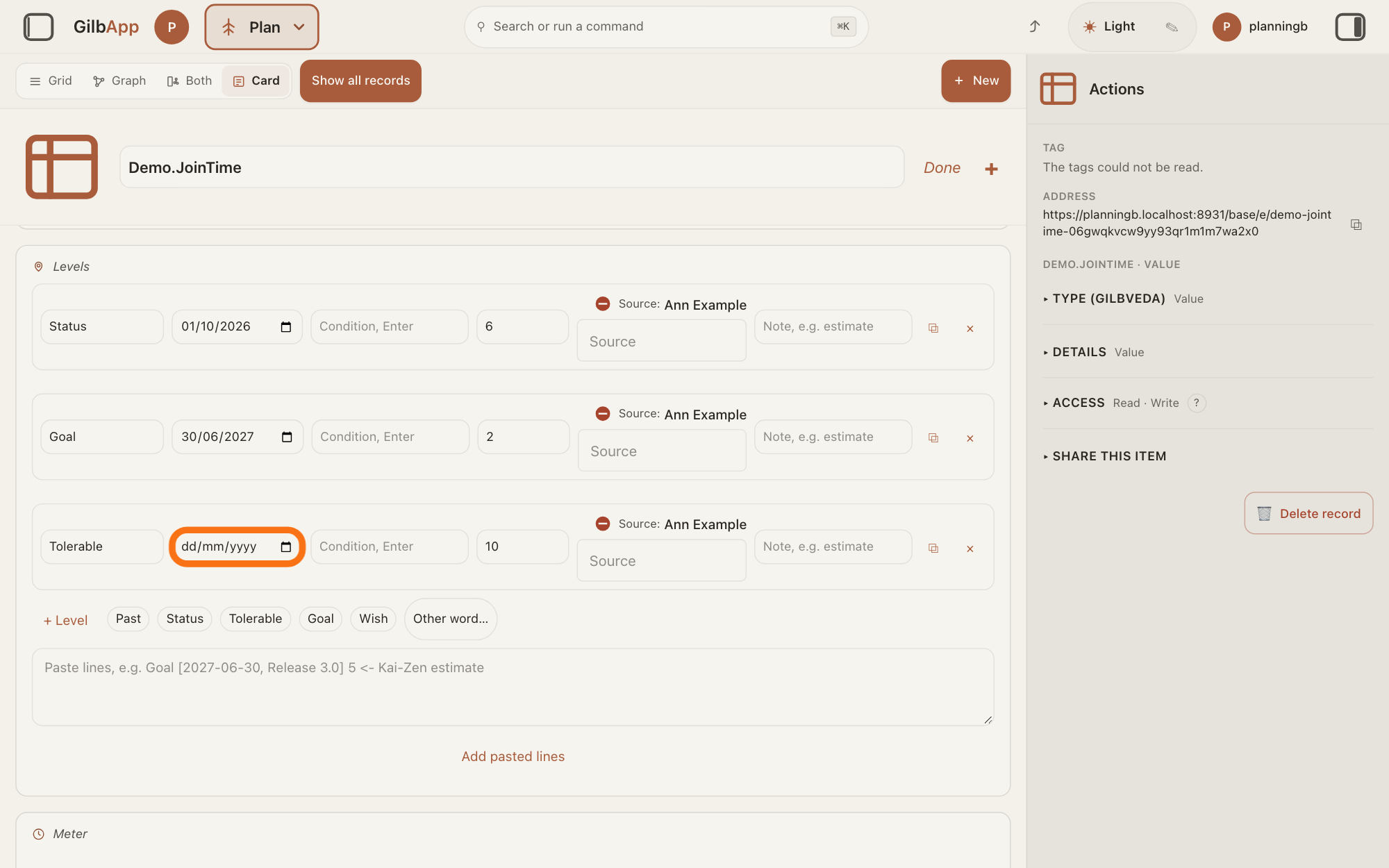
Show as text
The "Tolerable" row now holds its number. The outlined box is the row's date box, "dd/mm/yyyy". Type the date for the Tolerable level.
More about this
In the Kai-Zen examples, a Tolerable and its Goal have the same date. If the conditions of the Goal were not copied, type them here too, so that the two compare like with like. The date is not needed to save.
Press Done when you have finished.
Press Done at the top right of the card. What you typed is already saved.
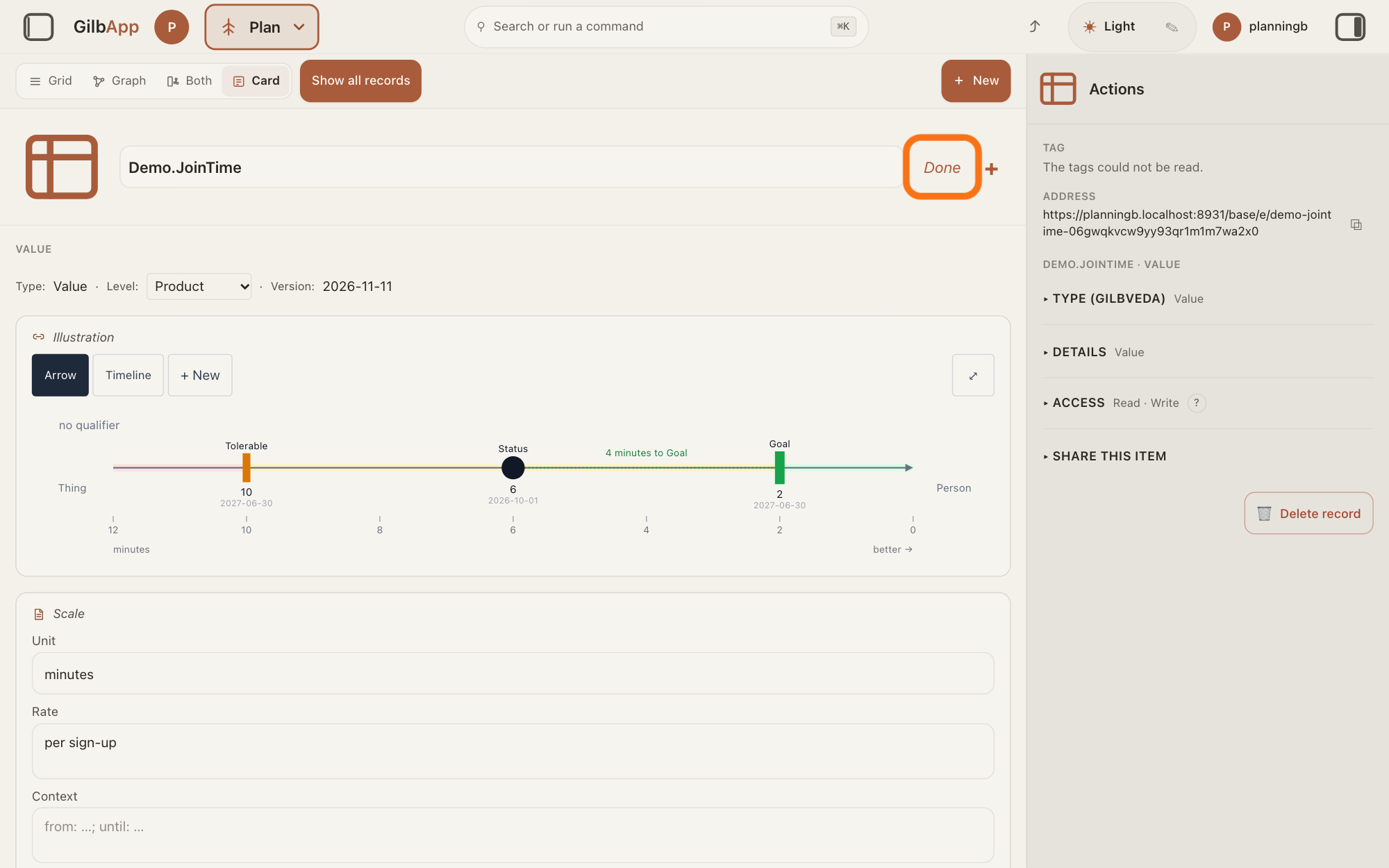
Show as text
The card is scrolled to the top. The "Illustration" now shows "Tolerable", "Status" and "Goal" on the arrow, with a line such as "4 minutes to Goal". At the top right, the outlined word is "Done". Press it when you have finished.
More about this
The Illustration at the top of the card shows the ranges on its Arrow: pale green from the Goal on is success, pale yellow between the Tolerable and the Goal is the tolerable range, and pale red beyond the Tolerable is the intolerable range. Over the arrow, a line says how far the Status is from the Goal, such as 4 minutes to Goal. If the Tolerable is on the wrong side of the Goal, only the green shows. Timeline beside Arrow shows the levels by date instead. In edit mode the Illustration also has + New, which adds a level from the picture, and ⤢, which opens it full screen; you need neither.
Deeper
Also asked:
What do Goal and Tolerable mean? Goal is the number you plan to reach; Goal or better is success. Tolerable is the survival limit: worse than it, the whole project is expected to fail because of this Value alone. Between them is tolerated only for a short time.
Only the number is needed for a Goal or a Tolerable. Every other box on the row is optional.
A Value is a variable on its Scale, not pass or fail: the closer the Status is to the Goal, the better off you are. Goal or better is the success range, the level you plan to reach. Between the Tolerable and the Goal is the tolerable range. It is not a good range: it is tolerated only for a short time, and when the Status is in it, act now to move it to the success range. Worse than the Tolerable is the intolerable range: there the whole project is expected to fail because of this one Value alone, however good everything else is.
For a Value whose Better is Target range, the aim is a band, so it has a low and a high limit of each kind. From the lowest number up: Tolerable low, Goal low, Goal high, Tolerable high. Add two Goal rows and two Tolerable rows, and in each row's list that shows One side, choose low or high.
A Value can have more than one Goal or Tolerable, each with its own date or condition, such as a nearer and a later Goal. Impacts work their % from one of each: of those with one plain number, the one dated nearest on or after today, else the latest dated; one with no date counts only when it is the only one. The bands under Illustration follow the latest-dated one. With no usable Status, Tolerable or Goal, the line says No % yet: and needs one Status, one Tolerable and one Goal.
A Meter can carry a qualifier, such as During Development (its box shows Qualifier, e.g. During Development). Mark a Status read with such a Meter with the same words, and replace it with a real reading at the first chance.
For a stakeholder's Value that the project cannot move, write a Wish (a number someone says they would like) instead of a Goal and a Tolerable: press Wish beside + Level. On a Development Resource, Budget takes the place of Goal.
When Kai-Zen writes a Value, it sets Status, Tolerable and Goal itself, marked as its estimates; the answer on what happens if the AI estimates a level you set explains them.
These Levels are not the levels of a plan, such as Business or Product; the answer on the levels of a plan explains those.
This answer is written for a computer screen.
Source: GilbApp af0f04ee838a4d55887d2ff1f72edd49a4ff7ca0 (https://gilb.com/app/version.json read 2026-11-09, buildTime 2026-11-09.522Z); code read at af0f04ee, no checkout. Levels: planKinds.ts:101-112, :162-175 (Levels, Illustration first on a Value card); planValue.ts:1649-1683 (blank rows Status, Tolerable, Goal; buttons Past, Status, Tolerable, Goal, Wish; Budget on a Resource; newLevelFromClick: only Status dated today, qualifier choices, conditions and side copied from the most recent level by date); PlanValueLines.tsx:1939-2025 (+ Level menu, portalled), :2029-2045 (blank rows only when the Value has no levels at mount), :2128-2193 (buttons, Other word…, paste box), :2478-2590 (edit row: kind, date, qualifier boxes, One side/low/high only for target, conditions, number with autofocus on the new row, Source, Note, e.g. estimate, ⧉ copies qualifier to a new Goal row, ×), :1840-1869 (Condition, Enter, × per condition), :1871-1895 (number box keeps any text; Enter or leaving saves), :1794 (Qualifier, e.g. During Development). Percent and limits: valueLimits.ts:1-64 (which Tolerable and Goal count: plain number; nearest dated on or after today, else latest; undated only if the only one), :90-93 (No % yet: <tag> needs one Status, one Tolerable and one Goal.); PlanCell.tsx:535; valuePercent.ts:120-126. Illustration: PlanValueGraph.ui.tsx:24-25 (arrow first), :38-56 (Arrow, Timeline); PlanValueGraph.tsx:426-460 (bands follow the latest-dated Goal and Tolerable; <n> <unit> to Goal line between Status and Goal); PlanValueGraph.geometry.ts:494-497 (band colours #fee2e2, #fef3c7, #dcfce7), :518-573 (red beyond Tolerable, yellow Tolerable to Goal, green Goal on; a Tolerable on the wrong side draws no red or yellow); planValue.ts:343-346 (no Better = higher). Standards (2026-11-09): Kai-Zen.ValueRules Limits, Scalar, SuccessRange, TolerableRange, IntolerableRange, SetTolerable, SpaceTime, MeterWhen, Bipolar, Better, Wish, Estimate; Kai-Zen.StakeholderLevelRules.CanMove; Kai-Zen.ValueTemplate (Status, Tolerable, Goal with [date, condition]; examples share the date; Bipolar low/high). GilbVeda public read 2026-11-09: t:Goal, t:Tolerable, t:Status, t:Wish, t:SuccessRange, t:TolerableRange, t:Range, t:Qualifier, t:Condition; t:IntolerableRange not found (404). Live cap 10 pictures (brief).
Checked against GilbApp d529620.