
← Back to How do I write a step?
How do I track estimates and actuals?
Short answer
In the Value Tracking Table, type each cell's Estimate; after delivery press Mark delivered, Enter Actual, type Status after, press Set Status.
Before you start
You need to be signed in to GilbApp on a computer, with a vault you can write to, such as your own vault. The plan needs a Value Tracking Table with its Values as rows and its steps as columns, each Value with Status, Tolerable and Goal numbers. The pictures show a made-up person on a test site; your screen shows your own name and address.
Words used here (12)
- Value Tracking Table
- A Value Tracking Table (VTT) follows a project's Values and Development Resources across its steps: the Estimate of each step, then its Actual.
- Estimate
- An Estimate is the change a step or a Solution is expected to make on a Value or Development Resource, written before it is built.
- Actual
- An Actual is how far a delivered step or Solution was measured to move a Value, or how much of a Development Resource it used.
- GilbApp
- GilbApp is the app, opened in a web browser at https://gilb.com/app, where you open, fill and share your vaults.
- Kai-Zen
- Kai-Zen is the planning agent: it finds out what you want, chooses the way, hands the work to other agents and reports back.
- record
- A record is one piece of data with its own address, such as a person, a place, a thing or a note.
- short name
- A short name is the one word you give one AI on one computer, such as gilb-example; it keeps that AI's key and tools apart.
- Value Delivery Step
- A Value Delivery Step, or step, is the Solutions, or parts of them, delivered together in one short cycle to move some Values.
- project
- A project is work to bring about a change you want, such as a new app or a better way of doing something.
- Budget
- A Budget is the most of a Development Resource you plan to use, such as the money for one month.
- Experience Level
- An Experience Level is a whole number from 0 to 10, chosen under an impact, that says how much experience stands behind its number.
- Evidence tag
- An Evidence tag says what a reading ran on: REAL if the real thing, MOCK if a stand-in, UNPROVEN if nothing was run.
Steps
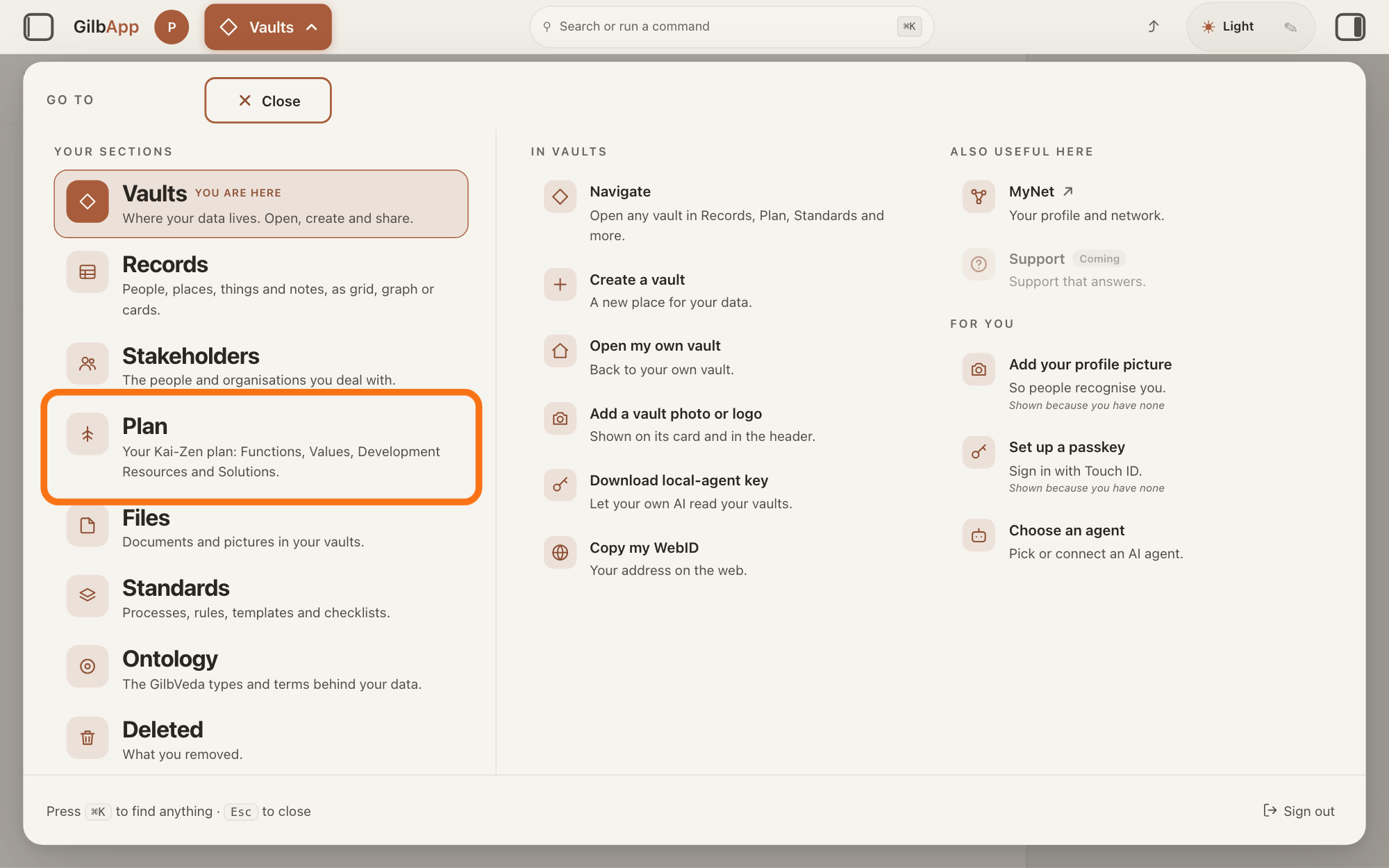
Press Main menu at the top left and choose Plan.
Press Main menu, next to your profile picture at the top left, and under YOUR SECTIONS choose Plan. The button shows the name of the section you are in, such as Vaults.
Show as text
In the GO TO panel that opens from "Main menu" at the top left, look under YOUR SECTIONS on the left. The outlined row is "Plan", with the line "Your Kai-Zen plan: Functions, Values, Development Resources and Solutions." Press it to open the Plan screen.
More about this
A panel headed GO TO opens; Plan reads Your Kai-Zen plan: Functions, Values, Development Resources and Solutions. You can also press the Plan button on the card of a vault (the place where a person or a group keeps their records) in Vaults. The Plan screen lists your plan records and has the views Grid, Graph, Both and Card.
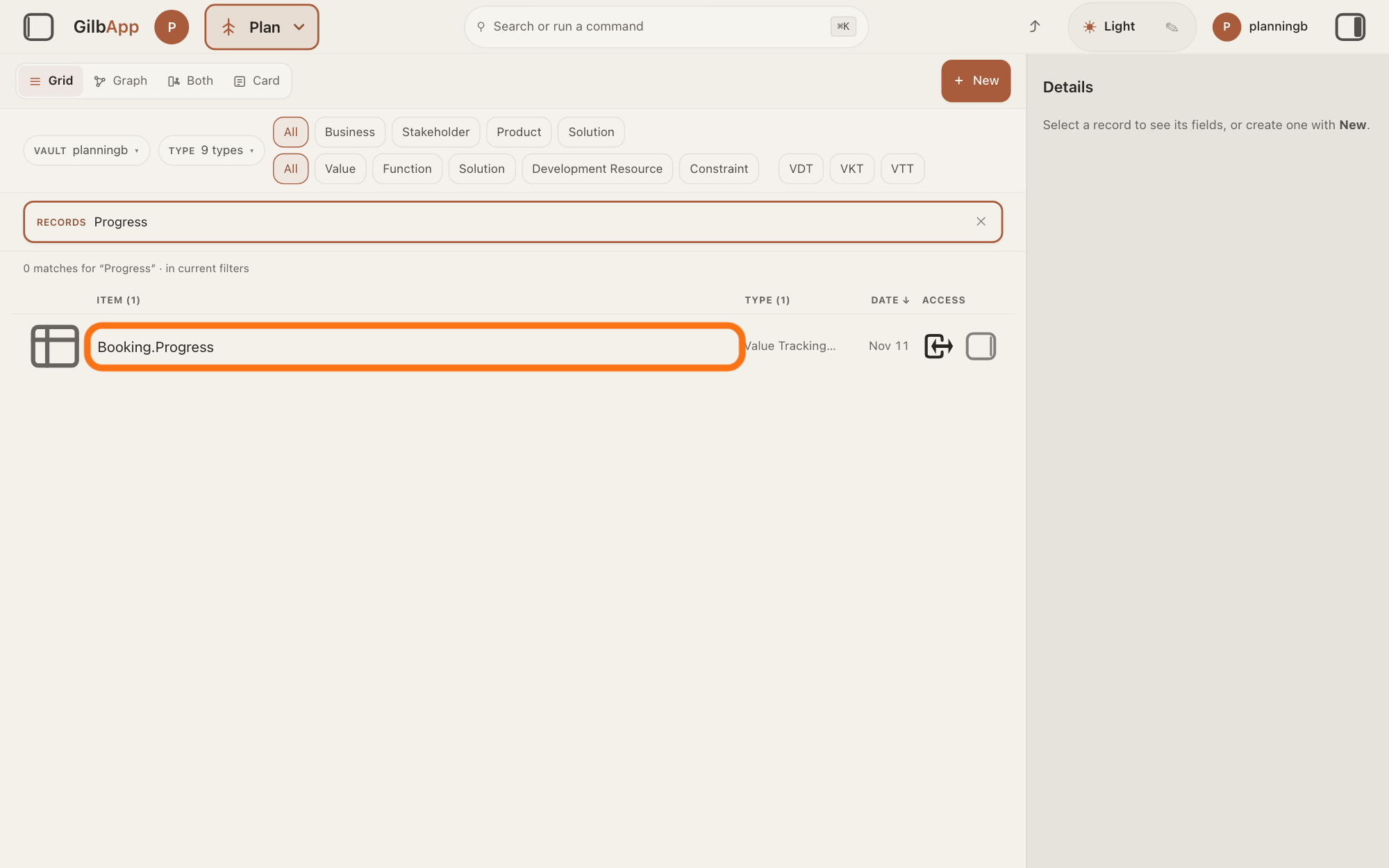
Search and select the Value Tracking Table in the list.
Type part of the table's tag (its short name) in the search box and select the Value Tracking Table in the list. The table opens in the middle of the screen.
Show as text
On the Plan screen, a word of the table's tag is typed in the "RECORDS" search box, and the list shows the Value Tracking Table. The outlined text is the table's tag in that row. Click it to open the table.
More about this
A Value Tracking Table (VTT) follows your Values and Development Resources across your steps: one column for each step, and in each cell the Estimate made before the step is built, then the Actual measured after it is delivered. A Value is a perceived benefit, measured as a number; a Development Resource is what the work uses up, such as money or time. A step, a Value Delivery Step, is the Solutions, or parts of them, delivered together in one short cycle to move some Values. The search box shows Search in current filters… while a filter is on, and Search your vault… otherwise. The button VTT in the row of kinds shows only Value Tracking Tables. Kai-Zen writes a VTT for each project it plans; Deeper, below the steps, says how to make one yourself.
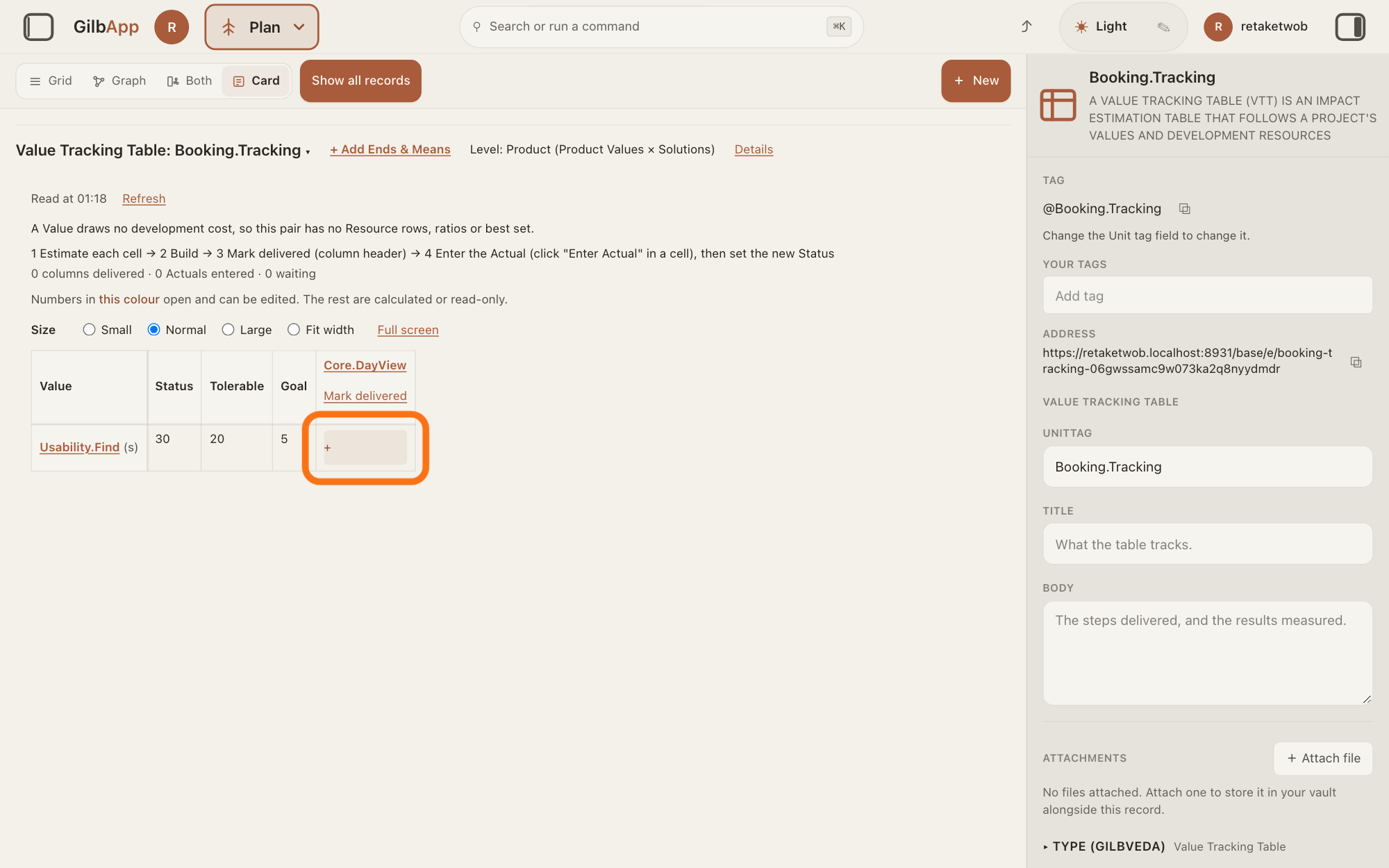
Press the cell where a step meets a Value.
Press the cell in a step's column and a Value's row. The right pane opens under IMPACTS, headed by the step's tag, → and the Value's tag.
Show as text
The table is open in the middle: the Value's row with its "Status", "Tolerable" and "Goal" numbers, and the step's column with "Mark delivered" under its tag. The outlined box is the empty cell where they meet. Click it.
More about this
If the table shows in the right pane instead, press Open the table there first. Above the table a line names the four stages, from 1 Estimate each cell and 2 Build to 3 Mark delivered (column header) and 4 Enter the Actual, with the counts of columns delivered, Actuals entered and cells waiting under it. Each row shows its Status (where it stands now), Tolerable (the survival limit) and Goal (the number you plan to reach; Budget for a Resource); the table adds nothing up across a row. An empty cell shows + when you point at it. Until the step is delivered, the pane also shows ACTUAL (BEFORE → AFTER) with Not delivered yet. The Actual is entered after delivery.
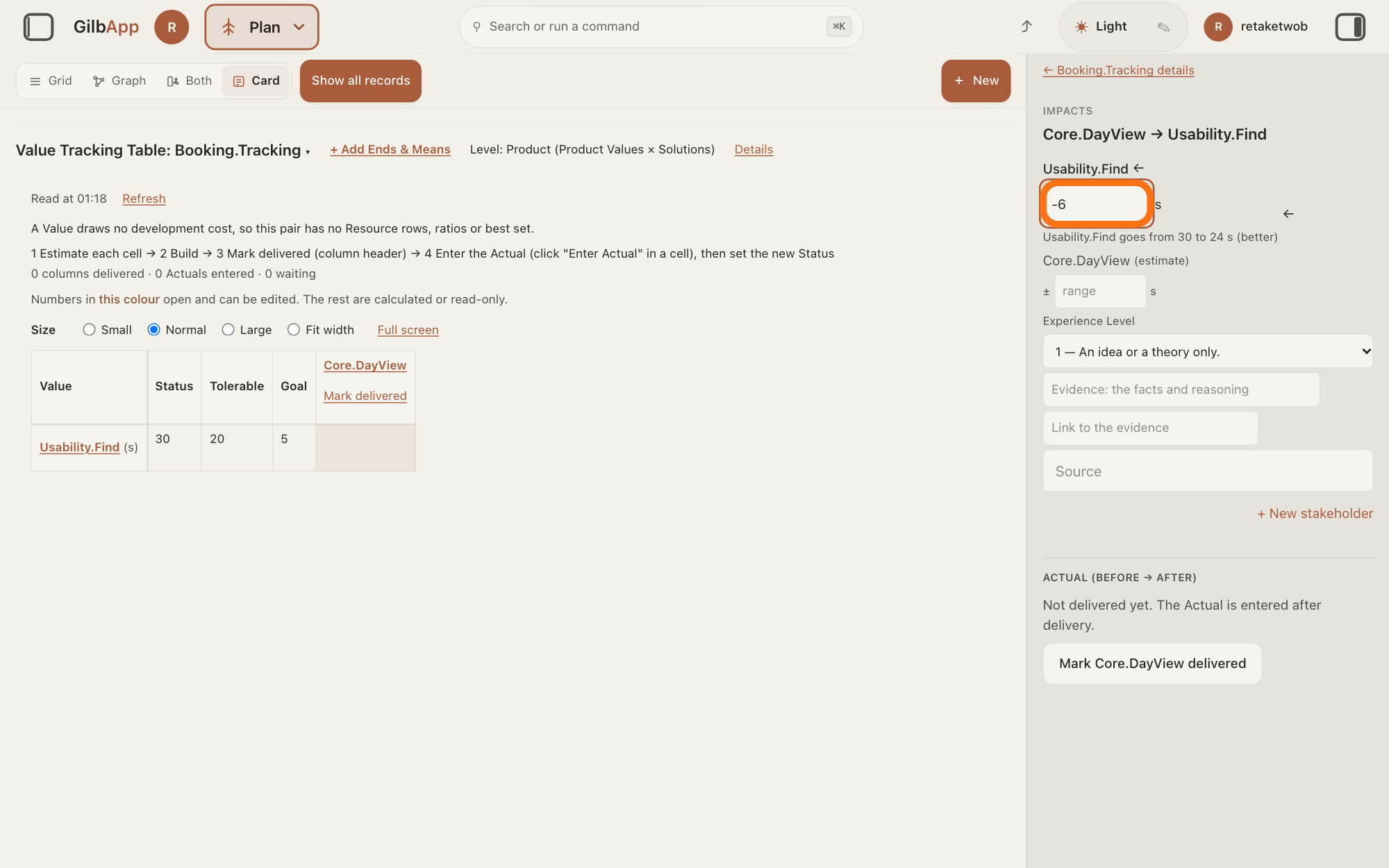
Press + Add an impact, type the Estimate and press Enter.
In the right pane, press + Add an impact, type how far you expect the step to move the Value, such as -2.8 or +100, and press Enter (for a Resource, the amount it uses). This is the Estimate, written before the step is built: you type the change, not the end number.
Show as text
On the right, under "IMPACTS", the heading names the step and the Value. After "+ Add an impact", the outlined box holds -6, the Estimate. Press Enter to save it. "ACTUAL (BEFORE → AFTER)" below says "Not delivered yet."
More about this
The cell then shows ESTIMATE and the change, with Tol and Goal and a %: how much of the way from Status to Tolerable, and to Goal, the step alone goes; a Resource's cell shows Tol and Bud, toward its Tolerable and Budget. Under HOW SURE, the Experience Level, the ± range and EVIDENCE work as the answer on comparing Solutions in a VDT shows. The Estimate shows only in tables that hold the step and under Impacts on the step's card, so it counts once. Repeat steps 3 and 4 for each cell before the step is built.
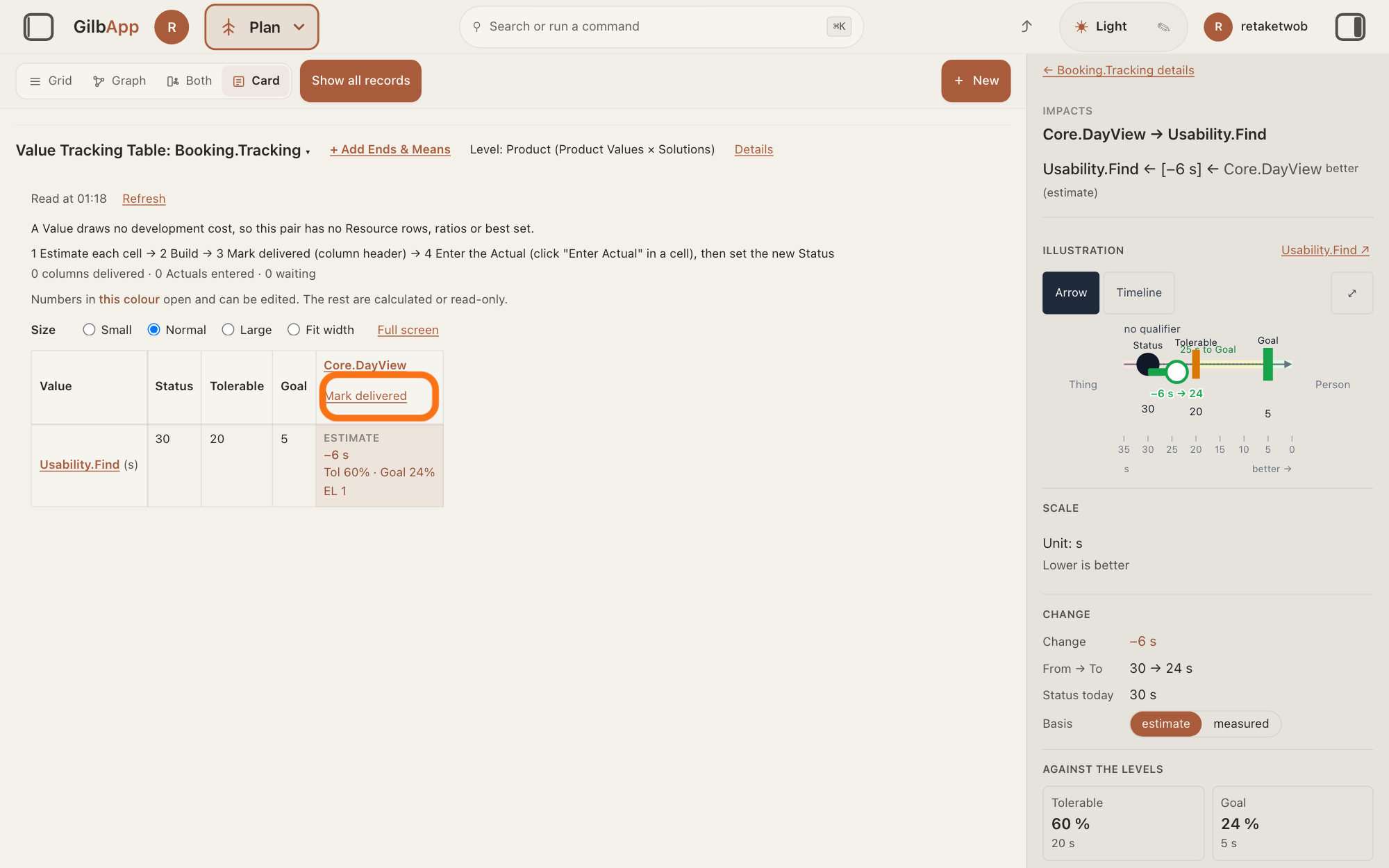
When the step is delivered, press Mark delivered under its tag.
Once the step is delivered, press Mark delivered under its tag at the top of its column. In the Kai-Zen method a step is delivered when real stakeholders can use it, and it is measured there, not on a test copy.
Show as text
In the table, the cell now shows "ESTIMATE" with −6 s and its % line. Under the step's tag at the top of its column, the outlined link is "Mark delivered": press it once the step has been delivered. The right pane shows the Estimate's "CHANGE" and "AGAINST THE LEVELS".
More about this
A stakeholder is a person, group or system that cares whether a Value goes up or down. GilbApp then adds the status Developed, dated today, with you as its source, and the header shows it; it counts a step as delivered once its Status is Developed or Production. In GilbVeda, the shared list of terms, Developed means built and tested but not yet serving its stakeholders in production; a later + Add beside Status on the step's card adds Production, which means it serves them. In the pane, the button that reads Mark, the step's tag and delivered does the same. From then on the Estimates stay as they stood: the pane says Delivered: the Estimate stays as it stood. The Actual is above. Only a person who may write the step sees the link.
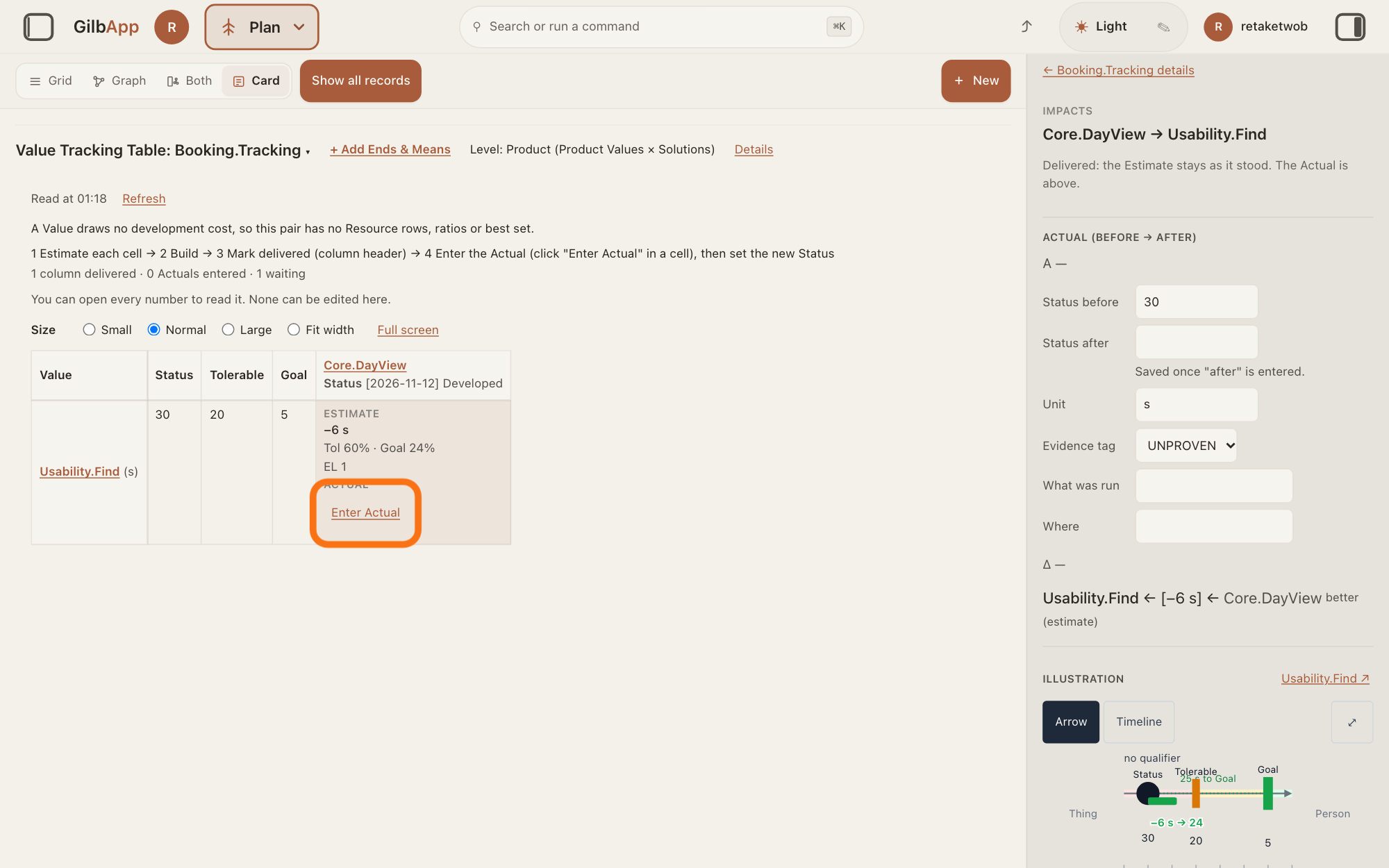
Press Enter Actual in the cell.
In a cell of the delivered step's column, press Enter Actual under ACTUAL. The pane opens with ACTUAL (BEFORE → AFTER) first and the cursor in Status before, which holds the Value's Status now.
Show as text
Under the step's tag the column now reads "Status [date] Developed", and the line above the table says "1 column delivered · 0 Actuals entered · 1 waiting". In the cell, under "ESTIMATE" and "ACTUAL", press the outlined "Enter Actual".
More about this
An Actual is how far the delivered step was measured to move the Value. Until one is entered the pane shows A —. A person who may not write the step sees Not entered yet in the cell and no boxes. Unit shows the unit of the Value's Scale, the ruler it is measured on, and cannot be changed when the Value has one. When the Value has Meter lines, which say how its number is found, a Meter list, No meter first, names the one used.
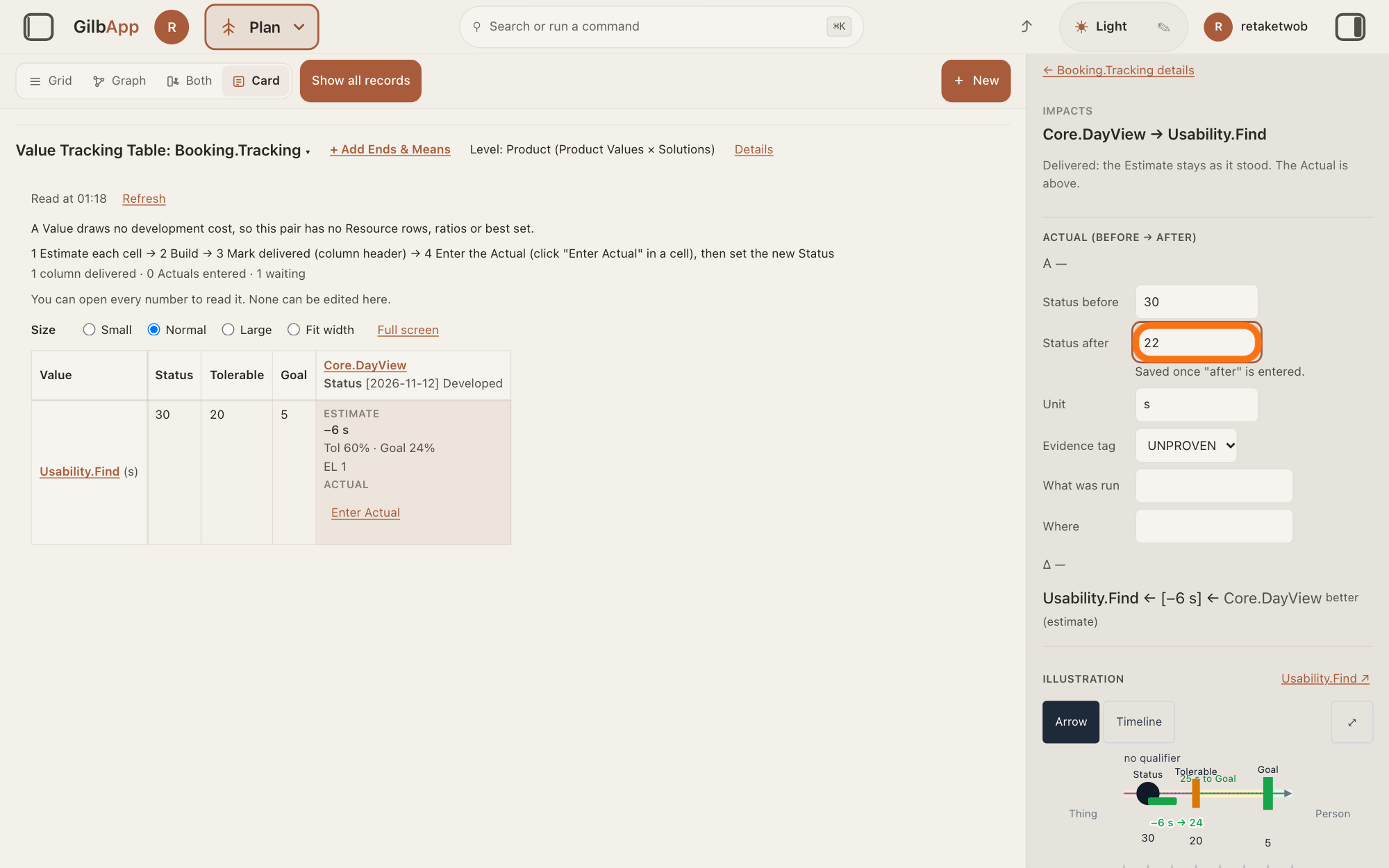
Type the Status after and press Enter.
In Status after, type where the Value stands now that the step is delivered, as measured, and press Enter. The Actual is saved once this box holds a number.
Show as text
On the right, under "ACTUAL (BEFORE → AFTER)", "Status before" already holds 30. Type the new measured number, here 22, in the outlined "Status after" box and press Enter. The line under the box says "Saved once "after" is entered."
More about this
Each box saves when you leave it or press Enter; there is no Save button, and Saved. shows under the boxes. The cell then shows ACTUAL, the reading as before → after with its evidence tag, and a line starting Δ: how far the Actual is from the Estimate, and whether it fell inside or outside the Estimate's ± range, or no ± given. Kai-Zen compares each Actual with its Estimate before it picks the next step, and uses the difference to estimate better. For a Resource row, type the amount the step used in Amount drawn instead. Text that is not a number gets Not saved: enter the Status before and after as numbers.
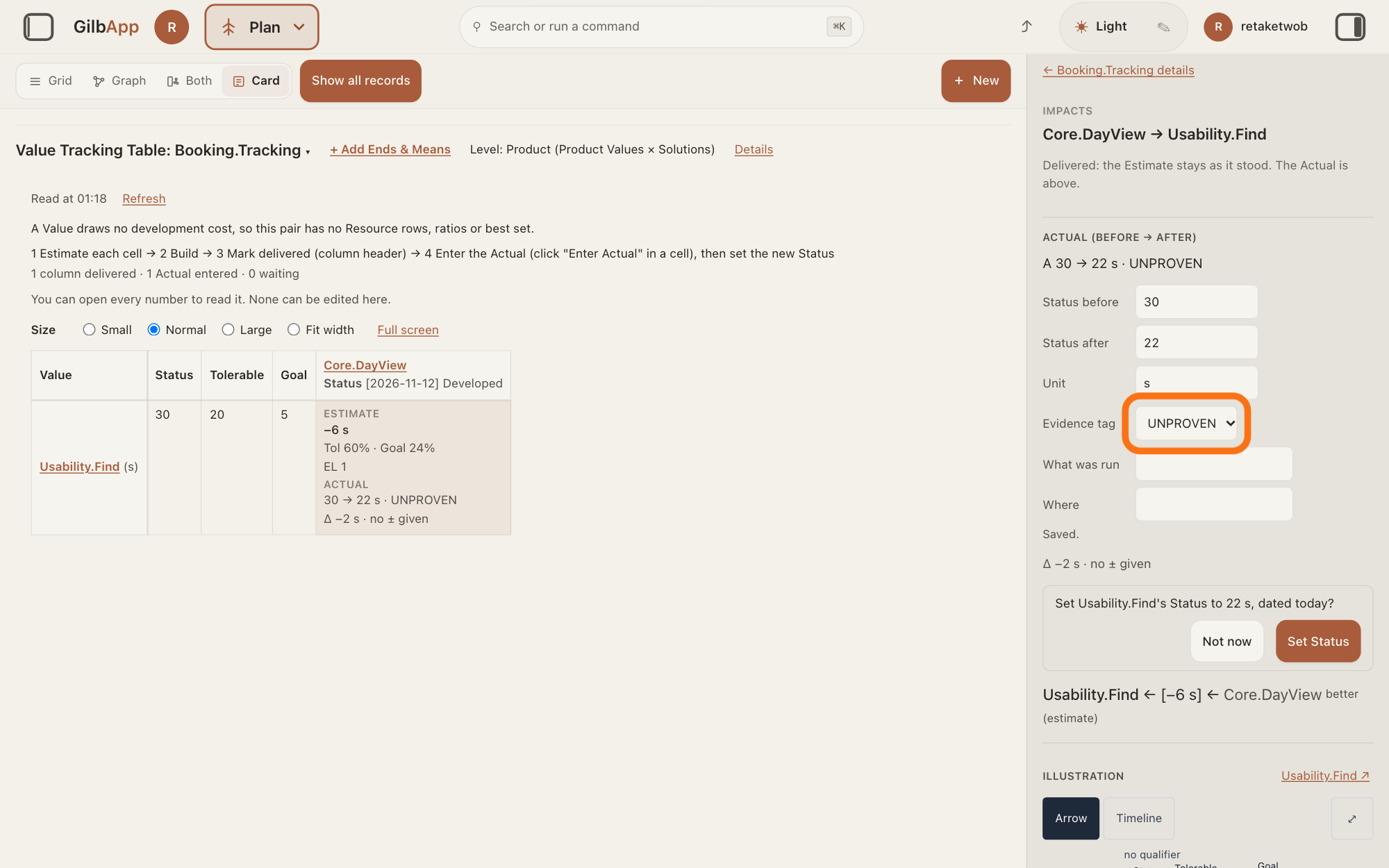
Under Evidence tag, choose how the reading was taken.
In Evidence tag, choose REAL if the reading ran on the real thing, MOCK if it ran on a stand-in, or UNPROVEN if nothing was run. It shows UNPROVEN until you choose.
Show as text
The right pane now says "Saved." and "Δ −2 s · no ± given", and the cell in the table shows the Actual 30 → 22 s. The outlined "Evidence tag" list still reads "UNPROVEN": open it and choose how the reading was taken.
More about this
The list saves when you choose. What was run and Where take what was measured and where; they are optional and save when you leave them. In the Kai-Zen method a reading taken elsewhere, such as on a test copy or a smaller set of data, does not move the Status: it is written beside it, with its condition.
Press Set Status if the reading is REAL.
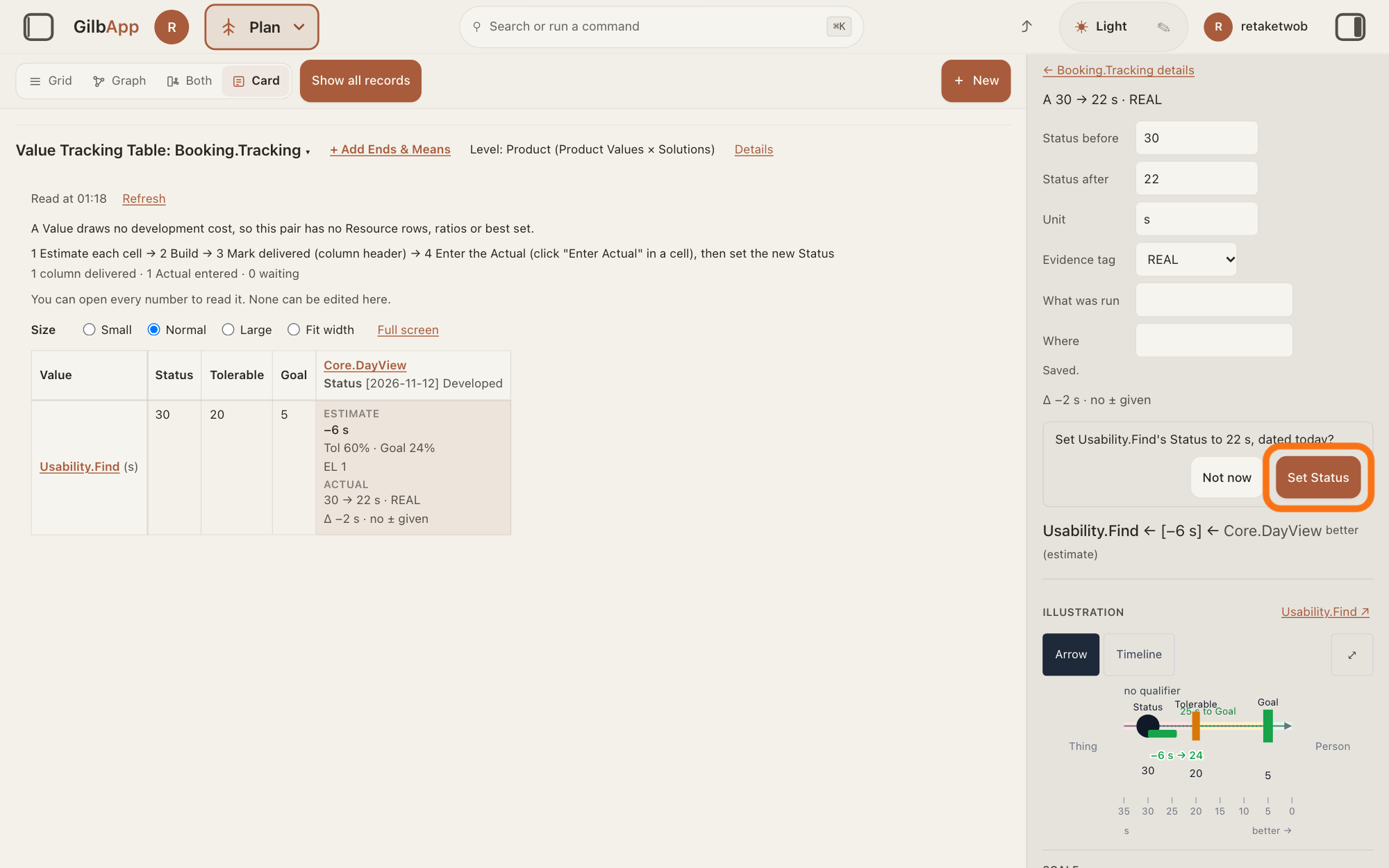
Under the Actual, GilbApp asks whether to set the Value's Status to the measured number, dated today. Press Set Status only if the Evidence tag is REAL and the reading was taken where the stakeholders use it; otherwise press Not now, which leaves the Value as it is.
Show as text
With "REAL" chosen in "Evidence tag", the right pane asks whether to set the Value's Status to 22 s, dated today, with "Not now" and the outlined "Set Status". Press "Set Status" to make the measured number the Value's new Status.
More about this
GilbApp offers Set Status whatever the Evidence tag says, as soon as Status after is saved, and adds no Evidence tag; the new Status keeps the old one's conditions. The question names the Value, its new number and its unit. Nothing is written without the press, and only a person who may write the Value is asked. For a Resource it asks to add the amount used to its Status. If the Value's Status is not one plain number, it says No Status offer: and why. The old Status stays, and the newest date is the current one, as the answer on updating a Value's Status explains. In the Kai-Zen method each row's Status is its latest measured level, and a number that was not measured is not a Status.
Deeper
Also asked:
What are an Estimate, an Actual and an Impact? An Impact is the effect of a step or a Solution on one Value. Its Estimate is the change expected, written before it is built; its Actual is the change measured after delivery. One cell holds both.
To make a Value Tracking Table, press + New in Plan, choose Value Tracking Table under TYPE, type a tag in TAG, keep Product: Product Values × Solutions under LEVEL and press Create. The tag box shows Area.Keyword, e.g. Product.Tracking until you type, and More value tracking table details holds an optional Title and Description. Then press + Add Ends & Means. Under Rows: Product Values and Development Resources, search and select each Value and Development Resource to track in the box that shows Find a Value or Development Resource by tag; a Development Resource is what the work uses up, such as money or time. Under Columns: Value Delivery Steps and Solutions, search and select each step in the box that shows Find a delivery step or a Solution by tag, and press Done. A step, a Value Delivery Step, is the Solutions, or parts of them, delivered together in one short cycle to move some Values. The answer on comparing Solutions in a VDT shows the same dialog and boxes step by step, and the answer on writing a step shows how to make a new step in the columns box.
A whole Solution delivered as a step of its own can be a column too; it has Mark delivered and Actuals the same way. An Actual is entered only in a Value Tracking Table; elsewhere GilbApp says Edit this Actual in its Value Tracking Table. The columns stand in delivery order: a new one goes last, and while + Add Ends & Means is open, ← and → on a column move it. With a Development Resource row, Order offers only Delivery order.
In the Kai-Zen method a Value Tracking Table has the Product Values with Status, Tolerable and Goal as rows, then the Development Resources with Status, Tolerable and Budget, one column per step in delivery order, and in each cell the Estimate, then the Actual, in units and as a %. Kai-Zen fills a step's Estimates before it is built, from today's Status, and its Actuals after it is delivered and measured, and it adds nothing up across a row. In GilbApp today the Development Resource rows stand above the Values, and an Actual shows as before → after with its Δ line, with no %.
In a round of delivery, Kai-Zen has each Value the step targets measured with its Meter by an agent other than the one that built the step, writes the Actuals in the step's column, and then updates each Status. An agent is your AI following one written procedure, its standing instructions, for one kind of work. After the Actuals, Kai-Zen decides whether to keep the step's Solution, throw it away or change it; throwing it away puts each Value's Status back, and the Development Resources used stay used. GilbApp has no row for that choice; the answer on deciding to keep or throw away a step's result covers it. After each round Kai-Zen shows you the measured Values and the next step, as the answer on picking the next step explains.
This answer is written for a computer screen.
Source: GilbApp af0f04ee838a4d55887d2ff1f72edd49a4ff7ca0 (https://gilb.com/app/version.json read 2026-11-09, buildTime 2026-11-09.522Z, dirty false); code read from the archive (no checkout). Step 3: PlanTable.tsx:404-452 (cell button, + on hover, opens the pair), :517-545 (VTT_STEPS line and counts <n> columns delivered · <n> Actuals entered · <n> waiting), :775-800 (a VTT draws Status, Tolerable, Goal and no Combined, Winners, ratio or sum rows; Kai-Zen.VTTRules.NoRowSum), :1864; PlanImpactsPane.tsx:163-205 (Impacts uppercase, <step> → <Value>, Actual section after the Estimate while not delivered), ImpactActualForm.tsx:68, :80 (Actual (before → after), drawn uppercase by Section, PlanImpactPane.tsx:290-291; Not delivered yet. The Actual is entered after delivery.). Step 4: PlanImpacts + Add an impact (PlanImpacts.tsx:1912-1945); PlanTable.tsx:393, :456 (Estimate label, uppercase), :457-481; planKinds.ts:262-269 (a step holds an Estimate), :289-295 (counted once). Step 5: PlanTable.tsx:547-551, :856-860 (Mark delivered under a not-delivered column's tag); MarkDelivered.tsx:1-4, :66-92 (only to a person who may write the column, only while not delivered); PlanFunctionForm.tsx:177-183 (Developed, dated today, source the person), :382-388 (next word after Developed is Production); planCard.ts:893-912 (delivered = Developed or Production); PlanImpactsPane.tsx:145-160 (button Mark <tag> delivered); planKinds.ts:296-304 (Delivered: the Estimate stays as it stood. The Actual is above.). Step 6: PlanTable.tsx:394-396, :501-511 (Actual label, Enter Actual, Not entered yet); PlanImpactsPane.tsx:116-122, :188-199 (Actual first once delivered; focus in the first box); ImpactActualForm.tsx:191-198, :246-258 (Status before holds the row's Status), :360 (A —), :366-401 (Unit read-only with a unit, Meter with No meter). Step 7: ImpactActualForm.tsx:271-333, :372-383 (Status after, saved once it holds a level; Amount drawn), :417 (Saved.), :420-422 (Learn line); PlanImpactEstimate.tsx:41-42 (box saves on leave or Enter); impactActual.ts:141-149 (line A <before> → <after> <unit> · <tag>), :150-193 (Learn: Δ, inside/outside the ±, no ± given), :58 (Not saved: enter the Status before and after as numbers.); PlanTable.tsx:489-499 (cell: Actual, line without A , Learn line). Step 8: ImpactActualForm.tsx:402-415 (Evidence tag, What was run, Where); impactActual.ts:51-55 (REAL, MOCK, UNPROVEN, default UNPROVEN). Step 9: ImpactActualForm.tsx:94-162 (offer, Not now, Set Status, only with write on the Value; nothing written without the press); statusOffer.ts:26-48 (Set <Tag>'s Status to <n> <unit>, dated today?, Resource Add <amount> to <Tag>'s Status (now <n>)?, No Status offer: <Tag>'s Status could not be read as a number.; no offer when the Status already is that number), :50-62 (a new Status line appended). Deeper: recordTypes.ts:270-291, :473-486 (VTT dialog: New value tracking table, Area.Keyword, e.g. Product.Tracking, Title, Description, LEVEL); TableCard.tsx:102-111, :615-619, :708 (pickers); planKinds.ts:270-278 (a whole Solution is a delivery column; a Solution Constraint is not), :306-307 (Edit this Actual in its Value Tracking Table.); TableCard.tsx:501-520 (new column last; move); planTable.ts:574-575 (Delivery order only); PlanTable.tsx:897-907 (Resource rows drawn above Value rows); no Act row (the code shows none). Standards (2026-11-09, all 200): Kai-Zen.VTTRules (Rows, Columns, Cell, Estimate, Actual, Status, Act, Learn, NoRowSum), Kai-Zen.VTTTemplate (Blank, Example), Kai-Zen.ValueDeliveryStepRules (Delivered "A step is delivered when real stakeholders can use it. Measure there, not on a test copy.", Numbers), Kai-Zen.Cycle (Measure by an agent other than the builder, Update, Next), Kai-Zen.EvidenceRules (Measured, Tag REAL (ran on the real thing), MOCK (ran on a stand-in) or UNPROVEN (not run), Condition "(a local copy, a smaller set, a stand-in client) is written beside the Status, with its condition, and does not move it"), Kai-Zen.UpdateStatus. GilbVeda public read 2026-11-09: t:ValueTrackingTable (used for the new What-is entry), t:ImpactActual (used for the new What-is entry), t:DeliveryState ("DEVELOPED: it is built and passes its own tests, and it does not yet serve its stakeholders in production. IN-PRODUCTION: it serves its stakeholders in the production system."). stakeholder and agent glosses (published); step 3 and 4 Resource words planTable.ts:228-240 (figuresOf: a Resource row's third figure Budget <n>), :296-300 (Resource cell Tol <n>% · Bud <n>%), :333 (Value cell Tol <n>% · Goal <n>%), PlanTable.tsx:832 (one Goal heading for every row), valuePercent.ts:163-177 (Resource %: amount over what is left from Status to Tolerable and to Budget); step 5 GilbVeda t:DeliveryState (DEVELOPED / IN-PRODUCTION, as read for this page); step 9 statusOffer.ts:32-48 (statusOfferFor reads only role, after, amount and unit, never the Evidence tag), :52-59 (withNewStatus writes the level with the person as source, no tag or condition), Kai-Zen.EvidenceRules.Measured, .Tag, .Condition (Standards 2026-11-09).
Checked against GilbApp d529620.