
← Back to How do I start my first plan?
How do I update a Value's Status?
Short answer
Press Main menu, choose Plan, search and select the Value, press Edit, press Status under Levels, type the number, and press Enter.
Before you start
You need to be signed in to GilbApp on a computer, with a vault you can write to, such as your own vault. The Value needs its levels set already: numbers under Status, Tolerable and Goal in its Levels. The pictures show a made-up person on a test site; your screen shows your own name and address.
Words used here (5)
- GilbApp
- GilbApp is the app, opened in a web browser at https://gilb.com/app, where you open, fill and share your vaults.
- Kai-Zen
- Kai-Zen is the planning agent: it finds out what you want, chooses the way, hands the work to other agents and reports back.
- record
- A record is one piece of data with its own address, such as a person, a place, a thing or a note.
- short name
- A short name is the one word you give one AI on one computer, such as gilb-example; it keeps that AI's key and tools apart.
- field
- A field is one named fact on a record, such as its title or a due date; its name comes from GilbVeda.
Steps
Press Main menu at the top left and choose Plan.
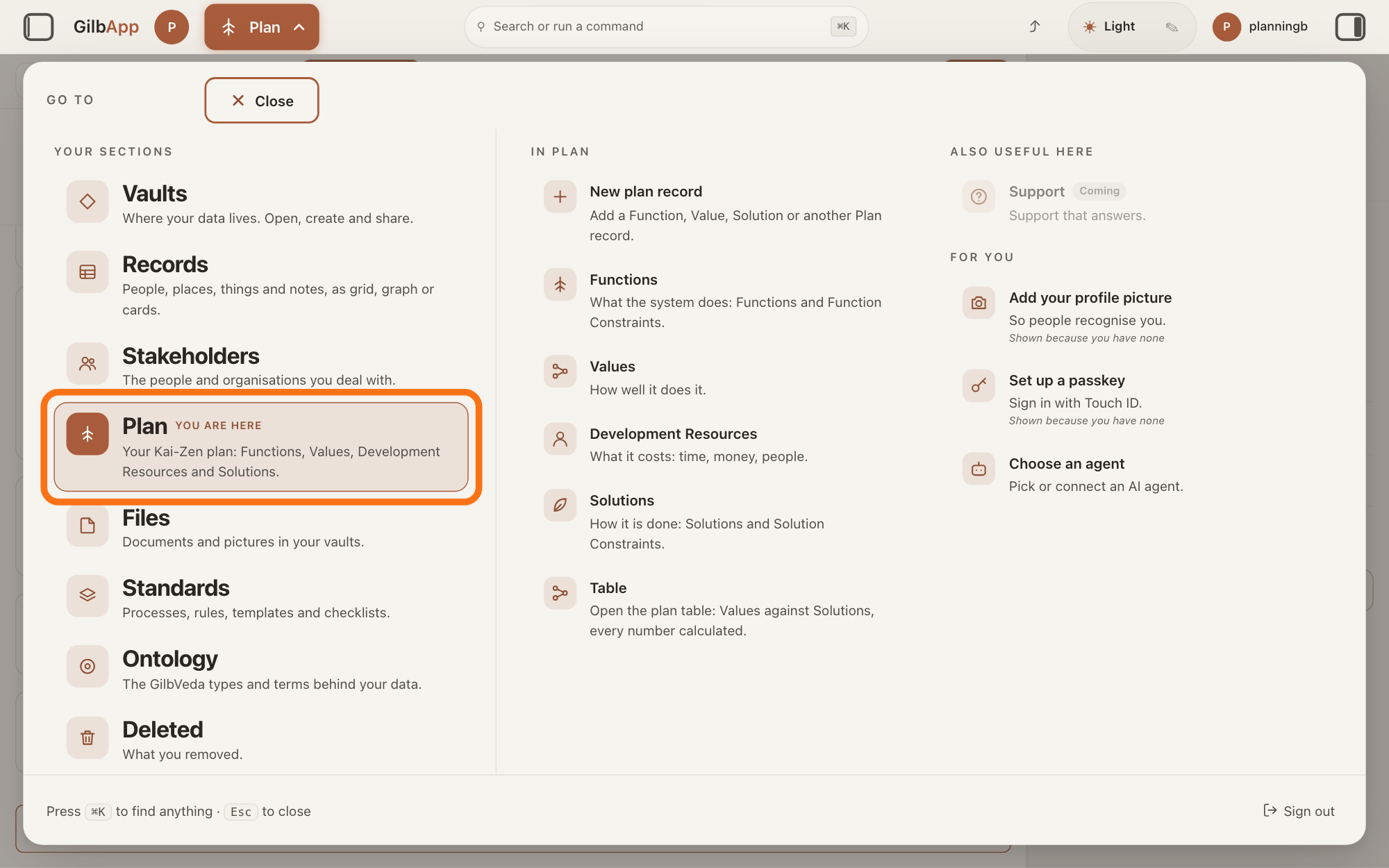
Press Main menu, next to your profile picture at the top left, and under YOUR SECTIONS choose Plan. The button shows the name of the section you are in, such as Vaults.
Show as text
In the GO TO panel that opens from "Main menu" at the top left, look under YOUR SECTIONS on the left. The outlined row is "Plan", marked "YOU ARE HERE", with the line "Your Kai-Zen plan: Functions, Values, Development Resources and Solutions." From another section, press it to open the Plan screen; here it only closes the panel.
More about this
A panel headed GO TO opens; Plan reads Your Kai-Zen plan: Functions, Values, Development Resources and Solutions. You can also press the Plan button on the card of a vault (the place where a person or a group keeps their records) in Vaults. The Plan screen lists your plan records and has the views Grid, Graph, Both and Card.
Search and select the Value in the list.
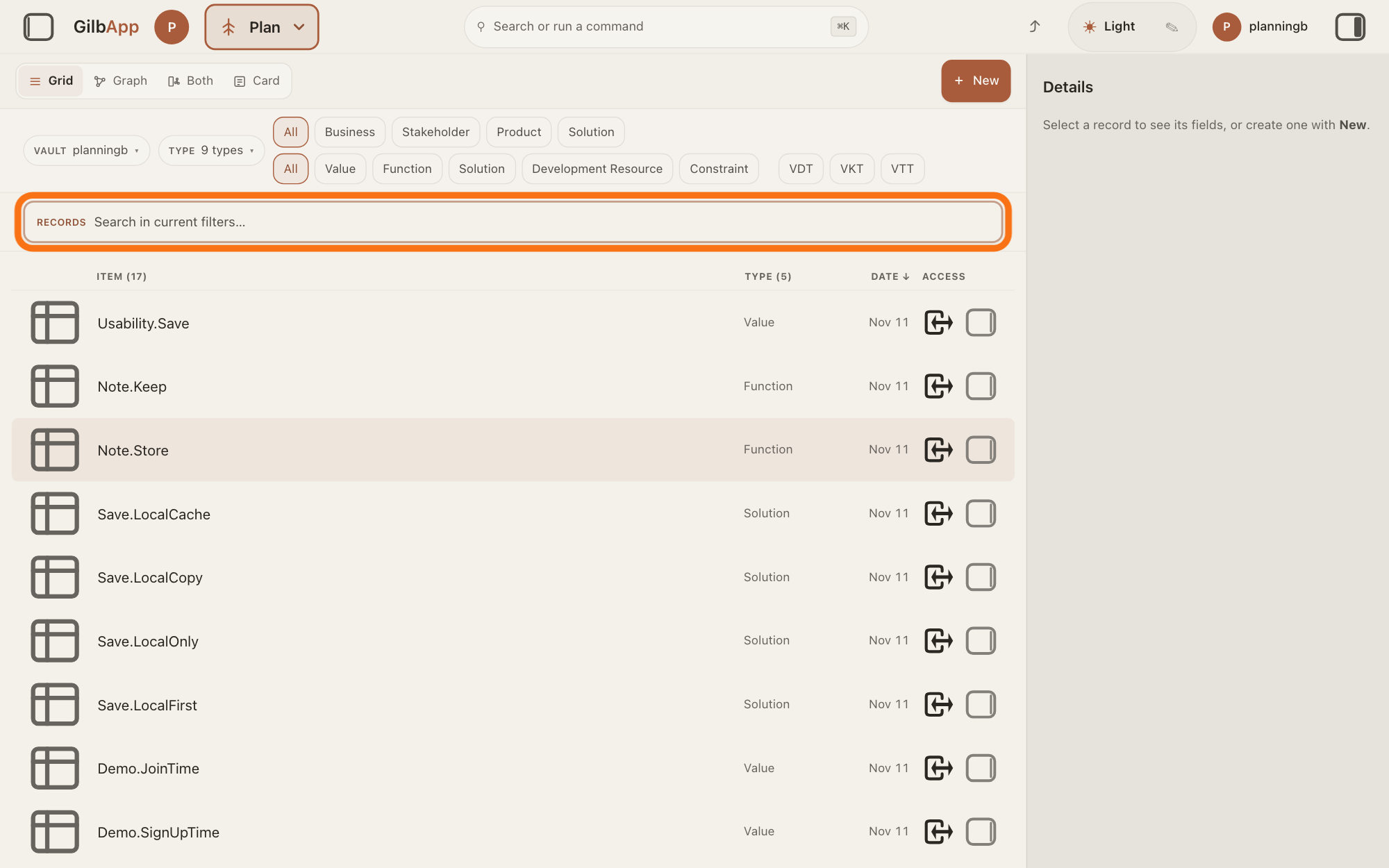
Type part of the Value's tag (its short name) in the search box and select the Value in the list. A Value is a perceived benefit, measured as a number.
Show as text
Look above the list on the Plan screen, under the type filters. The outlined box starts with "RECORDS" and reads "Search in current filters…". Click in it, type the tag of the record you want, and select it in the list.
More about this
The search box shows Search in current filters… while a filter is on, and Search your vault… otherwise. The button Value in the row of kinds shows only Values.
Press Edit.
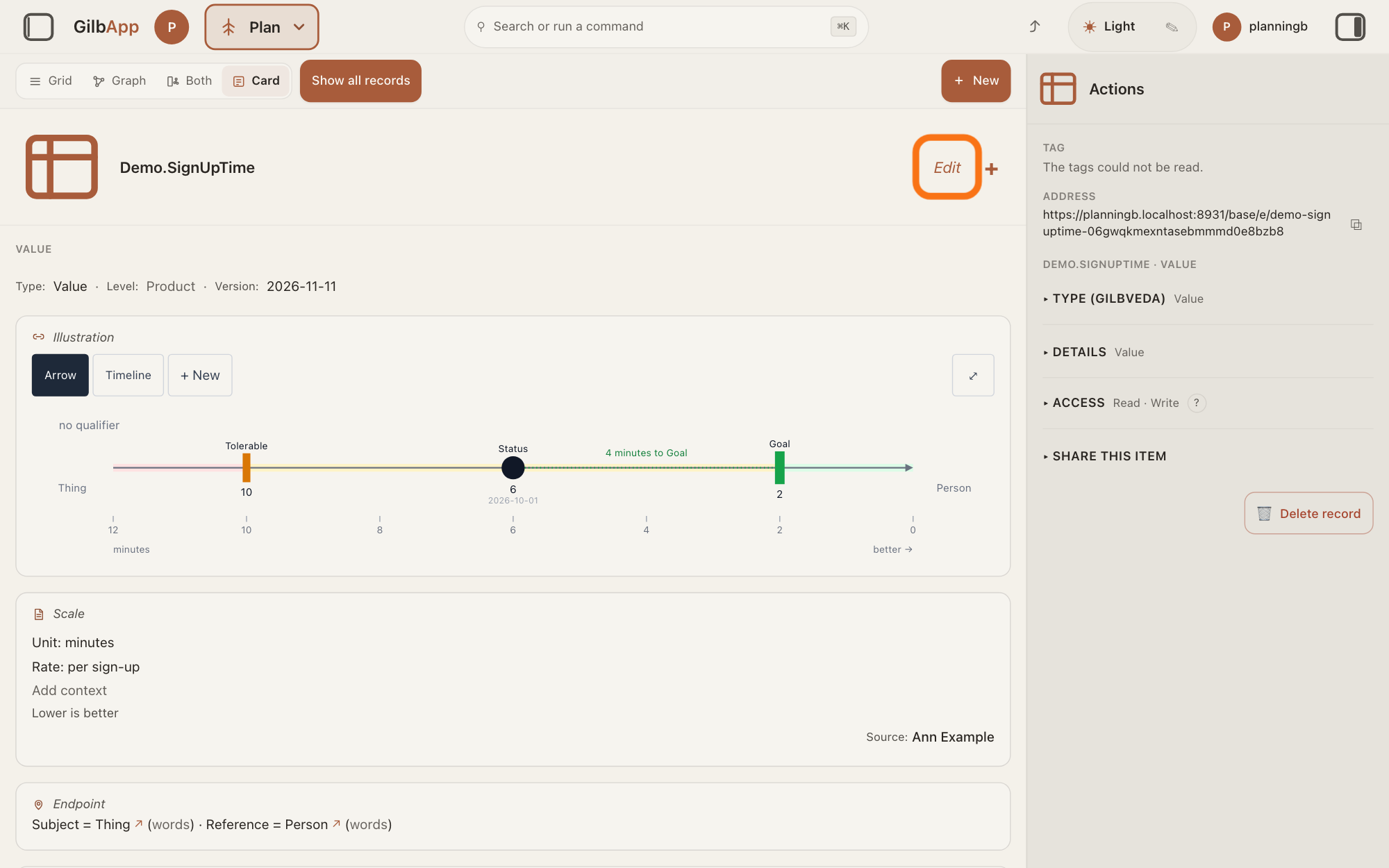
At the top right of the Value's card, press Edit. The button then reads Done.
Show as text
The Value's card fills the middle of the screen, not in edit mode; its "Illustration" shows "Tolerable", "Status" and "Goal" on an arrow. At the top right of the card, the outlined word is "Edit". Press it.
More about this
The card says Editing. Changes save as you leave a field. There is no Save button. Beside Done, a + does what + Add Information at the foot of the card does; you do not need it. The card shows Edit only to a person who may write in its vault. + Level also works without Edit: it opens a panel with the same kinds as buttons, and the new row shows Add value, which you press to type the number. Edit is clearer, because the number box is then ready at once.
Under Levels, press Status beside + Level.
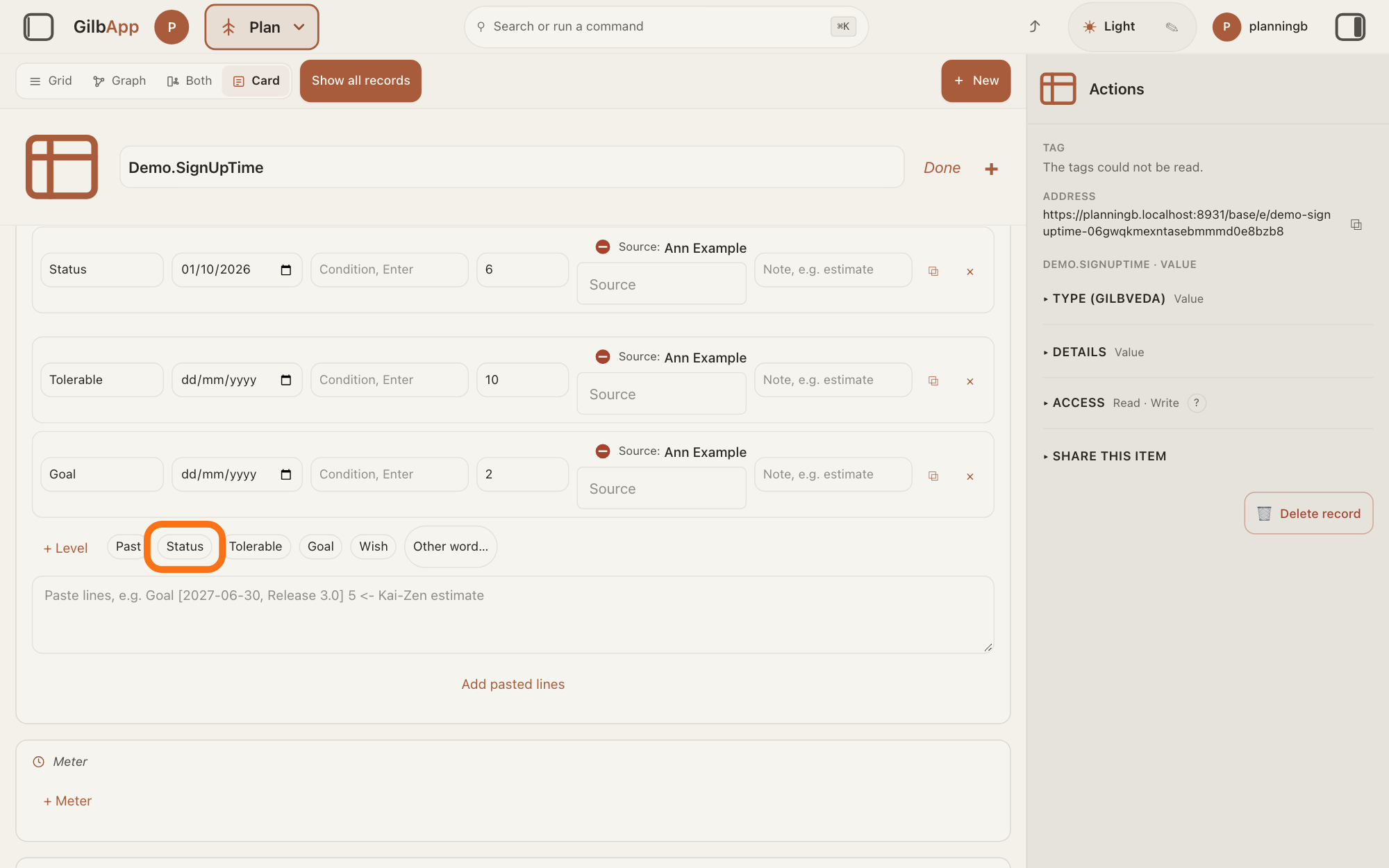
Under Levels, press the button Status beside + Level. A new Status row appears, dated today, with its number box ready to type in.
Show as text
In edit mode, scroll to "Levels". Under the "Status", "Tolerable" and "Goal" rows is a line of buttons: "+ Level", "Past", "Status", "Tolerable", "Goal", "Wish" and "Other word…". The outlined one is "Status". Press it, not "+ Level".
More about this
The buttons are Past, Status, Tolerable, Goal and Wish, then Other word…. + Level opens a menu of the same kinds, but in GilbApp today choosing from it can end edit mode, so press the button. The new row is added; the old Status stays. It copies the qualifier choices and conditions of the latest level. Other word… opens a box that shows Other word, Enter for a word of your own. Below is a box that shows Paste lines, e.g. Goal [2027-06-30, Release 3.0] 5 <- Kai-Zen estimate and the button Add pasted lines, which works only after you paste. You need none of them. Edit can also show blank rows Status, Tolerable and Goal among the filled ones. Leave them empty: a blank row has no date, so a number typed there would count as the oldest reading.
Type the new number in the new Status row and press Enter.
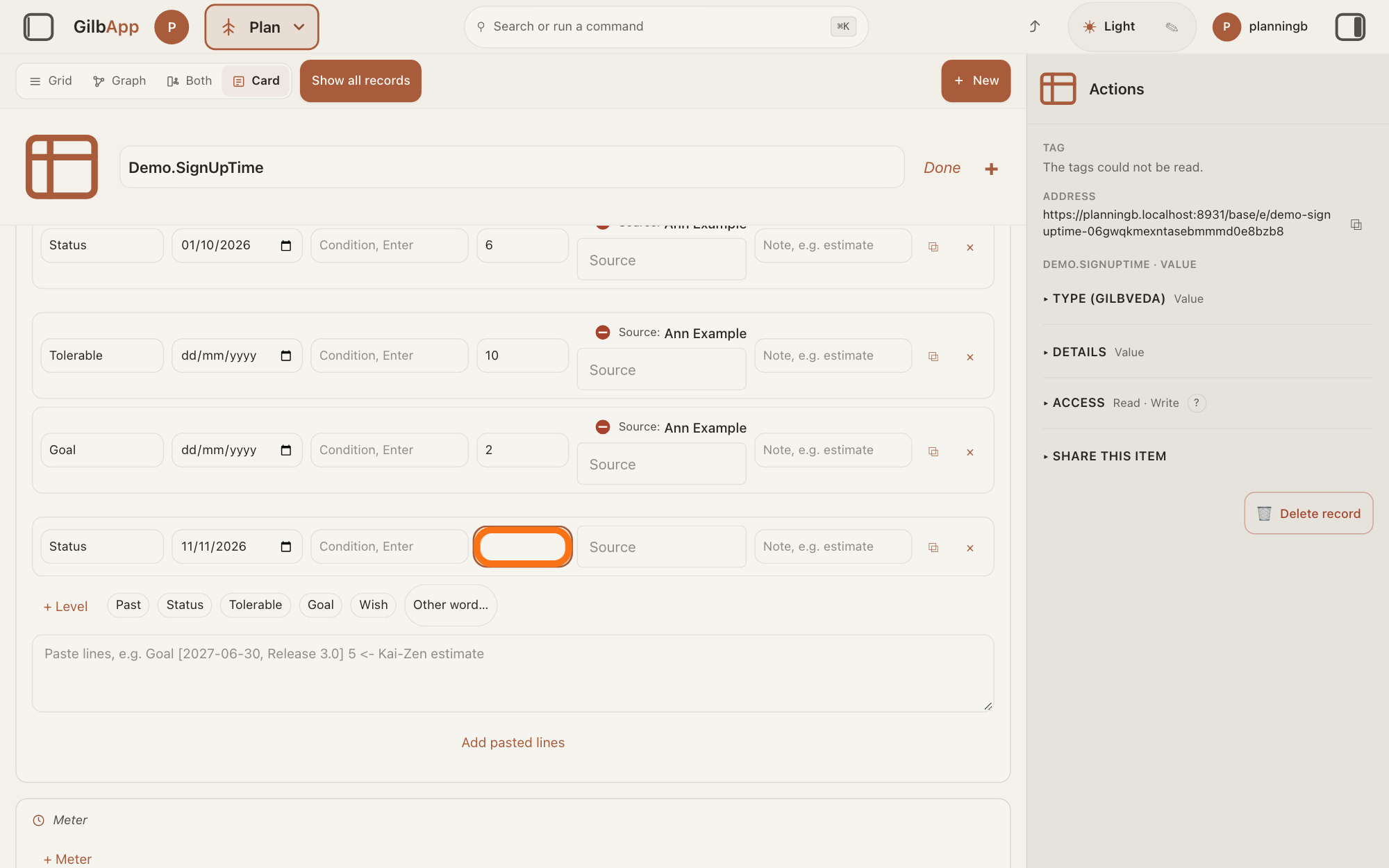
Type the new number in the box of the new Status row, the one dated today, and press Enter. The number is where the Value stands now on its Scale, the ruler it is measured on.
Show as text
A new row appears last under "Levels". Its first box reads "Status" and its date box holds today's date. The outlined box is its empty number box. Type the new number and press Enter.
More about this
Use one plain number, counted in the unit of the Scale. Clicking away saves it too; there is no Save button. If the Value has a Meter, it says how to find the number. Text such as 5-10 is kept as typed, but it is not one number, so Impacts cannot use it. Type the number before you change anything else on the row: a row saved without a number makes Impacts say newest Status has no number.
If the reading is from another day, type its date in the date box.
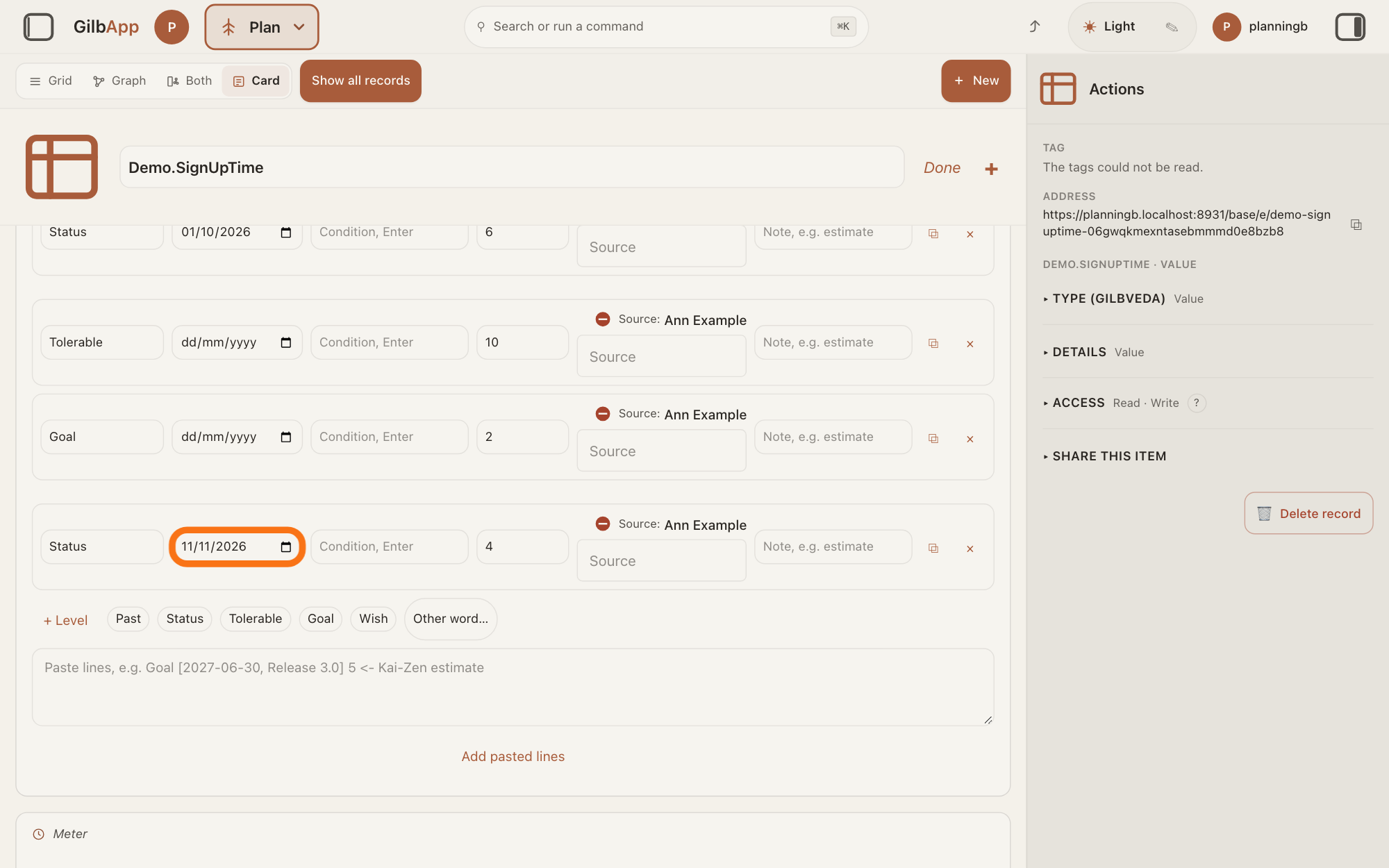
In the date box on the new row, type the day the reading was taken. It shows today's date until you change it.
Show as text
The new "Status" row now holds the number. The outlined box is its date box, showing today's date. Leave it, or type the date the reading was taken.
More about this
The Status with the newest date is the current one. A Status with no date counts as the oldest. If you date the new reading before the old one, the old one stays current. Two on the same date are a tie that the app settles in its own order, so give each reading its own day.
If you need it, type a note or a condition on the row.
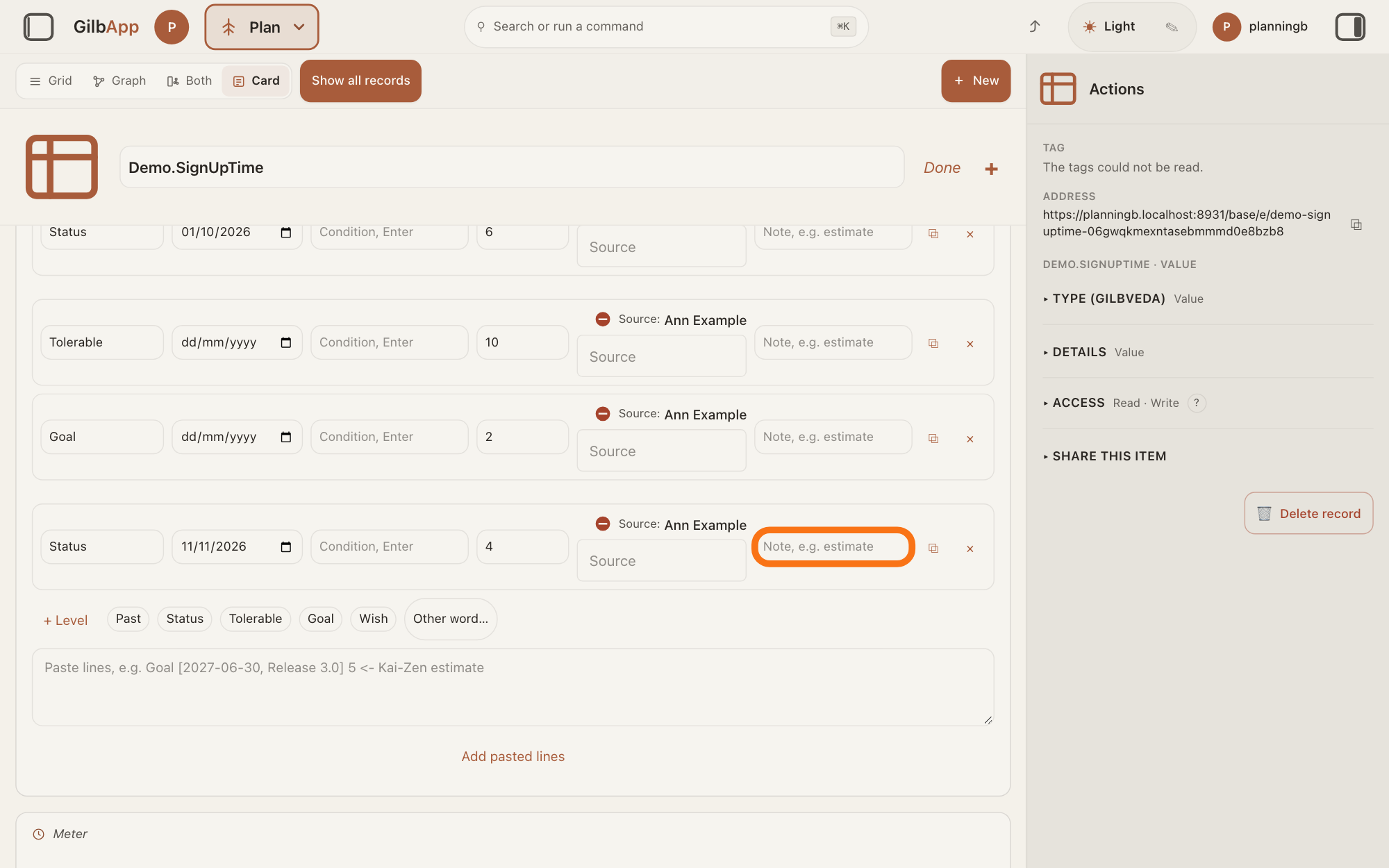
In the box that shows Note, e.g. estimate, type a short note. In the box that shows Condition, Enter, type a condition and press Enter.
Show as text
On the same new row, at the right after "Source", the outlined box reads "Note, e.g. estimate". Type a note there if you need one; the "Condition, Enter" box after the date is for a condition.
More about this
A condition says when or where the number holds, such as Release 3.0. A Source box says who said the number; it is optional. For a Scale with qualifiers, the row also shows a box for each, to say which case the number is for. One side shows only when Better is Target range. ⧉ copies the row's qualifiers to a new level and × removes the row; you need neither. None is needed to save.
If you like, type Past in the first box of the older Status row.
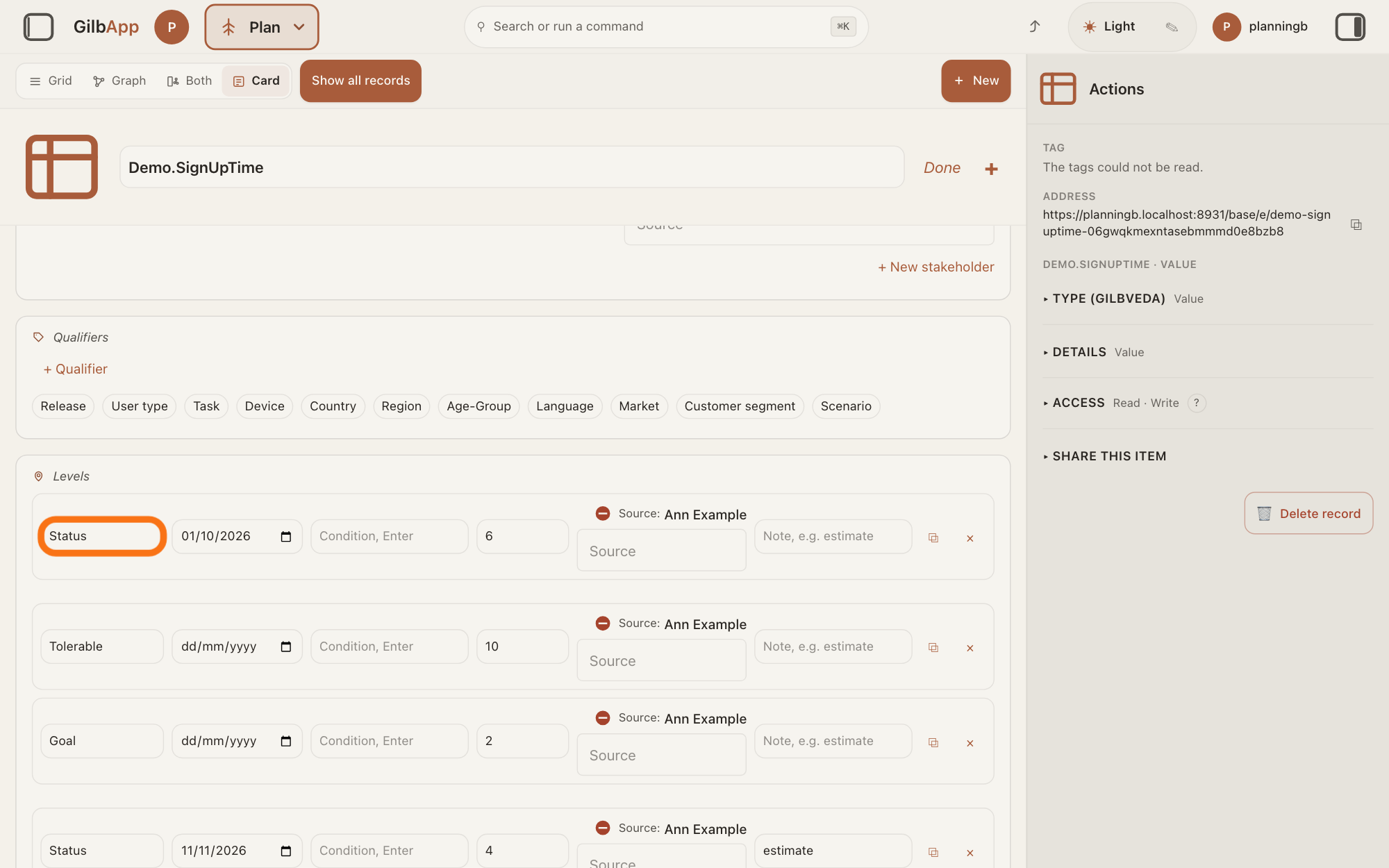
In the first box of the older Status row, type Past and click away. The older reading is then kept as history.
Show as text
Scroll up to the first row under "Levels": the older "Status" row, with the earlier date and the old number. The outlined box is its first box, which reads "Status". Type "Past" in it if you want to keep that reading as history.
More about this
You do not need this: the newest Status is already the current one, whatever the older row is called. The Kai-Zen method turns the old Status into a Past line when a new one is written; the card does not do it for you. The date and number of the older row stay as they were.
Press Done when you have finished.
Press Done at the top right of the card. What you typed is already saved.
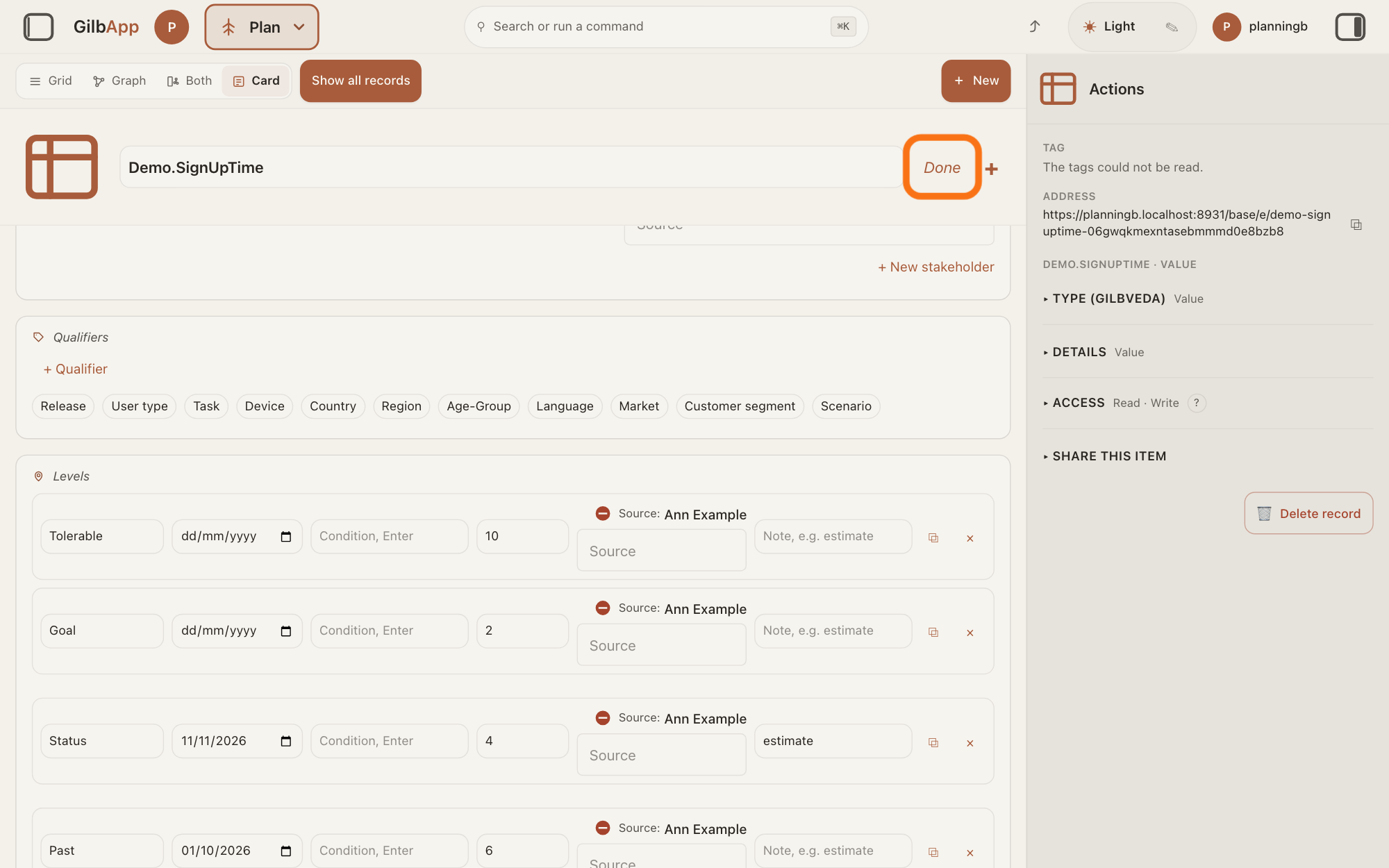
Show as text
The older row now reads "Past" and the new reading is the "Status". At the top right of the card, beside the box with the tag, the outlined word is "Done". Press it when you have finished.
More about this
The Levels now list the old and the new reading. In the Impacts line of this Value, and of any Solution that changes it, the % is worked again from the new Status, if the Value also has a Tolerable and a Goal. An impact made earlier keeps its own numbers, such as 6 → 2. When the new Status differs from the one it was written from, it also gains a line starting Worked from today's Status, then this change was written when it was the one it was written from. With no usable Status, Tolerable or Goal, the line says No % yet: and needs one Status, one Tolerable and one Goal.
Deeper
Also asked:
What does Status on a Value mean? It is where the Value stands now: one number on its Scale, the ruler the Value is measured on. Each new reading is added as a new Status, and the one with the newest date is the current one.
What is a Condition? It says when or where the number on a row holds, such as Release 3.0. Type it in the box that shows Condition, Enter and press Enter; a row can have more than one.
What is a Note? A short remark about the number on a row, such as that it is an estimate. Type it in the box that shows Note, e.g. estimate. It is optional.
Only the number is needed for a new reading. Every other box on the row is optional.
A new Status is added; it does not replace the old one. The one with the newest date is the current one. To correct a wrong number instead, type over it in its own row: that replaces the number on the card, and the card shows no earlier number.
A Status is one number on the Scale. The box keeps any text you type, such as 5-10, but only one plain number can be used. If the newest Status is not one number, an older one is not used in its place: a new impact gets no box and the card says Set it to one number first., and an impact already made shows No % yet:.
This answer is written for a computer screen.
Checked against GilbApp d529620.