
How do I write a new standard?
Short answer
Press Main menu, choose Standards, press its kind's tab and + New Process, type a title, press Save process, then add its steps.
Before you start
You need to be signed in to GilbApp on a computer, with a vault you can write to, such as your own vault. The pictures show a made-up person on a test site; your screen shows your own name and address.
Words used here (7)
- GilbApp
- GilbApp is the app, opened in a web browser at https://gilb.com/app, where you open, fill and share your vaults.
- record
- A record is one piece of data with its own address, such as a person, a place, a thing or a note.
- entry condition
- An entry condition is something that must be true before a process may start; a process starts only when its entry conditions hold.
- exit condition
- An exit condition is what must be true before a process may finish; when it is true, the process hands back.
- agent
- An agent is your AI following one written procedure, its standing instructions, for one kind of work.
- Procedure
- A Procedure is the kind of standard that holds an agent: who you call, and the steps that agent runs, in order.
- GilbPlatform
- GilbPlatform is the service that keeps people's and organisations' data in vaults, each at its own web address.
Steps
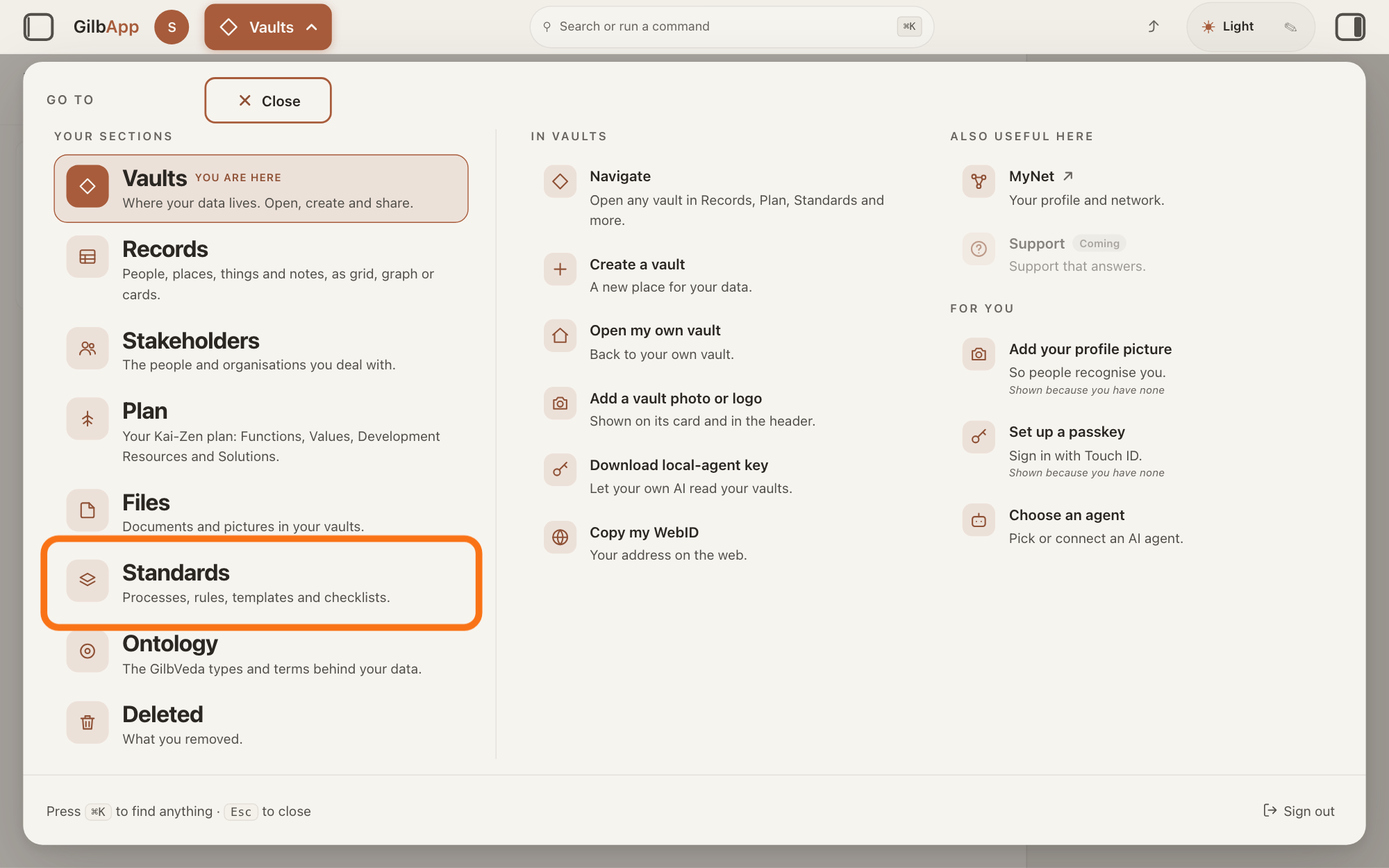
Press Main menu at the top left and choose Standards.
Press Main menu, next to your profile picture at the top left, and under YOUR SECTIONS choose Standards. The button shows the name of the section you are in, such as Vaults.
Show as text
The panel headed "GO TO" covers the screen. In the left column under "YOUR SECTIONS", the row "Standards" with the line "Processes, rules, templates and checklists." is outlined. Press it to open the Standards screen.
More about this
A panel headed GO TO opens; Standards reads Processes, rules, templates and checklists. Standards opens on the vault you picked in Vaults, or on your own vault if you picked none; a vault is the place where a person or a group keeps their records. It opens on the tab Processes, with Process chosen in the row under the tabs. A process is a standard that holds work: entry conditions, steps in order, and exit conditions; a standard is a written procedure, rule set, form or other guide that people and agents follow as they work. On the right, VAULT changes the vault, STANDARDS GROUP shows only the standards of one group, and + New group, shown only where you may write in the vault, makes a group; you need none of them here.
Press the tab for the kind you write.
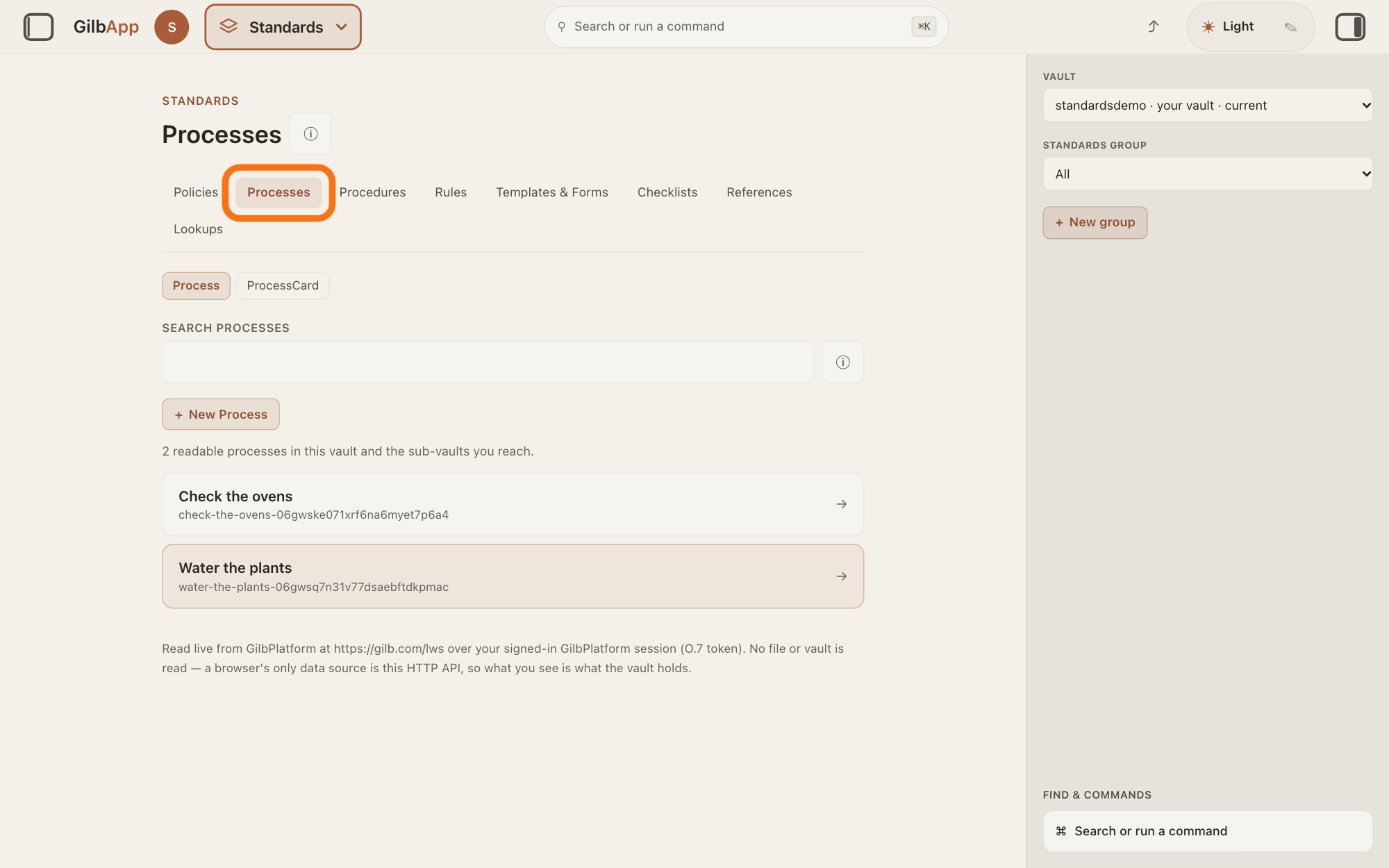
In the row of tabs, press the tab for the kind of standard you write, such as Processes for a process. The answer on what a standard is says which kind fits which job.
Show as text
Near the top of the middle, in the row of tabs from "Policies" to "Lookups", the tab "Processes" is outlined. Press the tab for the kind of standard you want to write. Below it is the list of processes you can read.
More about this
Each kind has its tab and its button in the next step: a process, Processes and + New Process; a process card, Processes, then ProcessCard under the tabs and + New Process Card; a procedure, Procedures and + New procedure; a rule document, Rules and + New rule document; a policy, Policies and + New policy; a template, Templates & Forms and + New template; a checklist, Checklists and + New checklist; a reference document, References and + New reference document; a lookup table, Lookups and + New lookup table.
Press + New Process.
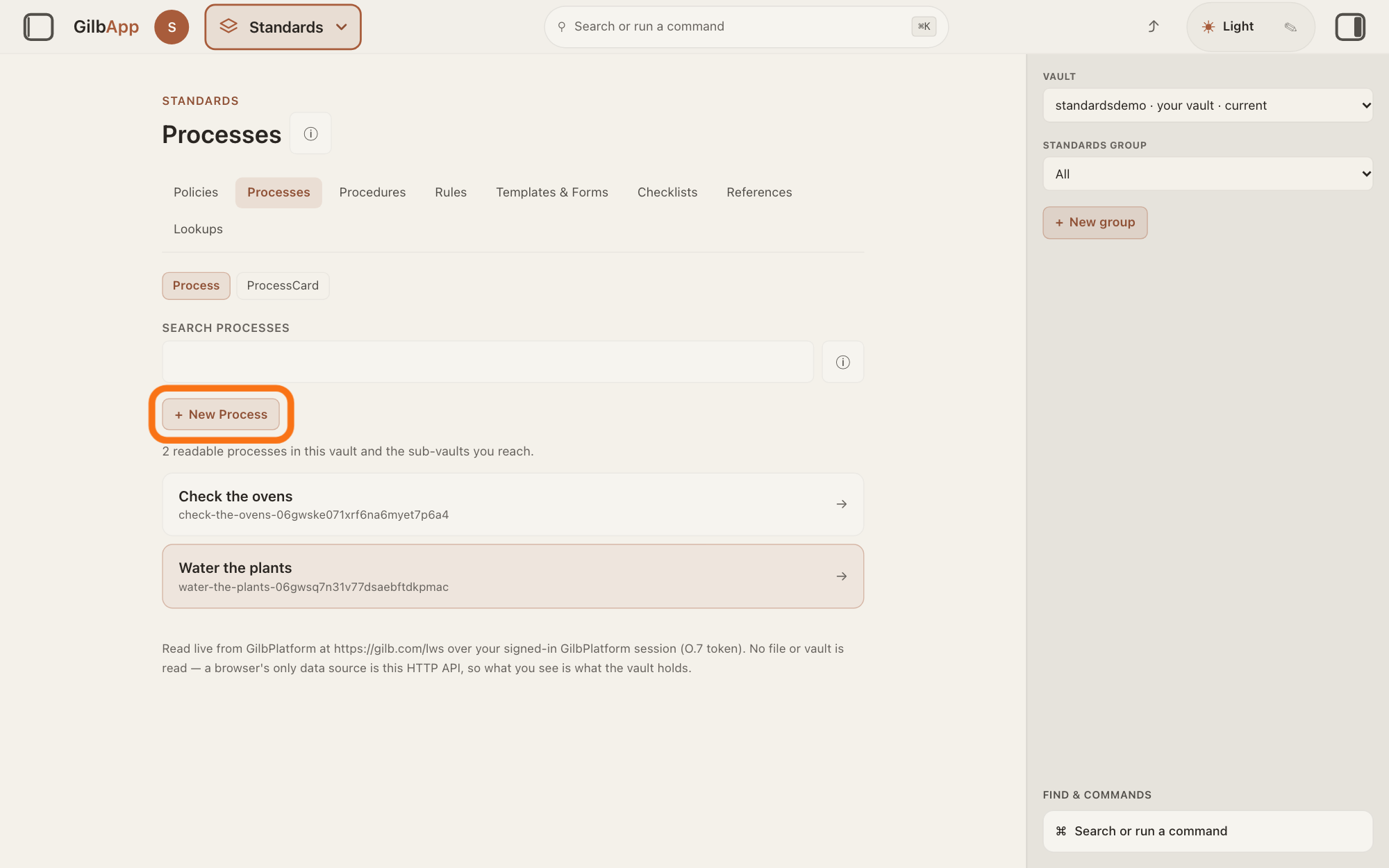
Press + New Process above the list. A form opens with the box TITLE; the grey text in it, Proc_ValueDeliveryCycle, is only an example.
Show as text
Under "SEARCH PROCESSES" and its empty box, the button "+ New Process" is outlined. Press it to open a small form for the new process. The made-up processes already in the vault are listed below it.
More about this
The button shows only while the search box is empty. Cancel closes the form and makes nothing. Most other kinds' forms also have STEWARD’S NOTE (optional), a note for the other people who look after your standards, which does not decide what the standard applies to; procedures and policies add AUTHORITY (optional), the person or body that set it, and process cards BODY, free text.
Type its name in TITLE and press Save process.
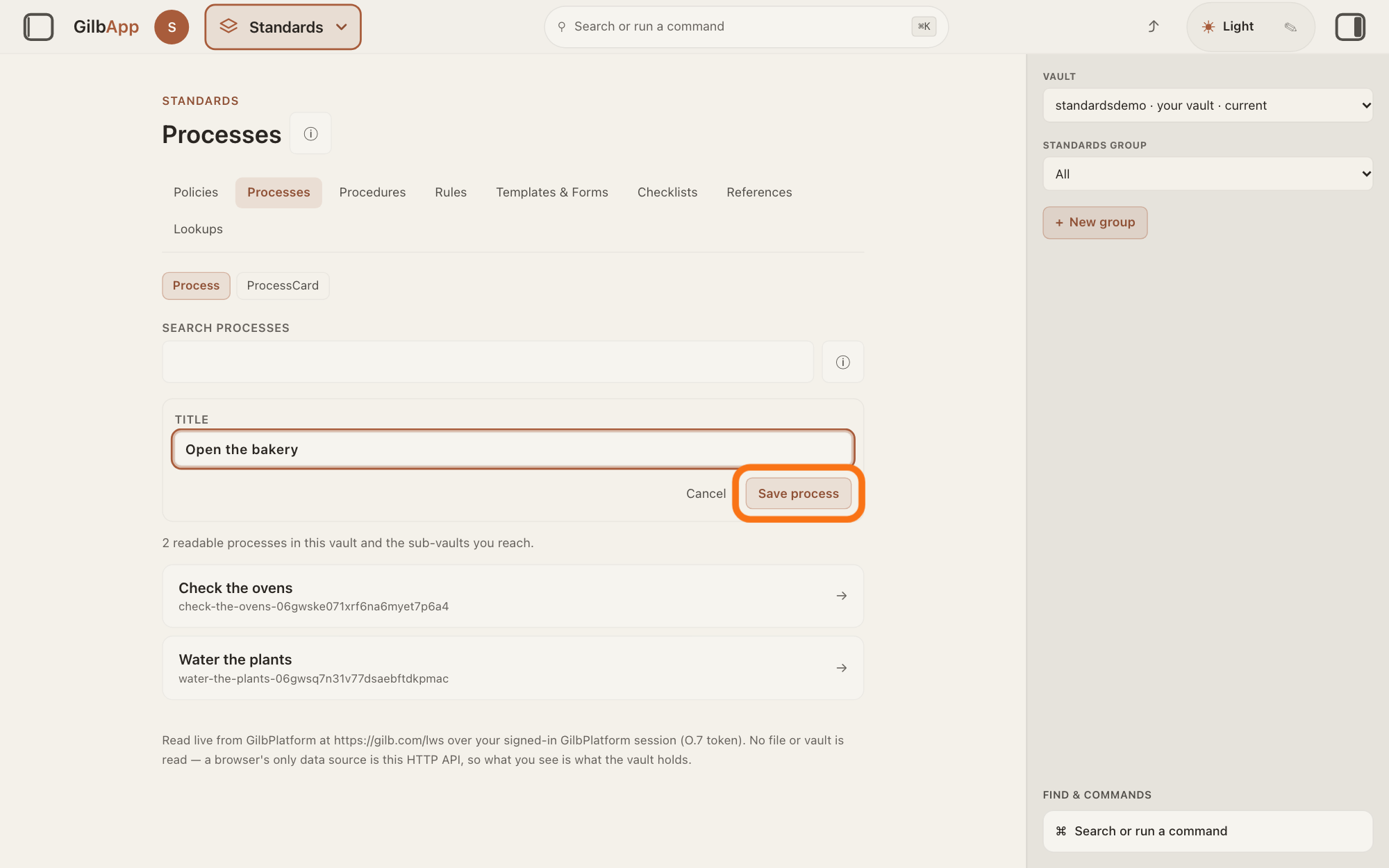
Type the standard's name in TITLE, such as Open the bakery, and press Save process. The new process opens, with Entry conditions, Steps and Exit conditions, and says it holds no steps yet.
Show as text
In the middle, a form headed "TITLE" holds the typed name Open the bakery. To the right under the box are "Cancel" and the outlined button "Save process". Press "Save process" to make the process.
More about this
The button reads Saving… while it works; on other kinds it reads, for example, Create rule document or Save checklist. Only someone who may write in the vault can make a standard there; for anyone else GilbPlatform refuses it, and the form shows why under its buttons. If a group is chosen under STANDARDS GROUP, a new procedure joins it, but in GilbApp today a standard of any other kind joins no group, so it shows only under All. Add tag gives it its tag, its short fixed name such as Bakery.Open; Rename process changes its name later.
Type a step in What the follower does at this step and press Add step.
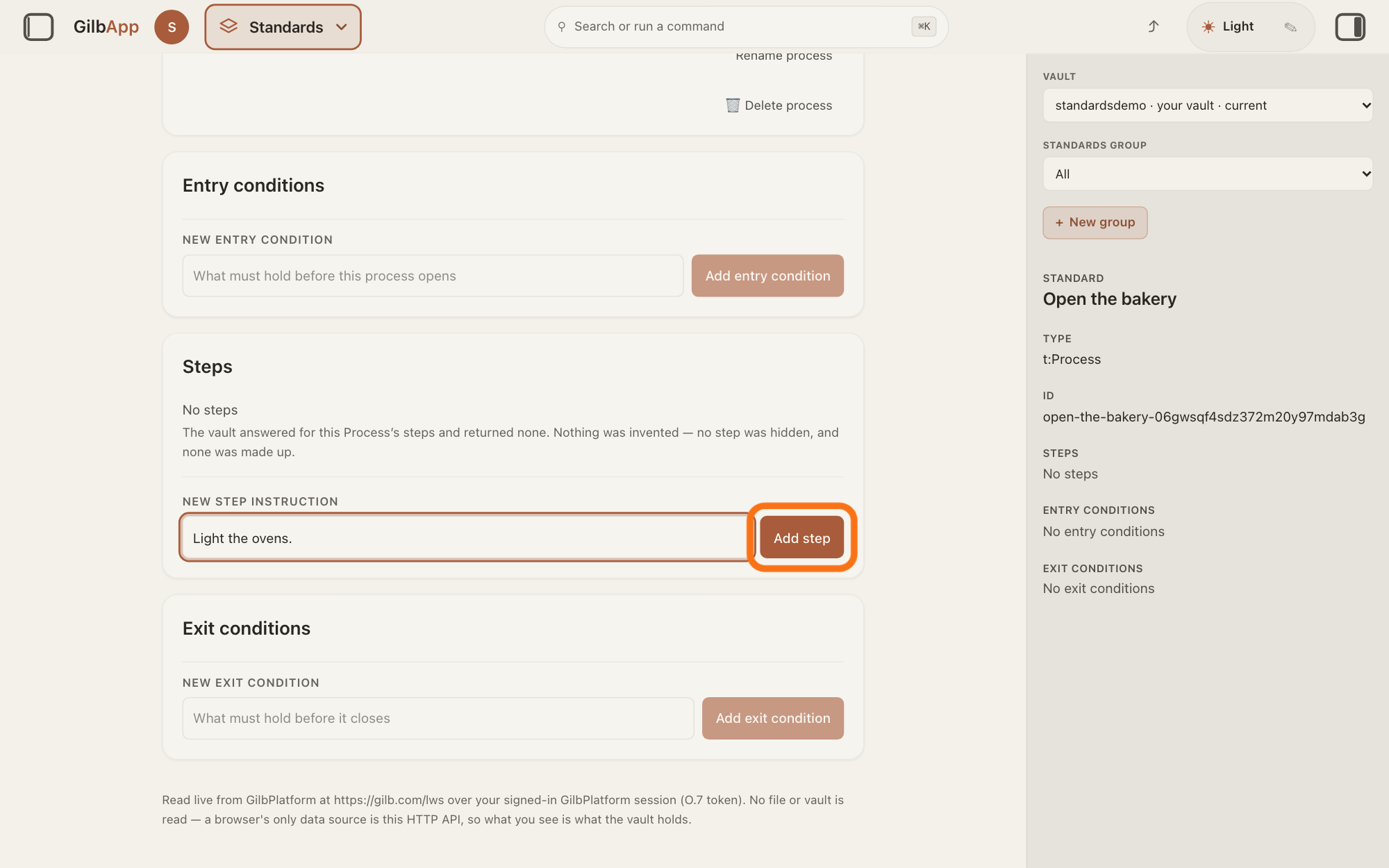
Under NEW STEP INSTRUCTION, type the first thing to do in the box that shows What the follower does at this step, such as Light the ovens., and press Add step. Add each further step the same way, in order.
Show as text
The new process is open. In the card "Steps" it says "No steps". Under "NEW STEP INSTRUCTION" the box holds Light the ovens., and the outlined button "Add step" is to its right. Press "Add step".
More about this
The answer on adding, editing, reordering or deleting a unit tells more; other kinds have their own box, such as NEW RULE and Add Rule on a rule document. Keep the standard short: a good example and a clear template do most of the work. Write a job in one place only: if another standard already holds it, hand off to that standard instead of copying its steps; the answers on finding a standard and on linking standards with hand-offs show how. A process also needs entry and exit conditions; the answer on writing them shows how.
Deeper
In the Kai-Zen method a standard is built backwards: first a good finished example, then the template made from it, then the rules, then the process, then the agent. The person decides, an agent drafts the exact text, the person says go, and the agent writes it and reads it back. An agent changes a standard only with the go of a person who may write in the vault the standard is kept in.
A standard you write in your own vault carries no copyright notice; the notice belongs to the standards Kai Gilb publishes on GilbPlatform.
GilbApp shows + New and the boxes for adding to a standard to everyone who can open the vault's standards; GilbPlatform takes the change only from someone who may write in that vault.
If the right pane is hidden, press the square button at the far right of the top bar. This answer is written for a computer screen. In a window narrower than 840 pixels, such as a phone, the side panes are hidden and the right pane is Detail in the bar at the bottom.
Source: GilbApp af0f04ee (https://gilb.com/app/version.json read 2026-11-10), code read: step 1; step 2 standardsTabs.ts:9-24; components/process/ProcessCreateForm.tsx:53-59 (+ New Process), StandardKindCreateForm.tsx:21-24, :73-74 (+ New Process Card), ProceduresTab.tsx:339, RulesTab.tsx:325, PoliciesTab.tsx:318, TemplatesTab.tsx:208, ChecklistsTab.tsx:210, ReferenceTab.tsx:152, LookupTab.tsx:145 (the other + New … buttons); step 3 ProcessCreateForm.tsx:63-95 (Title drawn uppercase, placeholder Proc_ValueDeliveryCycle, Cancel, Save process/Saving…, error under the buttons), StandardsSection.tsx:530-534, :582-584 (form shown when not searching), StandardKindCreateForm.tsx:82-108 (Steward’s note (optional), Body), ProceduresTab.tsx:361-388 and PoliciesTab.tsx:340-367 (Authority (optional)), RulesTab.tsx:365-367 ("Free text for other stewards, saved with the document. What you type here does not decide what this document governs."); step 4 ProcessCreateForm.tsx:39-47 (onCreated opens it; no group written), StandardsSection.tsx:2029-2213 (cards; No steps + empty sentence, ProcessViewer.tsx:2113-2121), RulesTab.tsx:382 (Create rule document), ChecklistsTab.tsx:244 (Save checklist), ProceduresTab.tsx:309-322 (only procedures pass partOf of the chosen group), standardsGroupScope.ts:25-27 and StandardsSection.tsx:459-462 (lists keep members only), DocumentTag.tsx:205 (Edit tag/Add tag), StandardsDocumentActions.tsx:280-284 (Rename process); step 5 ProcessViewer.tsx:168-206 (New step instruction uppercase, Add step, placeholder; New Rule, Add Rule), :1652-1723. GilbPlatform 4d008a55: src/lws/routes.ts:815-853 (create needs a whole-vault write grant: 403 otherwise). Standards (2026-11-10, 200): GilbPlatform.StandardRules.Owner, .Short, .OnePlace, .EntryExit, .Backwards, .WorkMode ("The person decides. The agent drafts the exact text. The person says go. The agent writes, reads back and reports."), .Notice (A standard a subscriber writes in their own vault does not carry them.); GilbPlatform.ChangeStandard.Go.
Checked against GilbApp d529620.