
← Back to How do I challenge a Solution?
How do I choose between options with a VKT?
Short answer
Press + New in Plan, choose Value Kick-out Table, type a tag, press Create, + Add Ends & Means, search and select Values and options.
Before you start
You need to be signed in to GilbApp on a computer, with a vault you can write to, such as your own vault. The options must exist as Solutions, and the Values they touch with Status, Tolerable and Goal numbers. For the ratios, you also need a Development Resource with Status and Budget. The pictures show a made-up person on a test site; your screen shows your own name and address.
Words used here (9)
- Value Kick-out Table
- A Value Kick-out Table (VKT) is a table that picks one of several options by how much Value each gives for its cost.
- GilbApp
- GilbApp is the app, opened in a web browser at https://gilb.com/app, where you open, fill and share your vaults.
- Budget
- A Budget is the most of a Development Resource you plan to use, such as the money for one month.
- Kai-Zen
- Kai-Zen is the planning agent: it finds out what you want, chooses the way, hands the work to other agents and reports back.
- record
- A record is one piece of data with its own address, such as a person, a place, a thing or a note.
- virtual folder
- A virtual folder is a view that groups records and files without moving them; each may sit in several folders.
- Value Decision Table
- A Value Decision Table (VDT) is a table that ranks options by how much they move the level's Values for their cost.
- short name
- A short name is the one word you give one AI on one computer, such as gilb-example; it keeps that AI's key and tools apart.
- Experience Level
- An Experience Level is a whole number from 0 to 10, chosen under an impact, that says how much experience stands behind its number.
Steps
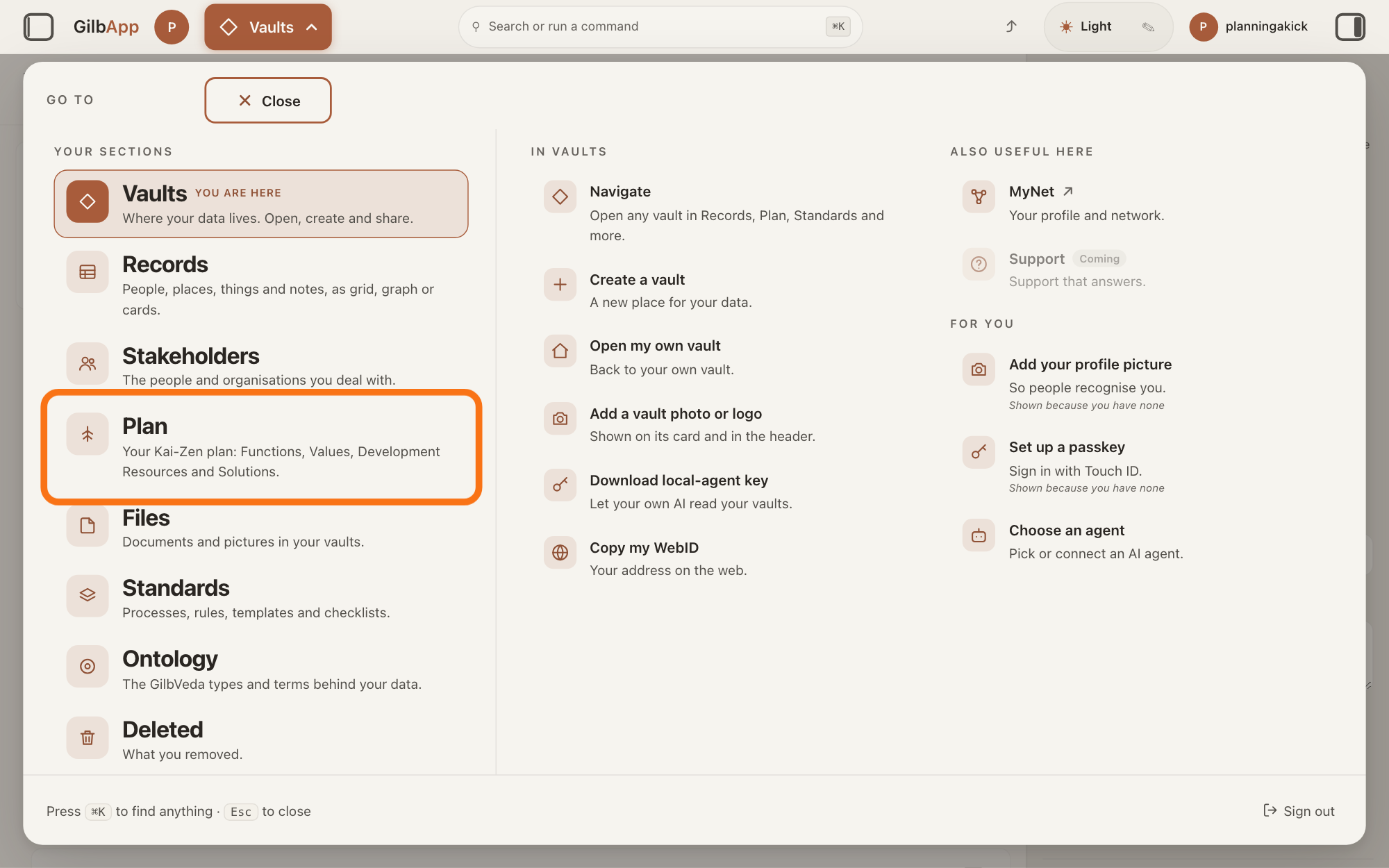
Press Main menu at the top left and choose Plan.
Press Main menu, next to your profile picture at the top left, and under YOUR SECTIONS choose Plan. The button shows the name of the section you are in, such as Vaults.
Show as text
The "GO TO" panel is open over the screen. Look in the left column under "YOUR SECTIONS": the outlined row is "Plan", with the line "Your Kai-Zen plan: Functions, Values, Development Resources and Solutions." Press it to open the Plan screen.
More about this
A panel headed GO TO opens; Plan reads Your Kai-Zen plan: Functions, Values, Development Resources and Solutions. You can also press the Plan button on the card of a vault (the place where a person or a group keeps their records) in Vaults. The Plan screen lists your plan records and has the views Grid, Graph, Both and Card.
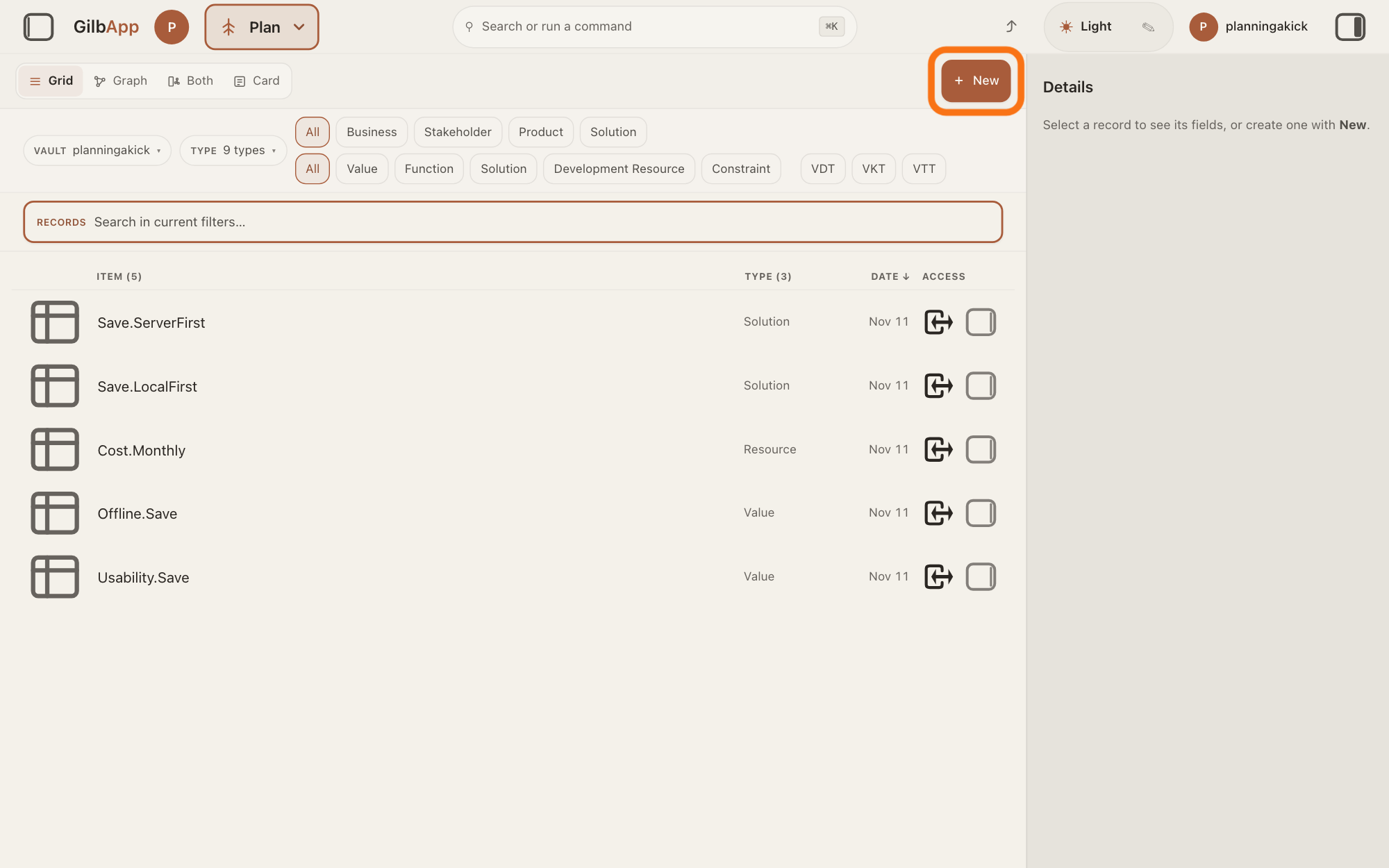
Press + New.
Press + New at the top right of the Plan screen. With no record selected, the type dialog opens at once.
Show as text
The "Plan" screen lists your Values, the Development Resource and the Solutions, with none selected; "VAULT" names your vault. Press the outlined "+ New" button at the top right.
More about this
If a record is selected, New first offers five choices: Create a record and link it to the selected record, Link the selected record to a record that already exists, Create a record on its own, Create a virtual folder and Upload a file. Choose Create a record on its own. A new Value Kick-out Table needs nothing else; the others make a record joined to the selected one, link two records that already exist, make a virtual folder or upload a file. In Plan, the GO TO panel also has New plan record, which does the same.
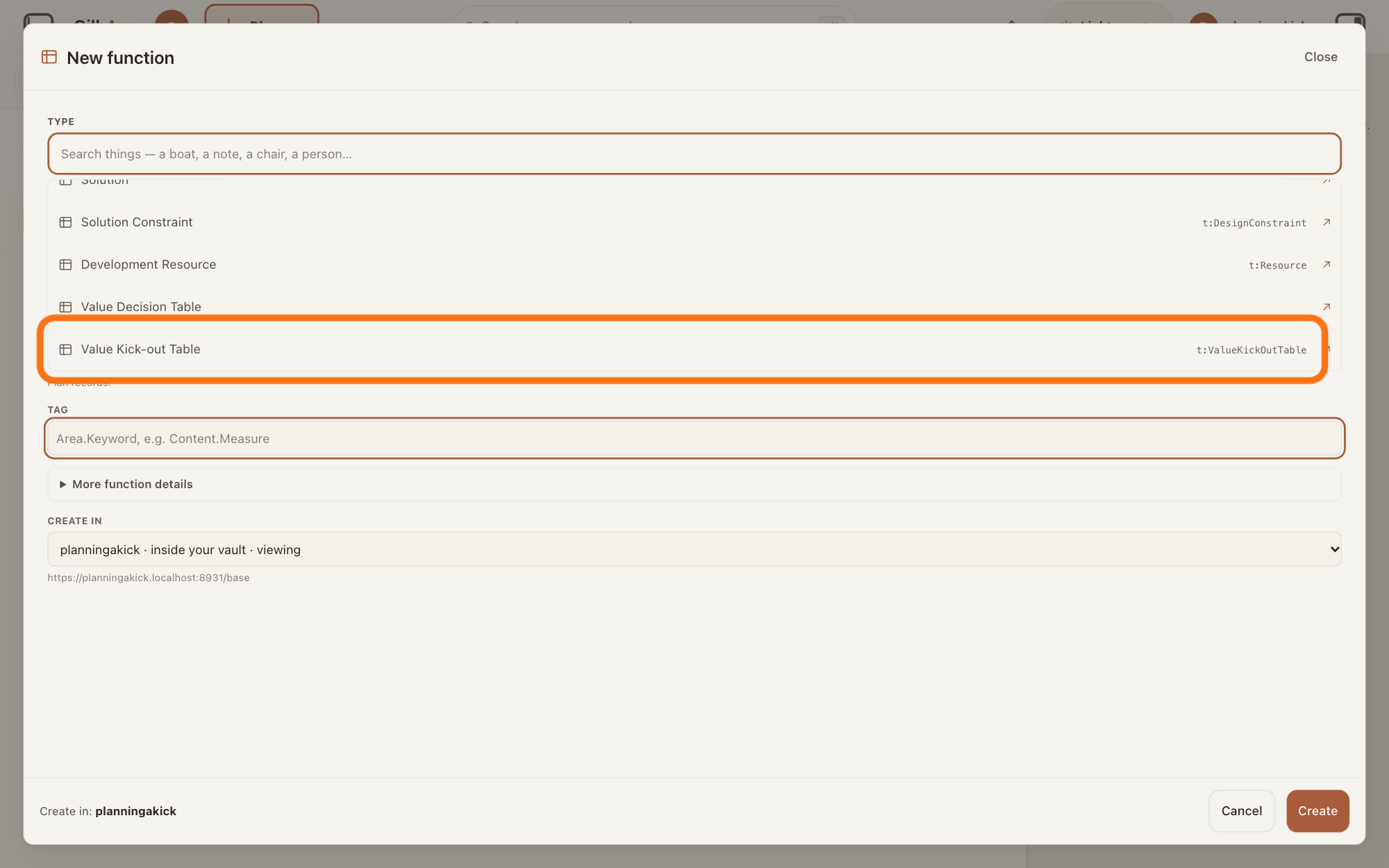
Under TYPE, choose Value Kick-out Table.
In the list under TYPE, choose Value Kick-out Table, near the end. A Value Kick-out Table (VKT) is a table that picks one of several options.
Show as text
A window headed "New function" is open. Under "TYPE" the list shows the plan types; it is scrolled so "Value Kick-out Table" shows. Press the outlined option "Value Kick-out Table".
More about this
The dialog opens headed New function with Function chosen; after you choose Value Kick-out Table it is headed New value kick-out table. The chosen type then shows under TYPE with a DEFINITION read from GilbVeda, the shared list of terms; it can be long, and you need not read it. × beside the type brings the list back. Value Decision Table, just above, ranks a set of options to use together; the answer on comparing Solutions in a VDT covers it. A search box above the TYPE list narrows it as you type, and Close at the top of the dialog closes it like Cancel; you need neither. ↗ at the end of a row shows what GilbVeda says about that type; you do not need it. Cancel closes the dialog without making anything. Where it shows Back instead, Back returns you to the five choices.
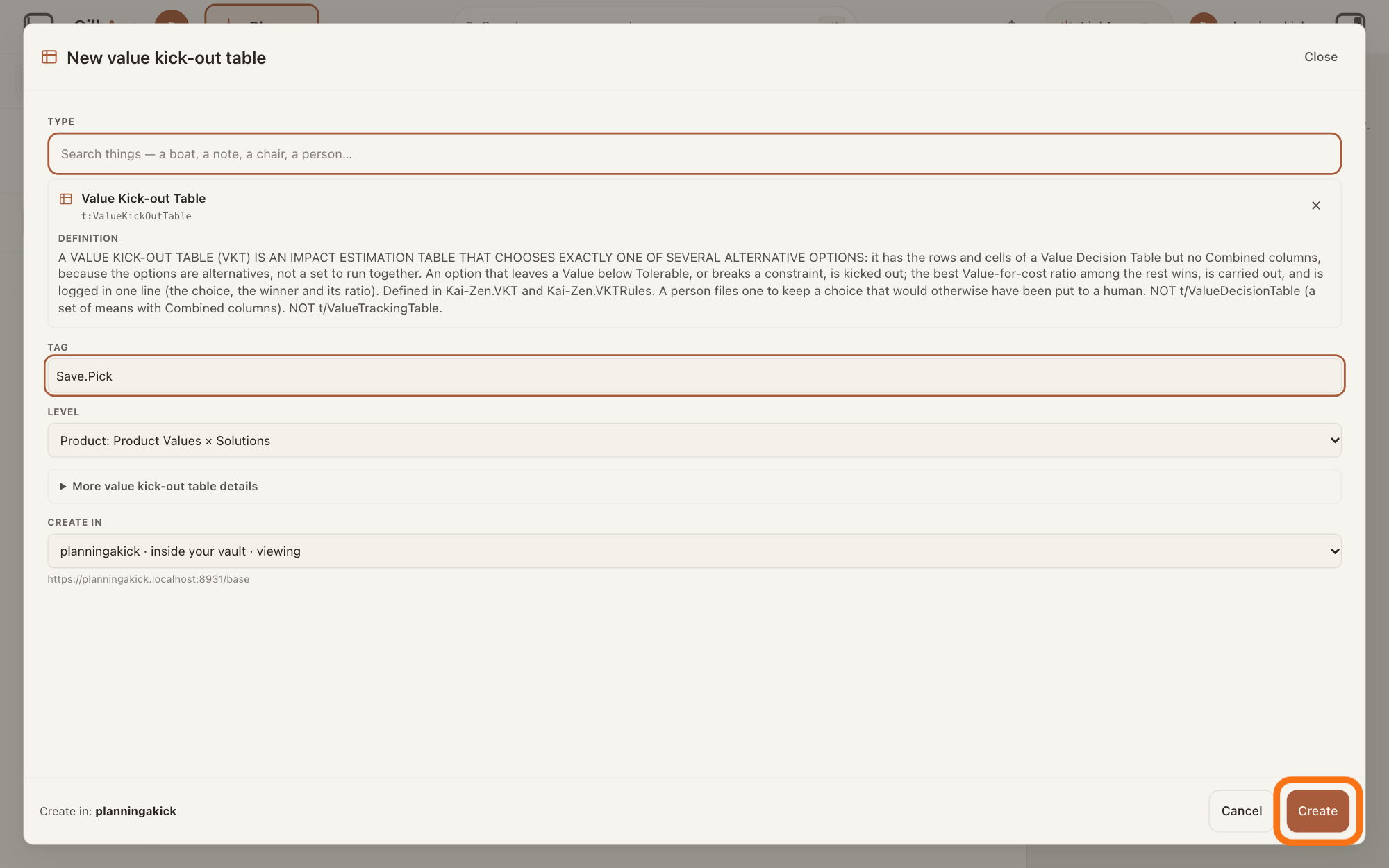
Type a tag in TAG and press Create.
Type a tag in TAG, keep Product: Product Values × Solutions under LEVEL, check CREATE IN, and press Create. A tag is the short name of a plan record: an area, a dot and a keyword, such as Save.Pick.
Show as text
The window is now headed "New value kick-out table". "TAG" holds a made-up tag, and "LEVEL" shows "Product: Product Values × Solutions". Press the outlined "Create" button at the bottom right.
More about this
LEVEL opens on Product: Product Values down, options across; it cannot be changed after Create. The box shows Area.Keyword, e.g. Product.KickOut until you type. With the tag empty the screen says Give it a Tag first: a Plan card is named by its Tag. Under CREATE IN, choose the vault where it will live; vaults you can only read say read only, you cannot create there. If the tag is already used in that vault, the screen says is already used in this vault. Pick another. If the vault is not the one you are viewing, the dialog stays open and says the record was made there, not in the vault you are viewing. It is not drawn here., with an Open it button. More value kick-out table details holds an optional Title and Description.
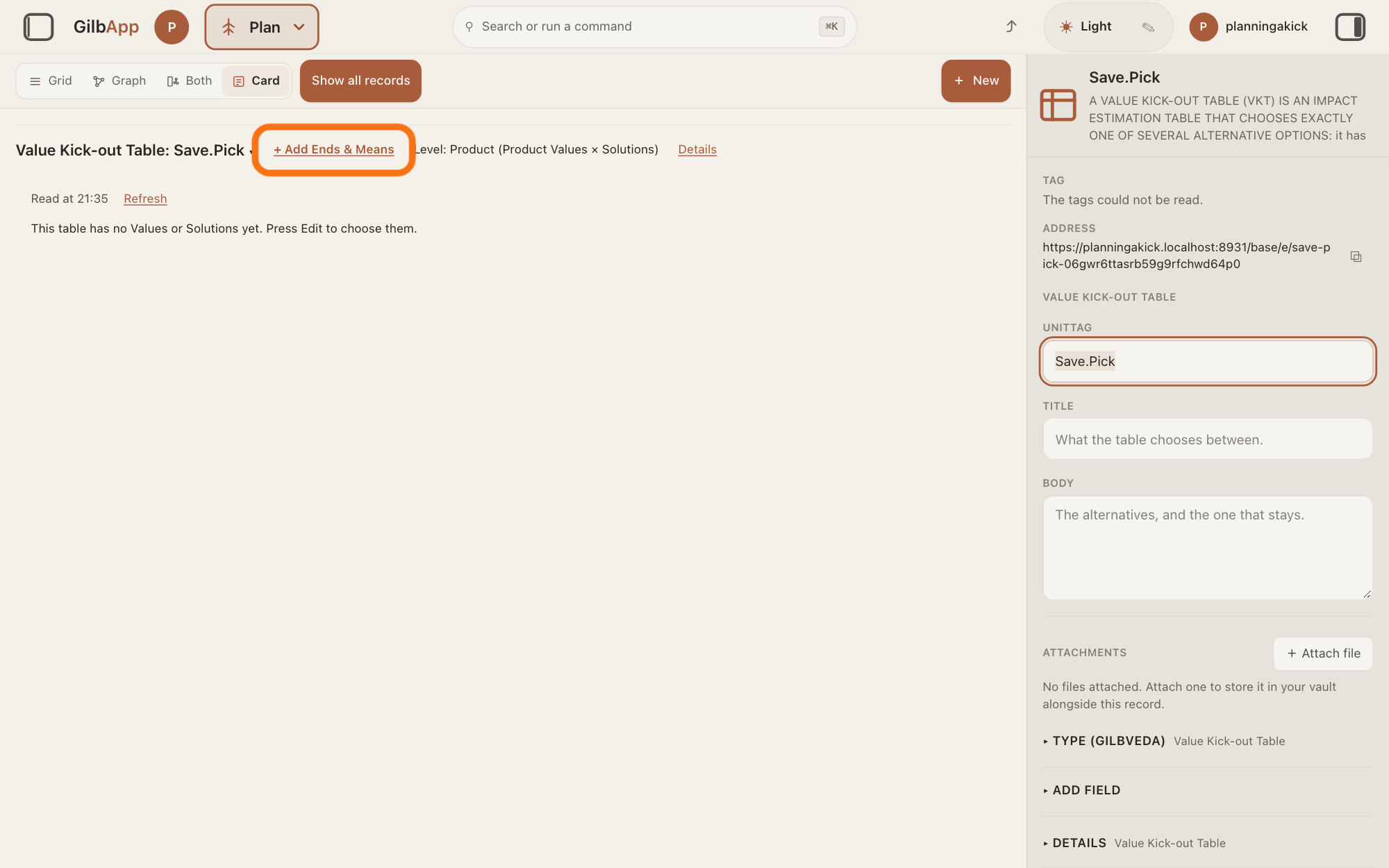
Press + Add Ends & Means.
At the top of the new table, press + Add Ends & Means: the ends are the Values and Development Resources the choice touches, and the means are the options. The button then reads Done.
Show as text
The new table opens in the middle of the screen, headed "Value Kick-out Table:" and its tag. It says "This table has no Values or Solutions yet." Press the outlined "+ Add Ends & Means" right of the heading.
More about this
After Create, the table opens in the middle of the screen; if it shows in the right pane instead, press Open the table there. Its top line shows Value Kick-out Table: and its tag, + Add Ends & Means, Level: Product (Product Values × Solutions) and Details, which shows the table's own details in the right pane. Pressing the tag lists every Value Decision, Kick-out and Tracking Table in the vault; choose one to open it. Until you choose rows and columns, the table says This table has no Values or Solutions yet. Press Edit to choose them.; the button it means is + Add Ends & Means. Only a person who may write the table sees that button.
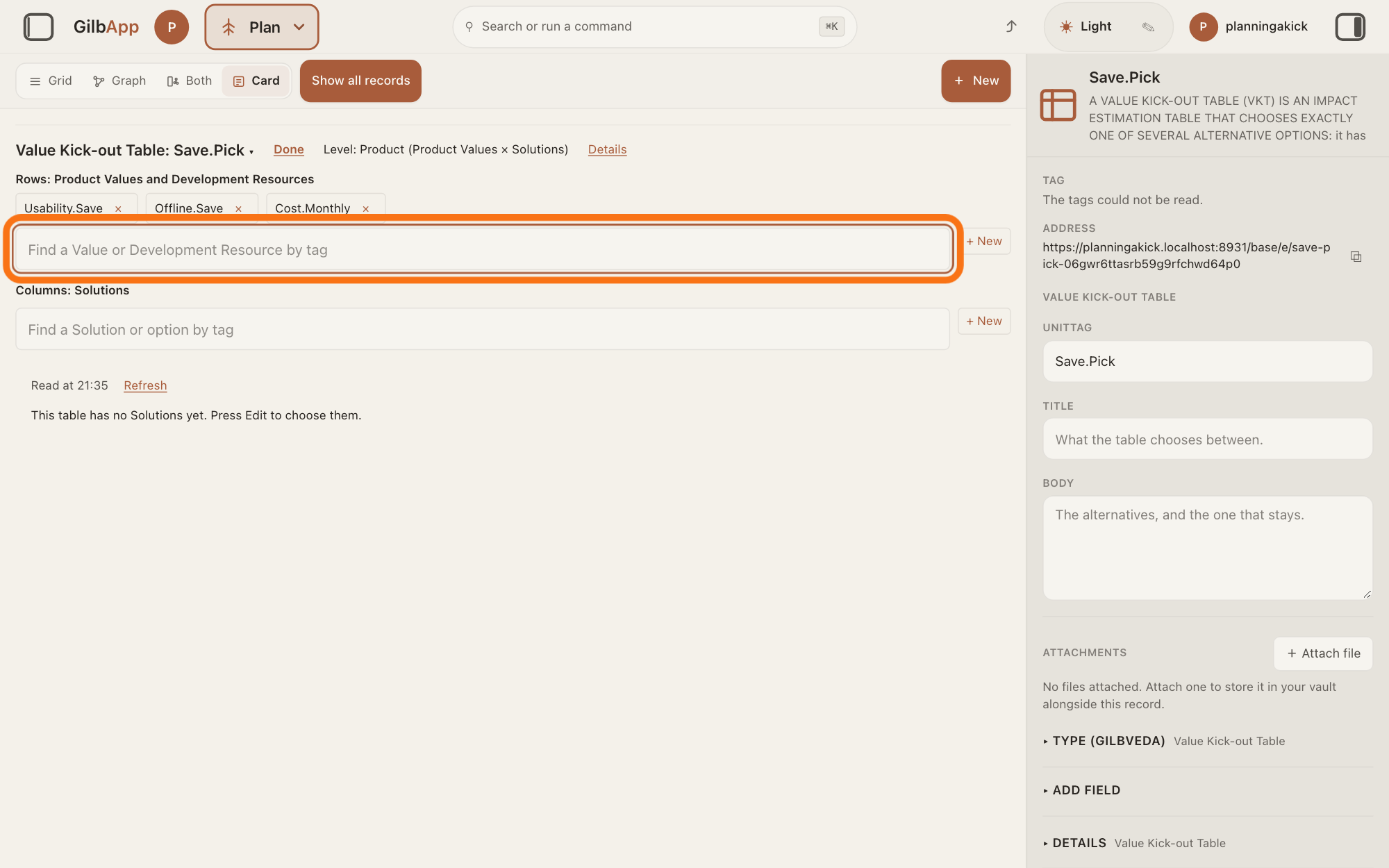
Under Rows: Product Values and Development Resources, search and select the Values and Resources.
Type part of a tag in the box that shows Find a Value or Development Resource by tag and select it, once for each Value the choice touches and each Development Resource the options use. A Value is a perceived benefit, measured as a number; a Development Resource is what the work uses up, such as money or time.
Show as text
The row picker is open under "Rows: Product Values and Development Resources", with three chips chosen: Usability.Save, Offline.Save and Cost.Monthly. The outlined box "Find a Value or Development Resource by tag" is empty again; type a tag in it and choose the match to add a row.
More about this
Each one you choose becomes a row and shows above the box with a ×, which takes it out of the table, not out of the vault. Only Values at the table's level, Product, are offered (a Value that shows Product because no level was chosen counts there too), and Development Resources of any level. + New beside the box makes a new card instead: it opens a box that shows Tag, e.g. Usability.Learn, holding what you typed, with New Value (Product), New Development Resource and Cancel. Without a Development Resource, the ratios end in no cost yet.
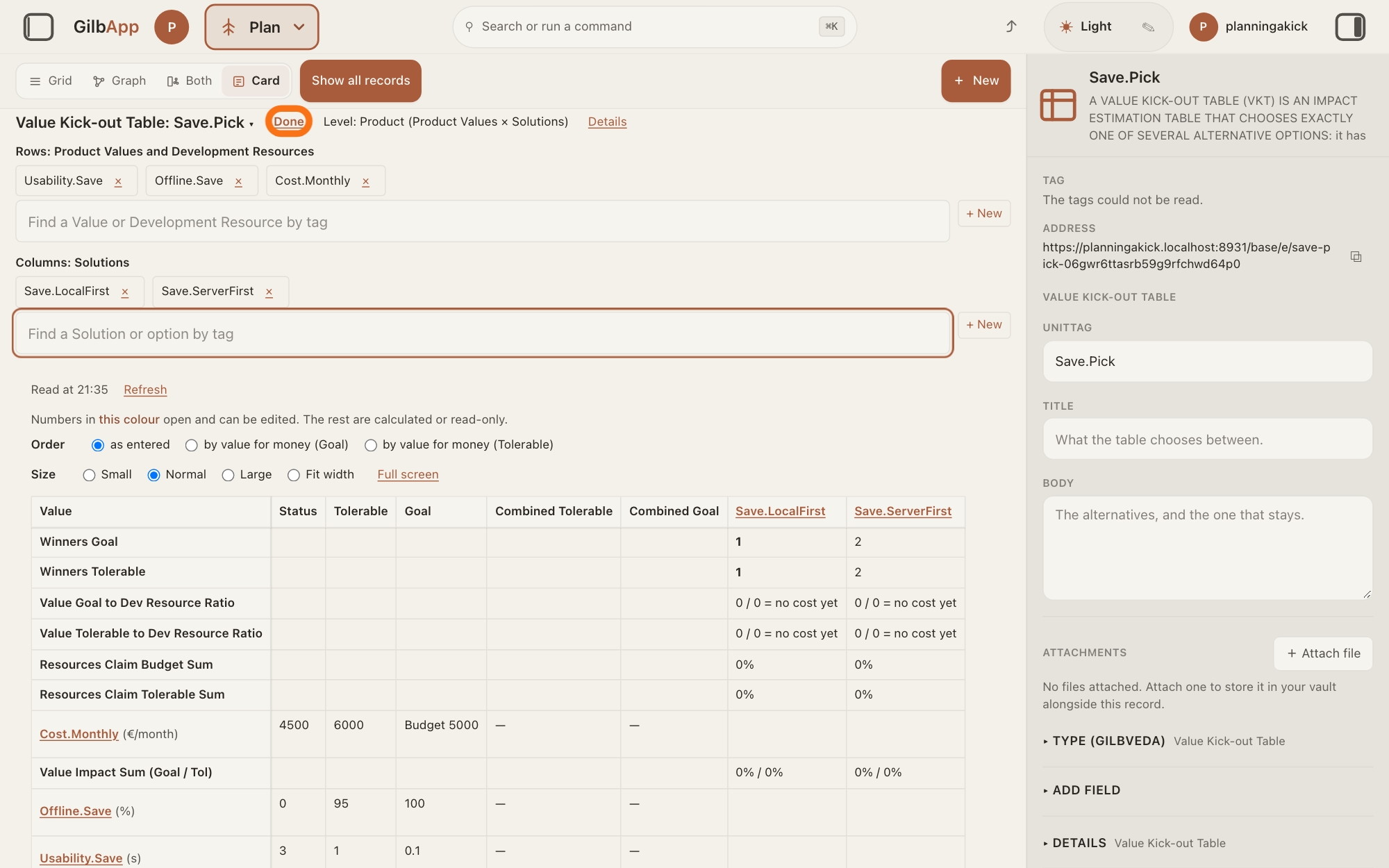
Under Columns: Solutions, search and select each option, and press Done.
Type part of an option's tag in the box that shows Find a Solution or option by tag and select it, once for each option; then press Done. Each option is a Solution, how a Function (what a system does) gets done; write a missing one first, as the answer on writing a Solution in your plan shows.
Show as text
Under "Columns: Solutions" the chips Save.LocalFirst and Save.ServerFirst are chosen, and the table is drawn below. Press the outlined "Done" right of the heading "Value Kick-out Table:" to close the pickers.
More about this
Each option becomes a column, even before it has an impact; Kai-Zen compares 2 to 10 options. A Solution Constraint (a Solution a named person requires) is offered too. + New beside the box makes a new Solution from the tag typed in it, and × beside a chosen one takes it out of the table only. The table then shows, for each row, its Status (where it stands now), Tolerable (the survival limit) and Goal (the number you plan to reach; Budget for a Resource), and a column per option, with the rows of sums and Winners on top. Order, Size, Full screen and Refresh above it change only how it is shown, or read it again; you need none of them.
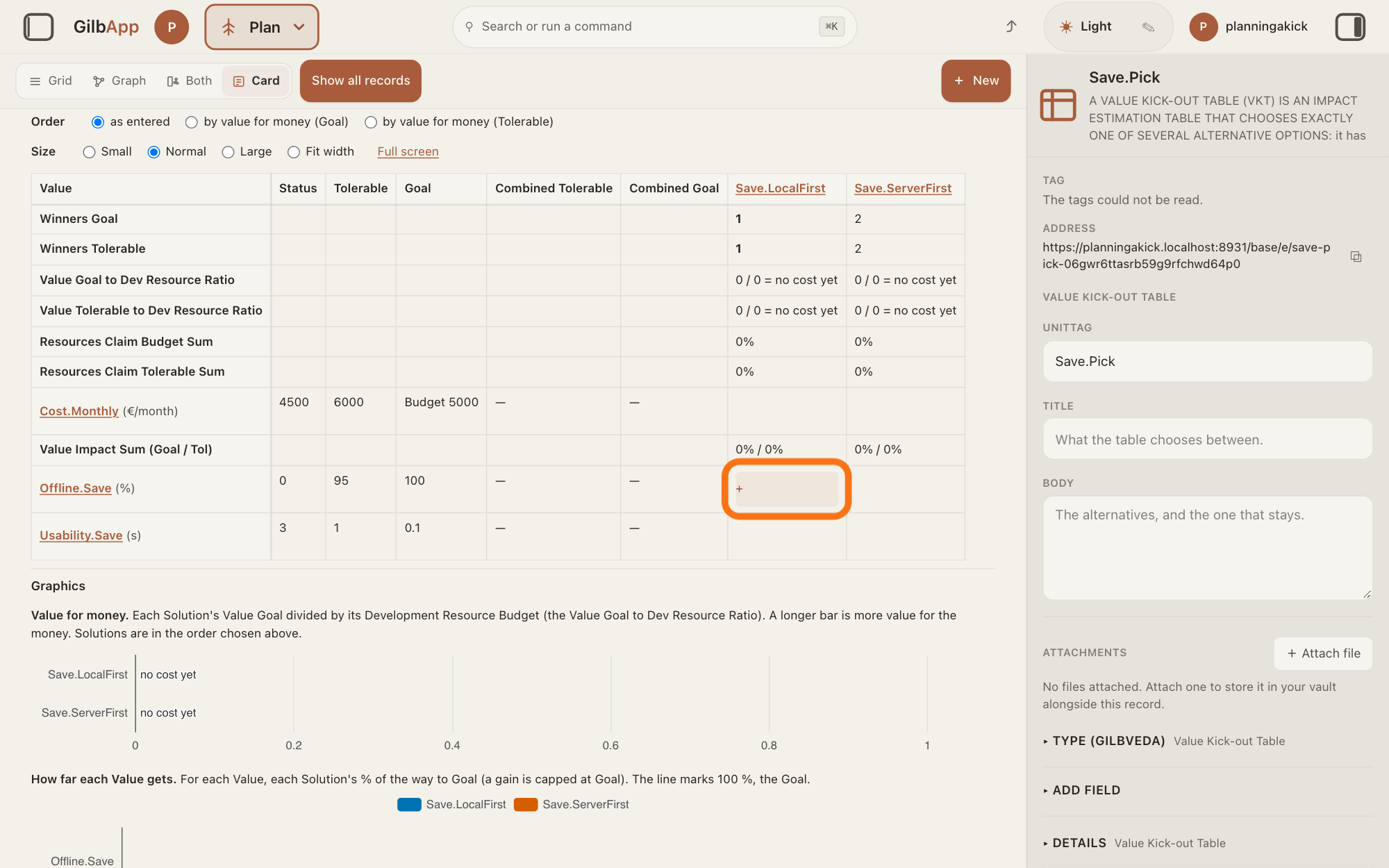
Press the cell where an option meets a Value.
Press the cell in an option's column and a Value's row. The right pane opens under IMPACTS, headed by the option's tag, → and the Value's tag.
Show as text
The pickers are closed and the table shows the columns Save.LocalFirst and Save.ServerFirst. The outlined cell is where Save.LocalFirst meets Offline.Save; it is empty and shows a small "+". Press it.
More about this
An empty cell shows + when you point at it. An impact, the effect an option has on a Value or a Development Resource, fills its cell by itself once written on the Solution's card: the change, then Tol and Goal with a % (how much of the way from Status to Tolerable, and to Goal, that option alone goes; a Resource's cell shows Tol and Bud, toward its Tolerable and Budget), EL (the Experience Level) with its number, and the evidence. With no Tolerable or Goal on the Value, the cell says No % yet. The line above the table says "Numbers in this colour open and can be edited. The rest are calculated or read-only.", or You can open every number to read it. None can be edited here.
Press + Add an impact, type the change and press Enter.
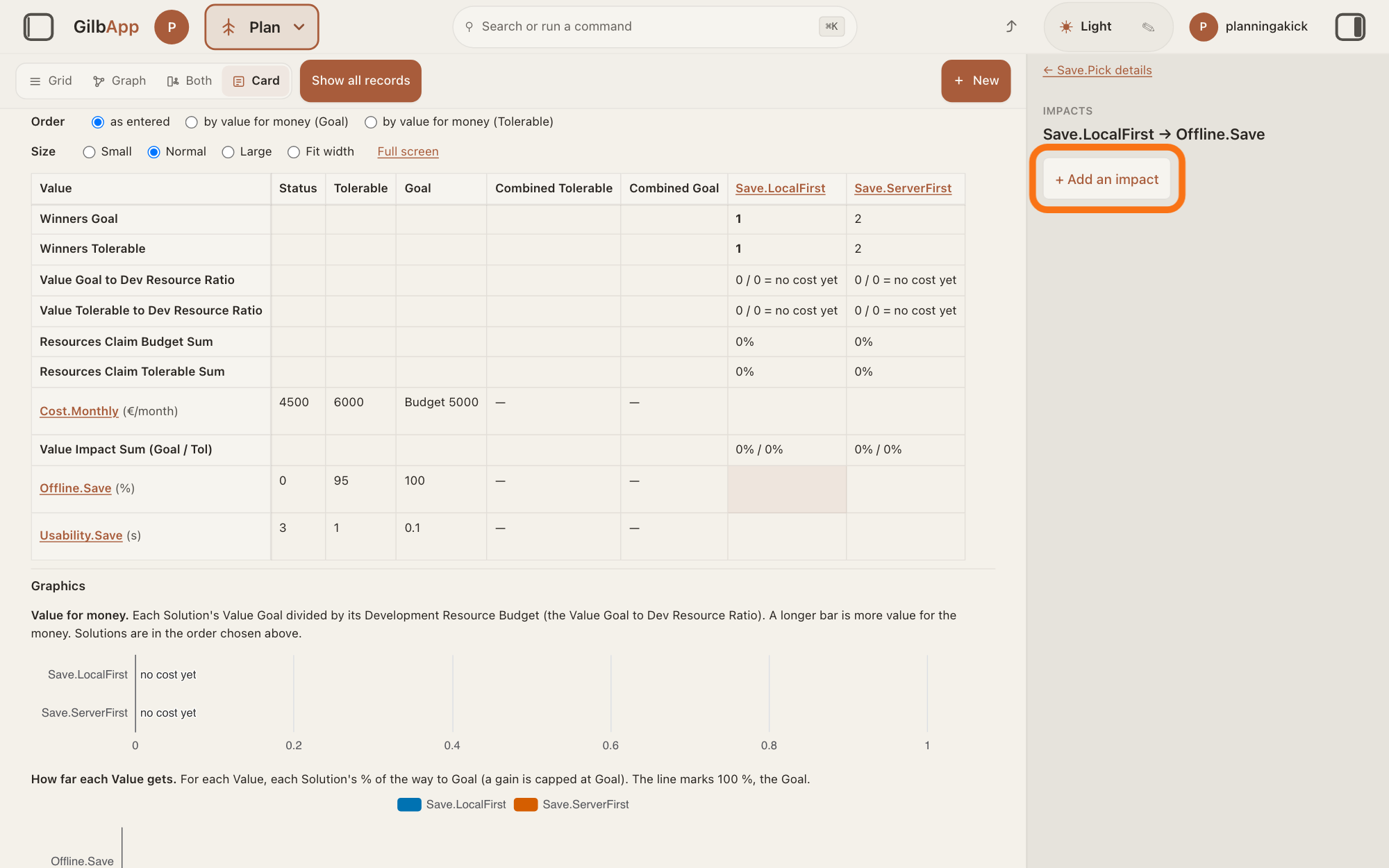
In the right pane, press + Add an impact, type the change the option brings, such as -2.8 or +100, and press Enter (for a Resource, the amount it uses). You type the change, not the end number: -2.8 on a Status of 3 makes 0.2.
Show as text
The right pane shows "IMPACTS" and the title "Save.LocalFirst → Offline.Save". Press the outlined "+ Add an impact" button under the title, type the change and press Enter.
More about this
The impact then shows in the cell, and on the Solution's card under Impacts. If you leave the box with nothing typed, no impact is made; text that is not a number gets Enter a decimal number. The Value needs one number under Status first. Under HOW SURE, the Experience Level shows 1 — An idea or a theory only. until you choose another; the answer on comparing Solutions in a VDT shows it, the ± range and the EVIDENCE. Repeat steps 8 and 9 for each cell; in the sums, an empty cell adds nothing.
Leave out each option that leaves a Value below Tolerable.
In each Value's row, read each option's Tol %. By the Kai-Zen method, an option that leaves a Value below Tolerable, or breaks a constraint, something that must be done because a named person requires it, is out, and the best ratio of Value to cost among the rest wins.
More about this
Tol is how much of the way from Status to Tolerable the option alone goes: at 100 % it reaches Tolerable, below that it falls short, and a minus % moves the Value away. past Tolerable in a cell means the Value was already past it and stays there. An option with no impact on a Value below Tolerable leaves it there. Example: an option that does not move Offline.Save from its Status of 0 leaves it below a Tolerable of 95, so it is out. Winners Goal, Winners Tolerable and Winners Goal Experience Level rank the options by three ratios of Value to cost; 1, in bold, is the best. GilbApp does not check constraints: hold each option against your Constraints yourself.
Deeper
Also asked:
How do I choose when I am unsure what to do? Score your options in a Value Kick-out Table: an option that leaves a Value below its Tolerable is out, and the best ratio of Value to cost among the rest wins. Kai-Zen does this itself for a choice it would otherwise ask you about.
What are a Value Decision Table, a Value Kick-out Table and a Value Tracking Table? A Value Decision Table ranks options by how much they move the Values for their cost. A Value Kick-out Table picks exactly one of several options. A Value Tracking Table follows your Values across your steps: the Estimate before each step, the Actual after.
GilbApp ranks every option and kicks none out: the rule in step 10 is the Kai-Zen method's. When the three Winners rows put different options first, the method's rule says only that the best ratio wins, not which of the three decides. GilbApp carries nothing out and writes no log line: you carry out the winner yourself. The table's Description is a place to note the choice: in the dialog its box shows The alternatives, and the one that stays.
In GilbApp today a Value Kick-out Table is drawn like a Value Decision Table: it also shows Combined Tolerable, Combined Goal, Combined Worst Case and Best set, which add the options together. In the Kai-Zen method the options of a VKT are alternatives, not a set, so these do not apply to it. The answer on comparing Solutions in a VDT explains every row and column.
Kai-Zen uses a VKT, when it can, for a choice it would otherwise ask you about, such as a method, a tool, an estimate, or a Status, Tolerable or Goal: it decides it itself and tells you in one line; you may change it later. It takes the Values and Development Resources of the work that the choice affects, lists 2 to 10 options, and fills a table like a Value Decision Table, without the Combined columns: it picks exactly one.
An option that leaves a Value below its Tolerable (the survival limit), or breaks a constraint, is out; the best ratio of Value to cost among the rest wins. Kai-Zen makes its own estimates, costs included, if none are given, sets the Experience Level to match, and never skips the table. It keeps every number a person set, as the answer on what happens if the AI estimates a level you set explains.
It does not ask you and does not offer the losing options again: it carries out the winner and writes one line in the work's log: the choice, the winner and its ratio; in the chat, that line ends its answer. When a fact or choice that only you have turns up after its one round of questions at the start, Kai-Zen chooses it the same way, writes it on the card as an assumption, with an AI agent as its source, and lists it for your approval at the end. Some acts it always stops and asks you about first, such as a release, ending a record, or spending over a Budget.
A Value Kick-out Table compares one pair of levels, as a Value Decision Table does. LEVEL also offers Business: Business Values × Stakeholder Values and Stakeholder: Stakeholder Values × Product Values: their options are the Values of the level below, and the heading over the second box says so. At those levels, with no Development Resource row, the table has no ratios and no best set: a Value draws no development cost. The answer on the levels of a plan explains the levels.
This answer is written for a computer screen.
Source: GilbApp af0f04ee838a4d55887d2ff1f72edd49a4ff7ca0 (https://gilb.com/app/version.json read 2026-11-09, buildTime 2026-11-09.522Z, dirty false); code read at af0f04ee (no checkout). Same screens, with the VKT's own words: planKinds.ts:17 (Value Kick-out Table); recordTypes.ts:459-472 (New value kick-out table, Area.Keyword, e.g. Product.KickOut, What the table chooses between., The alternatives, and the one that stays.), :270-291 (LEVEL); tableMembership.ts:44-48 (heading Value Kick-out Table); TableCard.tsx:627-700 (same card for all three kinds; only a Value Tracking Table differs, :345-347 `isVtt`); PlanTable.tsx:651-657, :833-839, :871-905, :1926-1927 (Combined columns, Winners, Best set left out only for a Value Tracking Table or a costless pair); valuePercent.ts:54-101 (% Tolerable: a gain counts only up to Tolerable, so 100 % reaches it; past Tolerable scored on its side, 0 while it stays, minus when it falls); planTable.ts:331-347 (Tol and Goal line, past Tolerable note); no kick-out, constraint or log logic in planTable.ts, bestSet.ts, TableCard.tsx. Standards (2026-11-09): Kai-Zen.VKT (Entry.Choice, Ends, Options 2 to 10, Table without the Combined columns, Execute, Log), Kai-Zen.VKTRules (Alternatives, TolerableFirst, NoHuman, Estimate, HumanSet, Constraints), Kai-Zen.AskRules.Decide (method, tools, estimates, Status, Tolerable and Goal; tell in one line; may change later), .Assume (Assumption, source AiAgent, end approval), .One, Kai-Zen.ConstraintRules.Options, Agent.VDT.Choices. GilbVeda public read: t:ValueKickOutTable ("CHOOSES EXACTLY ONE OF SEVERAL ALTERNATIVE OPTIONS ... no Combined columns ... An option that leaves a Value below Tolerable, or breaks a constraint, is kicked out; the best Value-for-cost ratio among the rest wins, is carried out, and is logged in one line"). Resource row and cell words planTable.ts:228-240 (Budget <n> under the one Goal heading, PlanTable.tsx:832; the row was already said by the shared Budget for a Resource), :296-300 (Tol <n>% · Bud <n>%), :333 (Tol <n>% · Goal <n>%); valuePercent.ts:163-177. Live answers: How do I compare Solutions in a VDT?; How do I pick the next step? (Value Tracking Table).
Checked against GilbApp d529620.