
← Back to How do I change a standard safely?
How do I publish a standard, or keep it private?
Short answer
Press Main menu, choose Vaults, press the card's panel button, open ▸ GRANT ACCESS, press Make public, Yes, make public; for private, skip these.
Before you start
You need to be signed in to GilbApp on a computer, with Control on a vault that holds only standards anyone may read; keep the others in a vault you leave private. The pictures show a made-up person on a test site; your screen shows your own name and address.
Words used here (3)
- GilbApp
- GilbApp is the app, opened in a web browser at https://gilb.com/app, where you open, fill and share your vaults.
- record
- A record is one piece of data with its own address, such as a person, a place, a thing or a note.
- AI vault
- An AI vault is a small vault that stands for your AI; your AI reaches only the vaults you grant it.
Steps
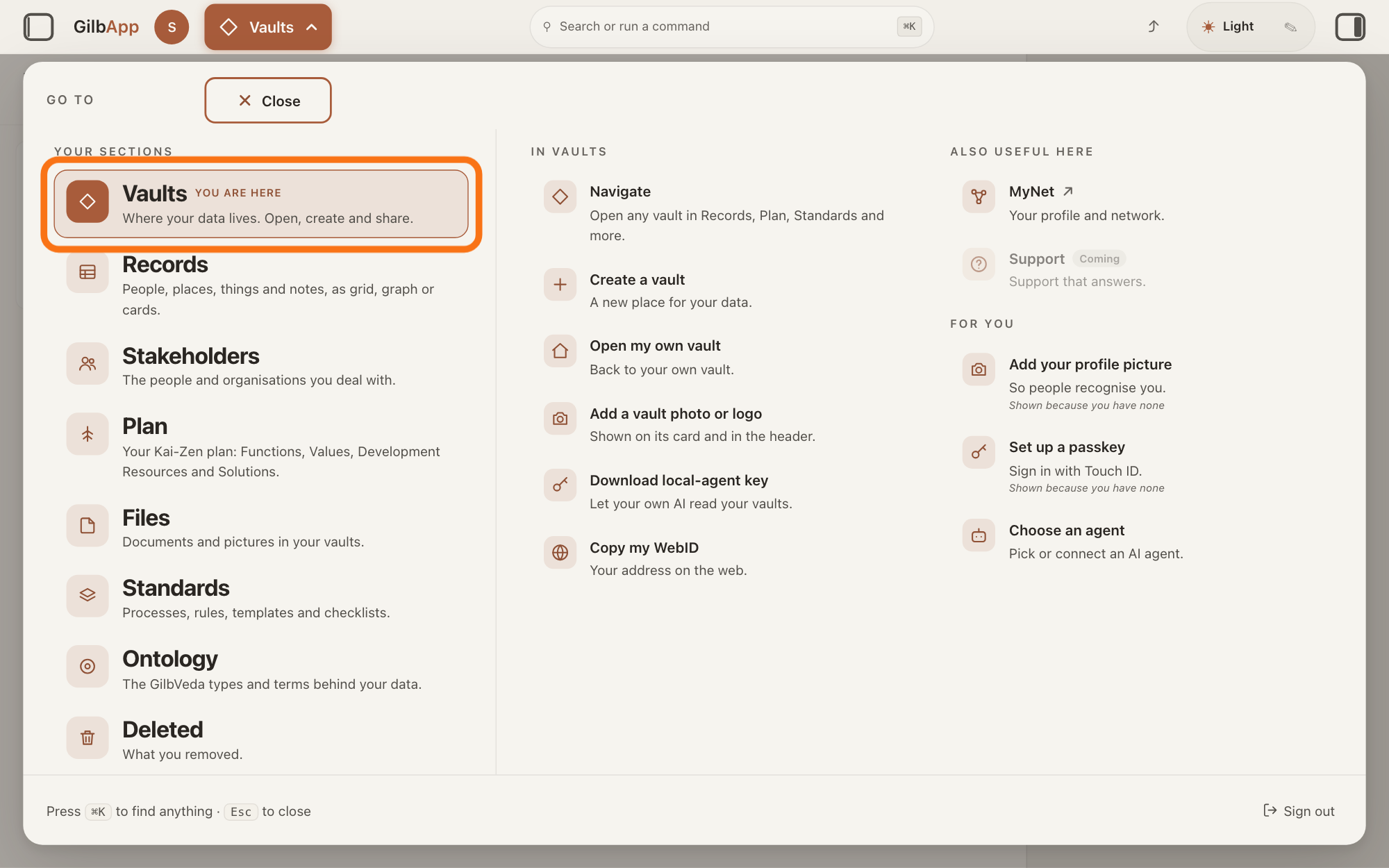
Press Main menu at the top left and choose Vaults.
Press Main menu, next to your profile picture at the top left, and under YOUR SECTIONS choose Vaults.
Show as text
The panel headed "GO TO" is open. In the left column under "YOUR SECTIONS", the row "Vaults" with "Where your data lives. Open, create and share." is outlined. Press it to see your vaults as cards.
More about this
Open GilbApp on a computer. A panel headed GO TO opens. A vault is where a person or a group keeps their records; the Vaults screen lists your vaults as cards.
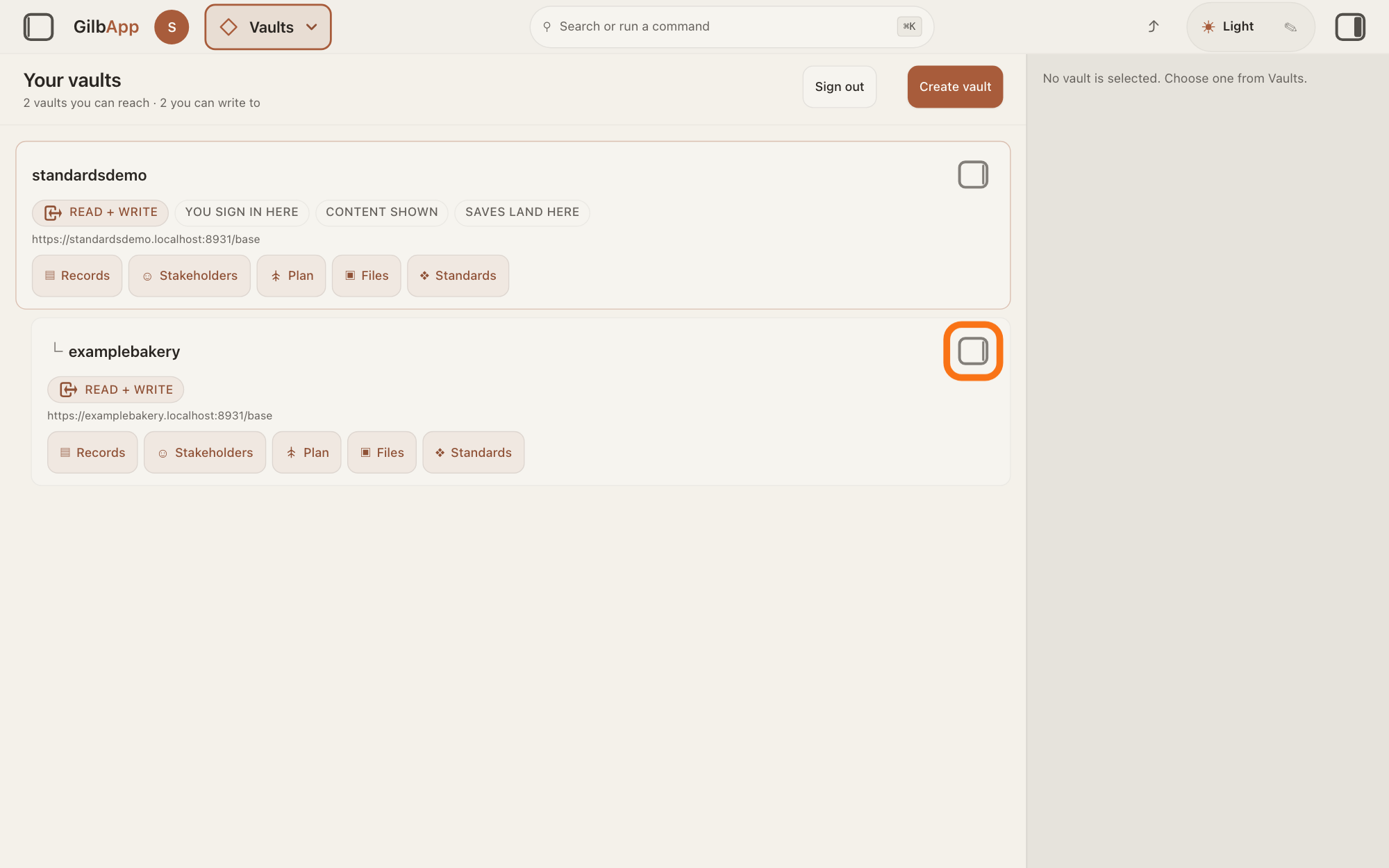
Press the panel button at the top right of the vault's card.
Press the small square button at the top right of the card of the vault that holds the standards to publish; its hover text is Show vault info. The pane on the right shows that vault's details.
Show as text
The screen "Your vaults" shows two made-up vaults as cards. At the top right of the second card, the small square panel button is outlined. Press it to open that vault's pane on the right.
More about this
Clicking the card itself only selects it; on a computer it does not open the pane.
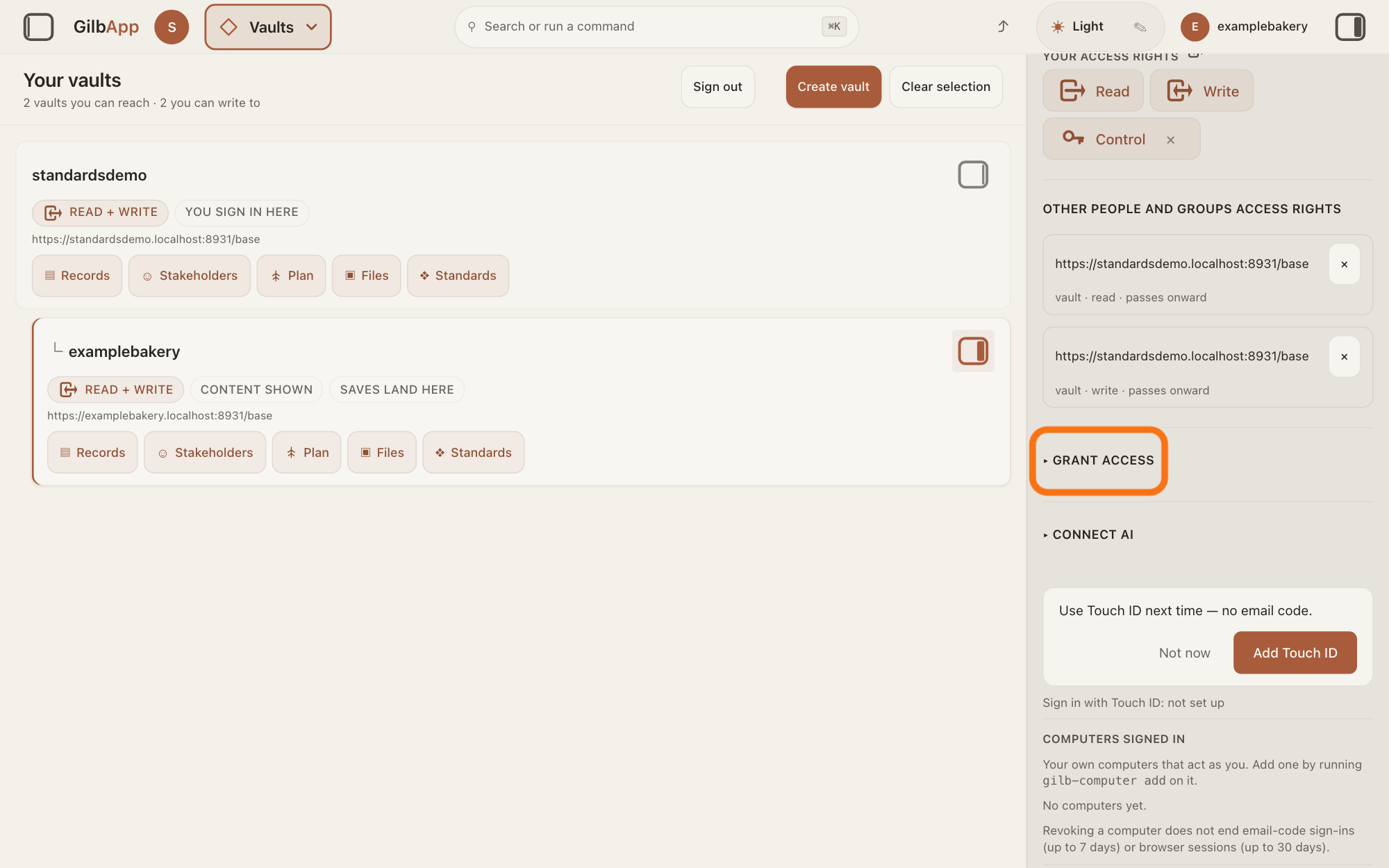
In that panel, scroll down and open ▸ GRANT ACCESS.
Below the vault's details find OTHER PEOPLE AND GROUPS ACCESS RIGHTS and open ▸ GRANT ACCESS. Its first part is PUBLIC, with a line of text and the button Make public.
Show as text
The right pane is scrolled down past "YOUR ACCESS RIGHTS" and "OTHER PEOPLE AND GROUPS ACCESS RIGHTS". Below them, the closed section "GRANT ACCESS" with a small arrow is outlined. Press it to open it.
More about this
Only someone who holds Control on the vault sees this part of the screen. If it is missing, you do not hold Control here; Control lets a person manage who else has access to a vault. While the vault is not public, the line starts This vault is not public on its own. The rest of ▸ GRANT ACCESS, from SHARE WITH down, gives access to one person or one vault, as the answer on sharing a vault with a person shows, and ▸ CONNECT AI further down is for your own AI; you do not need them here.
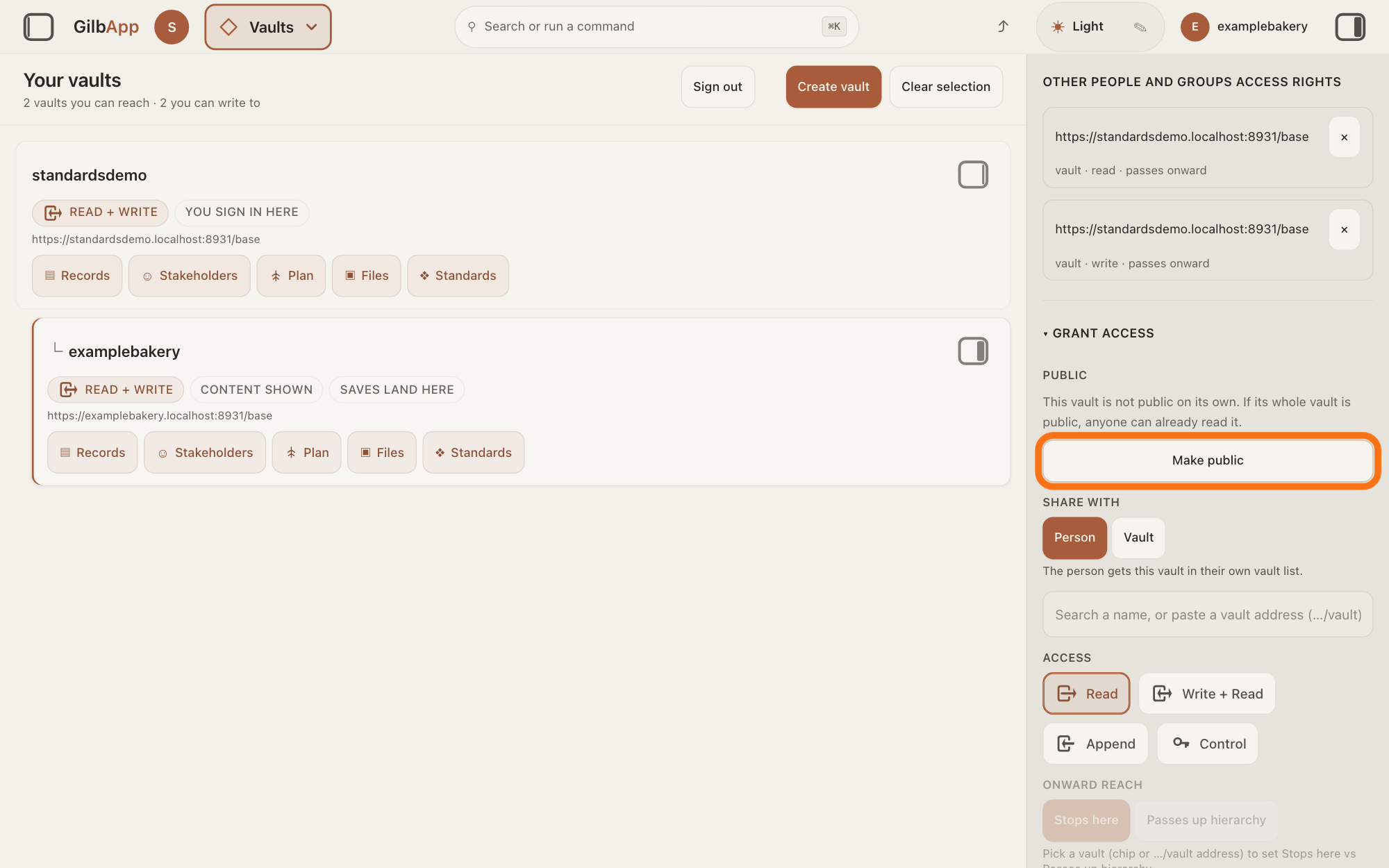
Press Make public.
Press Make public. Nothing changes yet: GilbApp first asks "Anyone on the internet will be able to read this vault and everything in it. Continue?"
Show as text
"GRANT ACCESS" is open. Its first part, "PUBLIC", says "This vault is not public on its own." Under that line the wide outlined button "Make public" is shown, with "SHARE WITH" below. Press "Make public".
More about this
Cancel closes the question and changes nothing.
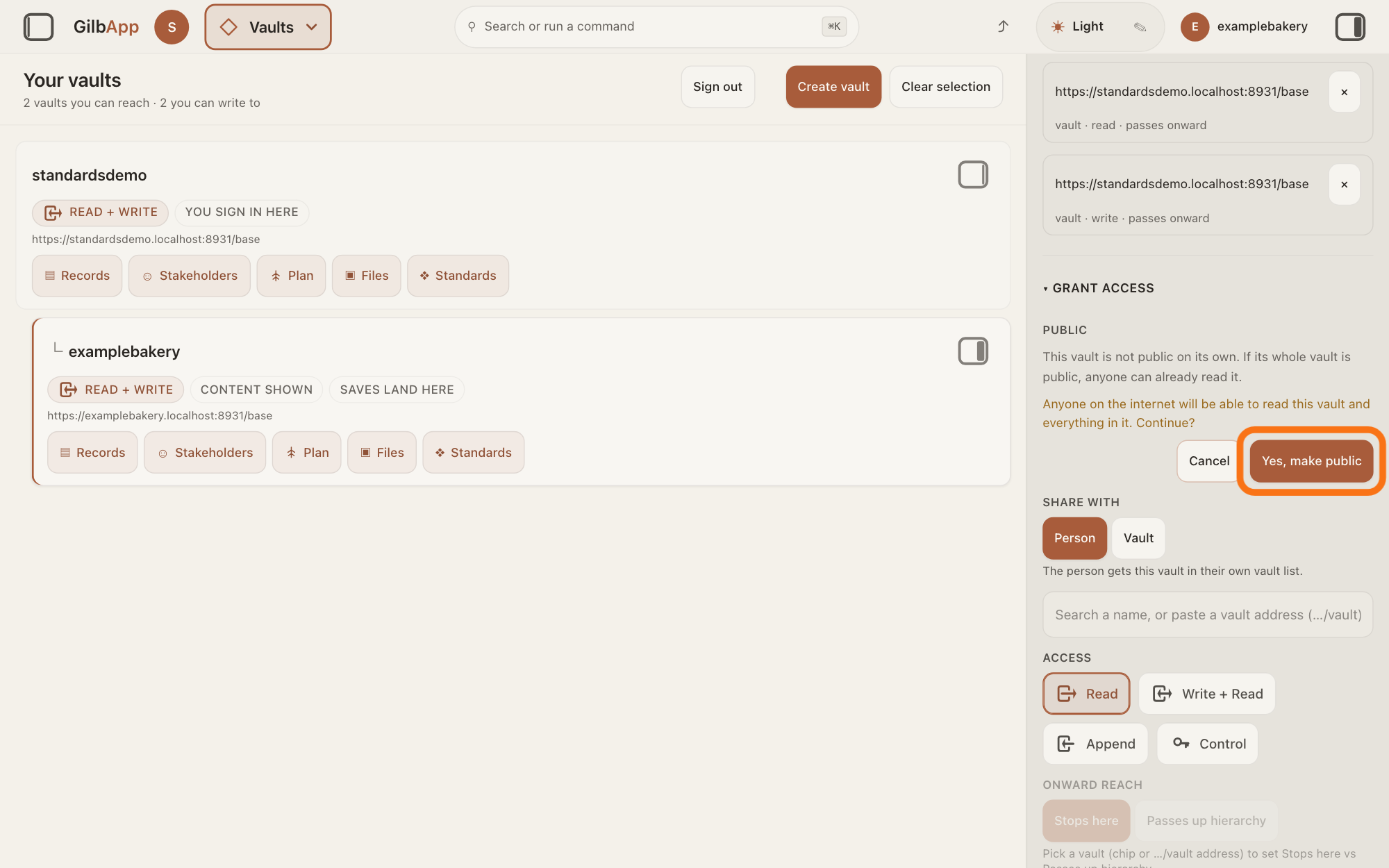
Press Yes, make public.
Press Yes, make public. It reads Working… while it works; then the pane loads again and the line reads Anyone can read this vault, signed in or not. Nobody can change it.
Show as text
Under "PUBLIC" the question "Anyone on the internet will be able to read this vault and everything in it. Continue?" is shown in orange. Below it are "Cancel" and the outlined button "Yes, make public". Press it only if the whole vault may be read by anyone.
More about this
The list above the form gets a line Everyone (public). From then on anyone, signed in or not, can read the vault, except a record whose holder narrowed who may see it, such as a detail in MyNet, Gilb's app for your profile and network, set to Private; being public lets no one change it. If it fails, the reason shows under the button; without Control it is You don't hold Control on this vault, so you can't make it public or private. An AI vault cannot be made public. A line Everyone (public) means anyone can read the vault; its ×, or Make private under ▸ GRANT ACCESS, makes the vault private again.
Deeper
In the Kai-Zen method a standard is public. It is private only when it names a secret, a key or the place a key is kept, a private host or address, a person's contact details, steps for running or putting a system live that would help an attacker, a flaw in who can reach what that is not fixed yet, or a client's unreleased information. Keeping it for the team only is not by itself a reason. When only a part is sensitive, that part goes into a private standard of its own and the rest stays public, and a private standard notes which of these reasons it has.
Here GilbApp makes a whole vault public: Make public lets anyone read the vault, its standards and every other record, except a record whose holder narrowed who may see it, such as a detail in MyNet, Gilb's app for your profile and network, set to Private. GilbPlatform also puts a public vault on its public list of public vaults, which anyone can read; the list gives each vault's address and what it stands for. The Standards screens have no public switch for one standard or one standards group. So keep standards that must stay private in a vault you do not make public. A standard is read only by those who can reach its vault, or the standard itself; the answer on seeing who can reach my vault shows who that is.
When an agent changes a standard, its last step is to read every part of it as someone who is not signed in; if a part that should be public cannot be read, it asks the person with write access to the vault to publish its group, and waits.
Public is not the same as findable: WHO CAN FIND THIS VAULT only decides whether people can find the vault by name. Vaults made inside a public vault are not made public with it. Making the vault private again ends only its Everyone (public) line; its ×, or Make private under ▸ GRANT ACCESS, does that, and the answer on making a vault public tells more. A record or file made public on its own, under its ▸ SHARE THIS ITEM, stays public, and so does what a public folder made public; the answer on sharing one record shows where that is.
On a phone or a window narrower than 840 pixels, choosing a vault card opens its details at once, in a sheet from the right. This answer is written for a computer screen.
Source: Re-checked 2026-11-11: live GilbApp is now ebd9415e7a90de8c289eaa7bb02f40c8ee80cf79 (https://gilb.com/app/version.json) and GilbPlatform 498d29a0dec9a15d167f4b6b5d731382a6bcede0 (https://id.gilb.com/version). the diff from af0f04ee to ebd9415e touches no file this page cites (src/components/process, RightRegion.tsx, gilbAppMenuRows.ts, the standards libs unchanged; processHooks.ts, records.ts and AppShell.tsx change only request headers and a palette note); the diff from 4d008a55 to 498d29a0 changes sign-in, DPoP and grant slices, not the write gate or deletes. Line numbers above hold at ebd9415e. evidence holds at ebd9415e (VaultAccessManager.tsx, PublicToggle.tsx, VaultsView.tsx not in the diff). GilbApp: no publish or public control anywhere in the Standards screens (src/components/process and the standards libs at af0f04ee, unchanged at ebd9415e: none); PublicToggle.tsx ("Anyone on the internet will be able to read this vault and everything in it. Continue?"). Standards (200, 2026-11-10): GilbPlatform.StandardRules.Public ("A standard is public. It is private only when it names a secret, a key or credential path, a private host or address, a person's contact, ops or deploy steps that would help an attacker, an access defect still open, or a client's unreleased information. A private standard sits in a private group, and its note says which of these it names. 'Team only' is not by itself a reason. When only a part is sensitive, that part goes to a private standard and the rest stays public."); GilbPlatform.ChangeStandard.Publish ("Read the written standard and each of its units with. If one answers 404 and StandardRules.Public says it is public, ask the person with write access to the vault to publish its group, and wait for the no-key read to answer 200.").
Checked against GilbApp d529620.