
← Back to How do I pick the next step?
How do I write a step?
Short answer
Search and select the Value Tracking Table, press + Add Ends & Means, type a tag, press + New, choose New value delivery step.
Before you start
You need to be signed in to GilbApp on a computer, with a vault you can write to, such as your own vault. The plan needs a Value Tracking Table and the Solution the step delivers. The pictures show a made-up person on a test site; your screen shows your own name and address.
Words used here (10)
- Value Tracking Table
- A Value Tracking Table (VTT) follows a project's Values and Development Resources across its steps: the Estimate of each step, then its Actual.
- GilbApp
- GilbApp is the app, opened in a web browser at https://gilb.com/app, where you open, fill and share your vaults.
- Kai-Zen
- Kai-Zen is the planning agent: it finds out what you want, chooses the way, hands the work to other agents and reports back.
- record
- A record is one piece of data with its own address, such as a person, a place, a thing or a note.
- short name
- A short name is the one word you give one AI on one computer, such as gilb-example; it keeps that AI's key and tools apart.
- Estimate
- An Estimate is the change a step or a Solution is expected to make on a Value or Development Resource, written before it is built.
- Actual
- An Actual is how far a delivered step or Solution was measured to move a Value, or how much of a Development Resource it used.
- Value Delivery Step
- A Value Delivery Step, or step, is the Solutions, or parts of them, delivered together in one short cycle to move some Values.
- project
- A project is work to bring about a change you want, such as a new app or a better way of doing something.
- step's Contents
- A step's Contents are the Solutions, or parts of their Description, that the step delivers together.
Steps
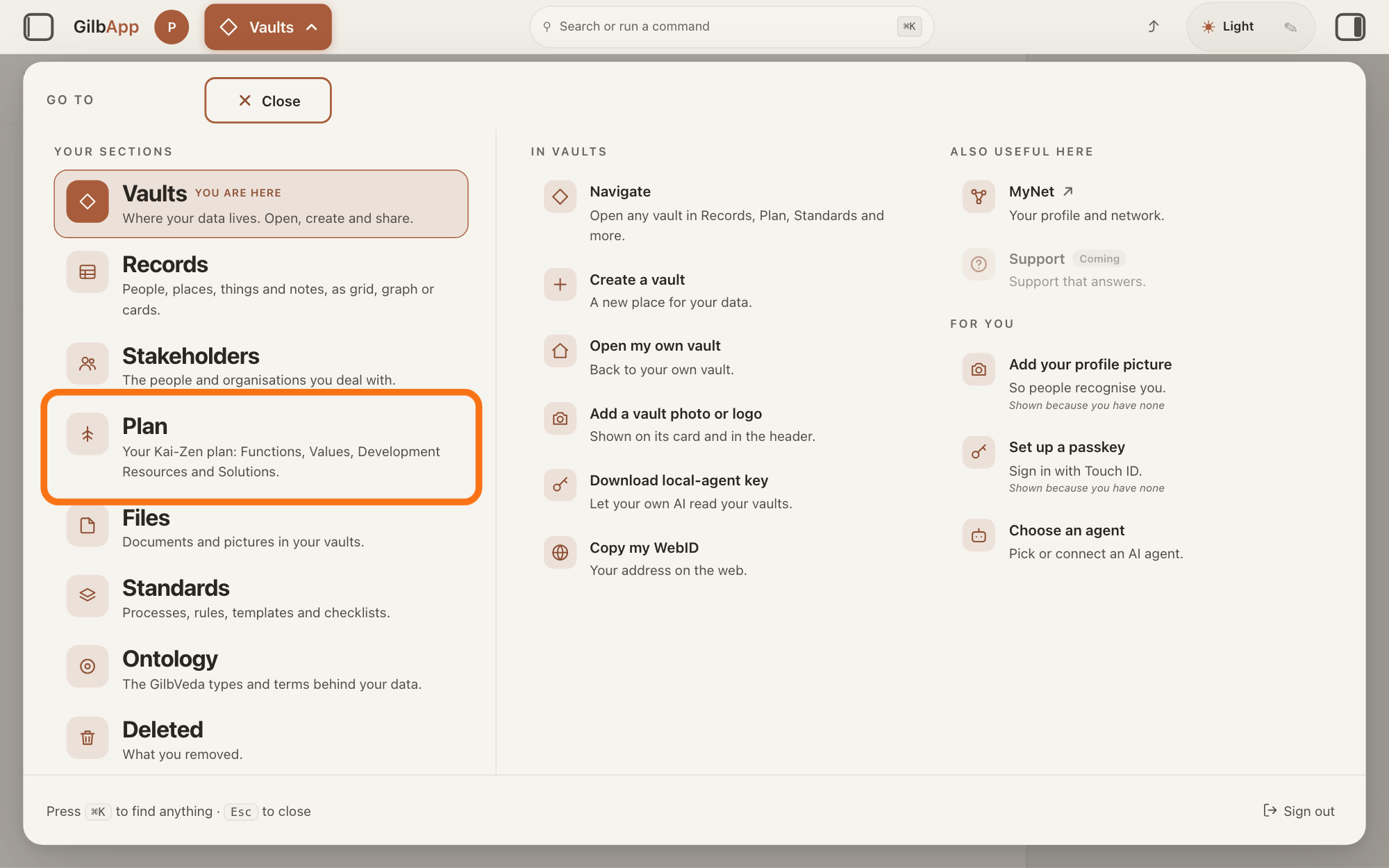
Press Main menu at the top left and choose Plan.
Press Main menu, next to your profile picture at the top left, and under YOUR SECTIONS choose Plan. The button shows the name of the section you are in, such as Vaults.
Show as text
In the GO TO panel that opens from "Main menu" at the top left, look under YOUR SECTIONS on the left. The outlined row is "Plan", with the line "Your Kai-Zen plan: Functions, Values, Development Resources and Solutions." Press it to open the Plan screen.
More about this
A panel headed GO TO opens; Plan reads Your Kai-Zen plan: Functions, Values, Development Resources and Solutions. You can also press the Plan button on the card of a vault (the place where a person or a group keeps their records) in Vaults. The Plan screen lists your plan records and has the views Grid, Graph, Both and Card.
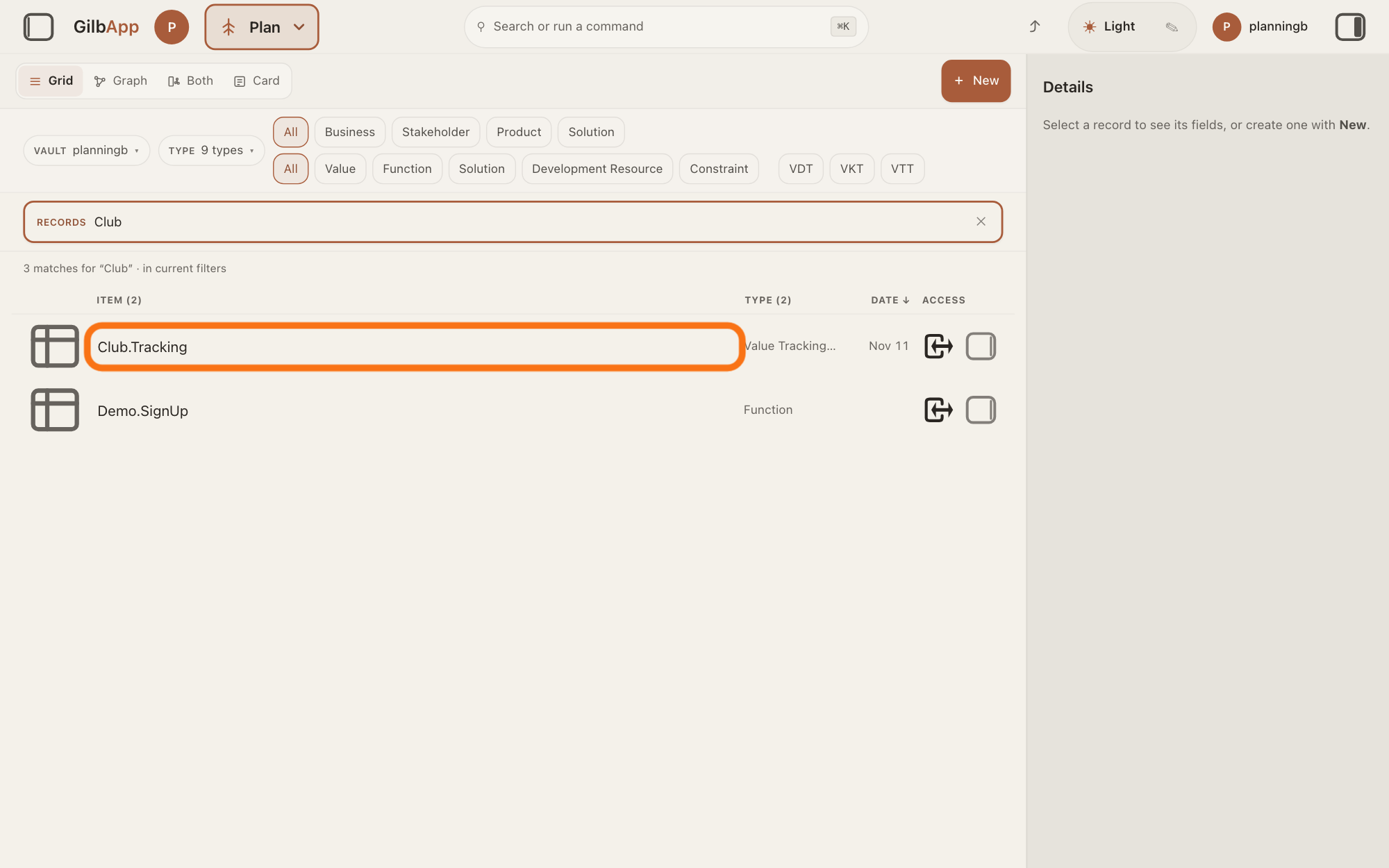
Search and select the Value Tracking Table in the list.
Type part of the table's tag (its short name) in the search box and select the Value Tracking Table in the list. The table opens in the middle of the screen.
Show as text
The "RECORDS" search box holds a word of the table's tag, and the list below shows the Value Tracking Table. The outlined text is the table's tag in its row. Click it to open the table.
More about this
A Value Tracking Table (VTT) follows your Values and Development Resources across your steps: one column for each step, and in each cell the Estimate made before the step is built, then the Actual measured after it is delivered. A Value is a perceived benefit, measured as a number; a Development Resource is what the work uses up, such as money or time. A step, a Value Delivery Step, is the Solutions, or parts of them, delivered together in one short cycle to move some Values. The search box shows Search in current filters… while a filter is on, and Search your vault… otherwise. The button VTT in the row of kinds shows only Value Tracking Tables. Kai-Zen writes a VTT for each project it plans; the answer on tracking estimates and actuals shows how to make one yourself.
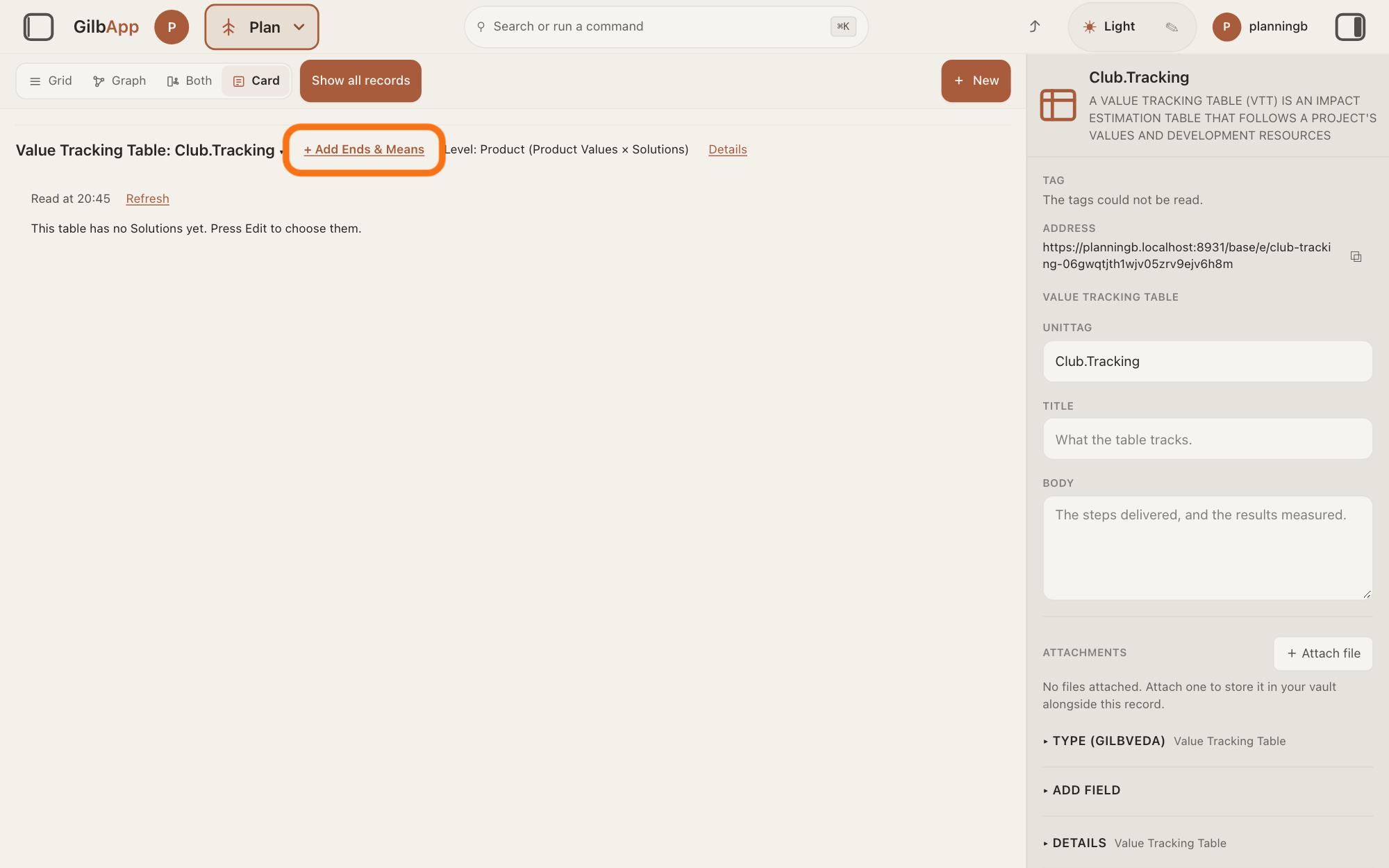
Press + Add Ends & Means.
At the top of the table, press + Add Ends & Means. The button then reads Done, and the boxes for the table's rows and columns open under it.
Show as text
The table is open in the middle. Its top line reads "Value Tracking Table:" and the tag, then "+ Add Ends & Means", "Level: Product (Product Values × Solutions)" and "Details". Below it: "This table has no Solutions yet." Press the outlined "+ Add Ends & Means".
More about this
If the table shows in the right pane instead, press Open the table there first. The top line shows Value Tracking Table: and its tag, + Add Ends & Means, Level: Product (Product Values × Solutions) and Details, which shows the table's own details in the right pane. Only a person who may write the table sees + Add Ends & Means. The box under Rows: Product Values and Development Resources adds rows; the answer on tracking estimates and actuals covers them. A table with rows but no column yet, as in the picture, says This table has no Solutions yet. Press Edit to choose them.; one with neither says This table has no Values or Solutions yet. Press Edit to choose them. The button they mean is + Add Ends & Means, and a step counts as a column.
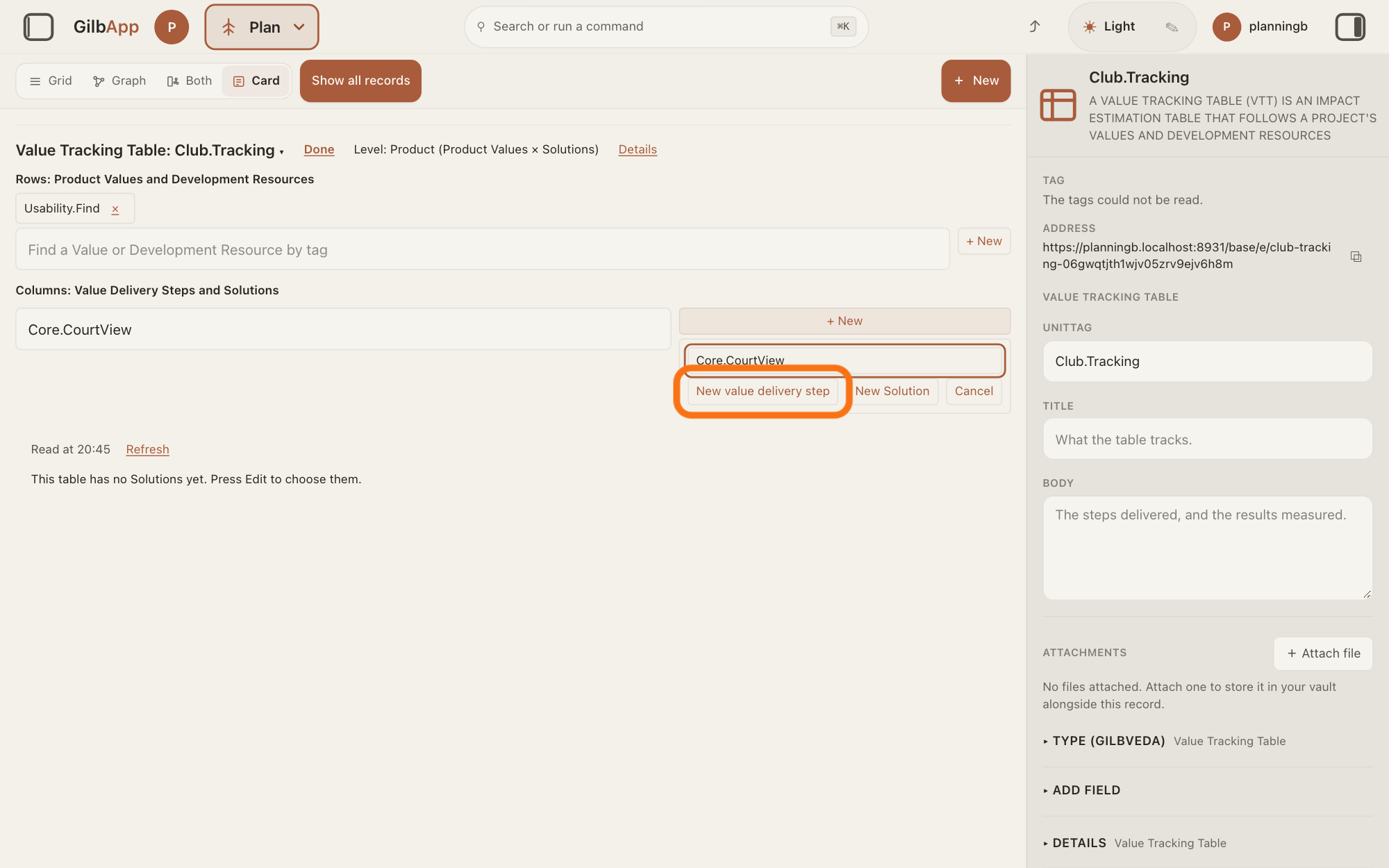
In the columns box, type a tag, press + New and choose New value delivery step.
Under Columns: Value Delivery Steps and Solutions, type the new step's tag in the box that shows Find a delivery step or a Solution by tag, press + New beside it, and choose New value delivery step. A tag is the short name of a plan record: an area, a dot and a keyword, such as Core.DayView.
Show as text
Under "Columns: Value Delivery Steps and Solutions", the box holds the new step's tag. After "+ New" at its right, a small box repeats the tag with "New value delivery step", "New Solution" and "Cancel" below. Press the outlined "New value delivery step".
More about this
+ New opens a box that shows Tag, e.g. Usability.Learn, holding what you typed, with New value delivery step, New Solution and Cancel; a choice works only once the box holds a tag. A tag the vault refuses is explained under the box, sometimes with a button that reads Use and a corrected tag, which puts that tag in. If the tag is already used in this vault, the table says is already used in this vault. Pick another. The new step becomes the last column, with its tag as its title. A step already in the vault is found by typing in the box and selected instead. ← and → on each column above the box move it in the delivery order; × takes it out of the table only.
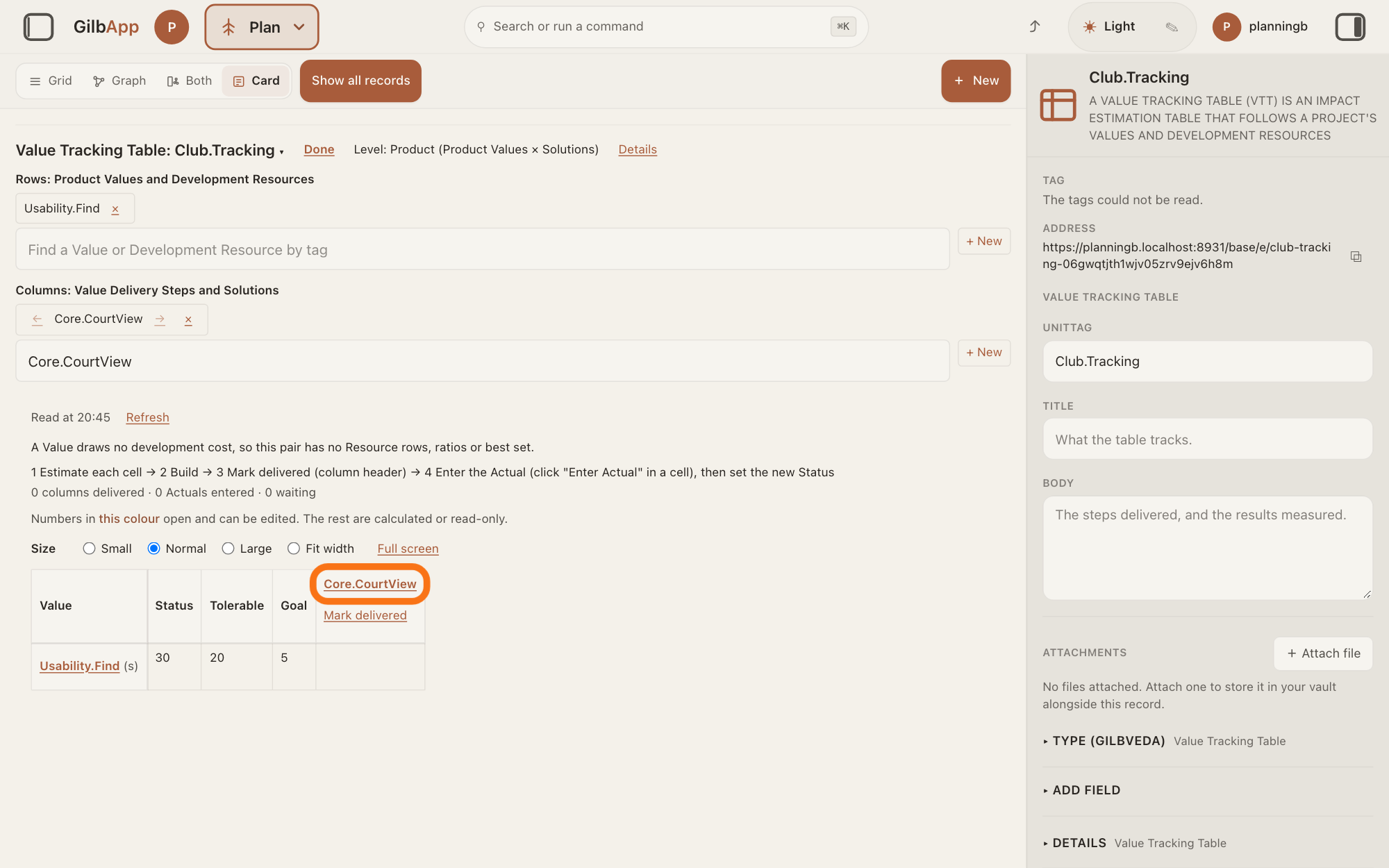
Press the new step's tag at the top of its column.
Press the new step's tag at the top of its column. The step's card opens in the right pane, and the table stays.
Show as text
The table now has a column for the step, with "Mark delivered" under its tag; the Value's row shows its "Status", "Tolerable" and "Goal" numbers. Press the outlined tag at the top of the column.
More about this
Under the tag, Mark delivered is for later, when the step is delivered: it writes the status Developed and keeps the step's numbers as they stand (see the answer on tracking estimates and actuals). Do not press it now. A Value or Resource name in the table opens its card in the right pane the same way.
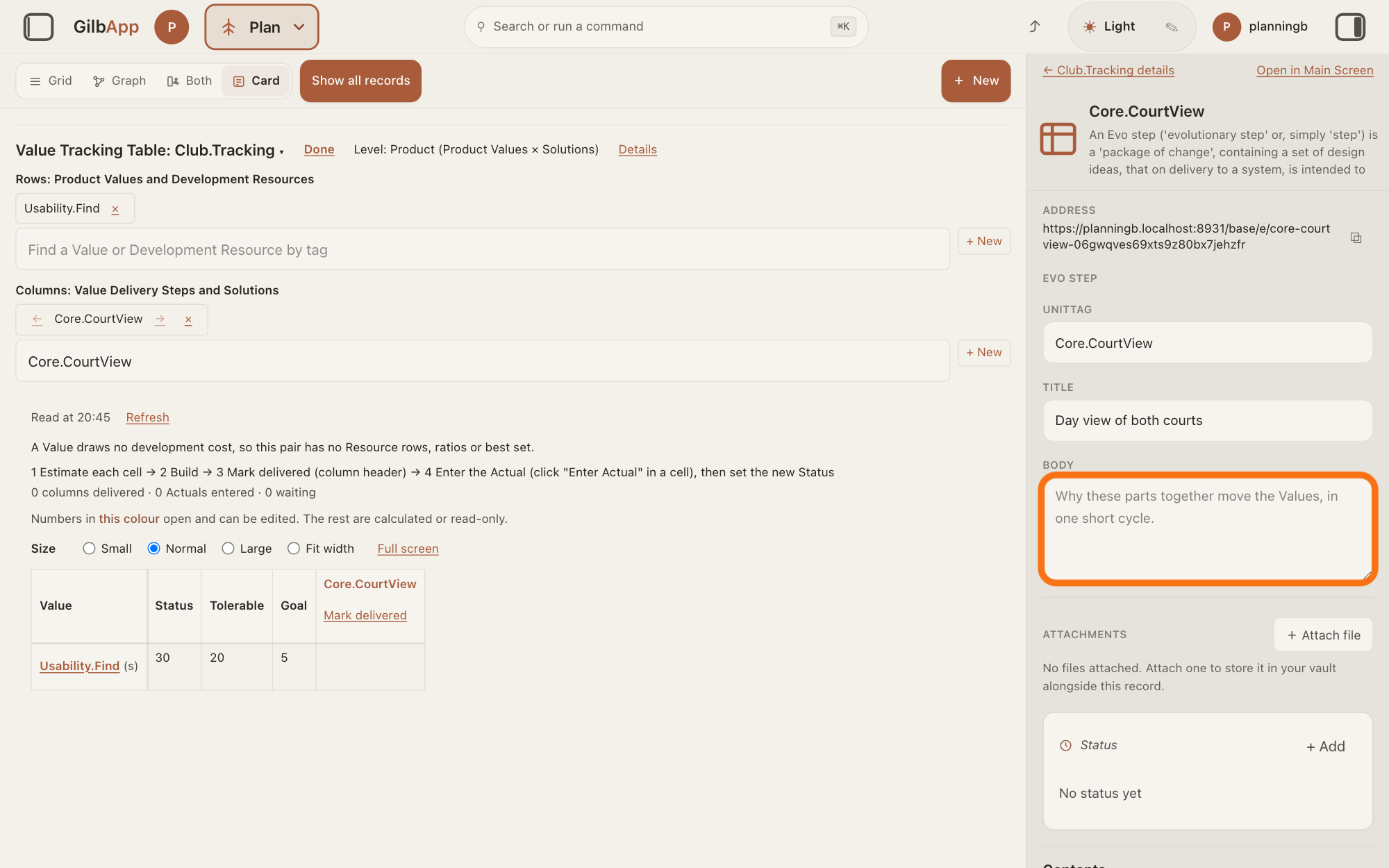
On the step's card, type a title and a description.
In the right pane, type what the step delivers together in the box that holds its title, which starts as the tag, and why these parts together move the Values in the box that shows Why these parts together move the Values, in one short cycle. Each box saves when you leave it; there is no Save button.
Show as text
The step's card opens in the right pane. Under "UNITTAG" is the tag and under "TITLE" the title you typed. Under "BODY", the outlined box reads "Why these parts together move the Values, in one short cycle." Type the description there.
More about this
The first box holds the tag; in the Kai-Zen method a tag never changes once it is written. Kai-Zen's own steps have more lines than the card has boxes, such as why the step comes now and what it leaves out; Deeper, below the steps, lists them. The right pane also holds TAG with a box that shows Add tag, and below the step's parts ▸ TYPE (GILBVEDA) (GilbVeda is the shared list of terms), ▸ ADD FIELD, ▸ DETAILS, ▸ ACCESS, ▸ SHARE THIS ITEM, ▸ ADD TO FOLDER and Delete record; you need none of them.
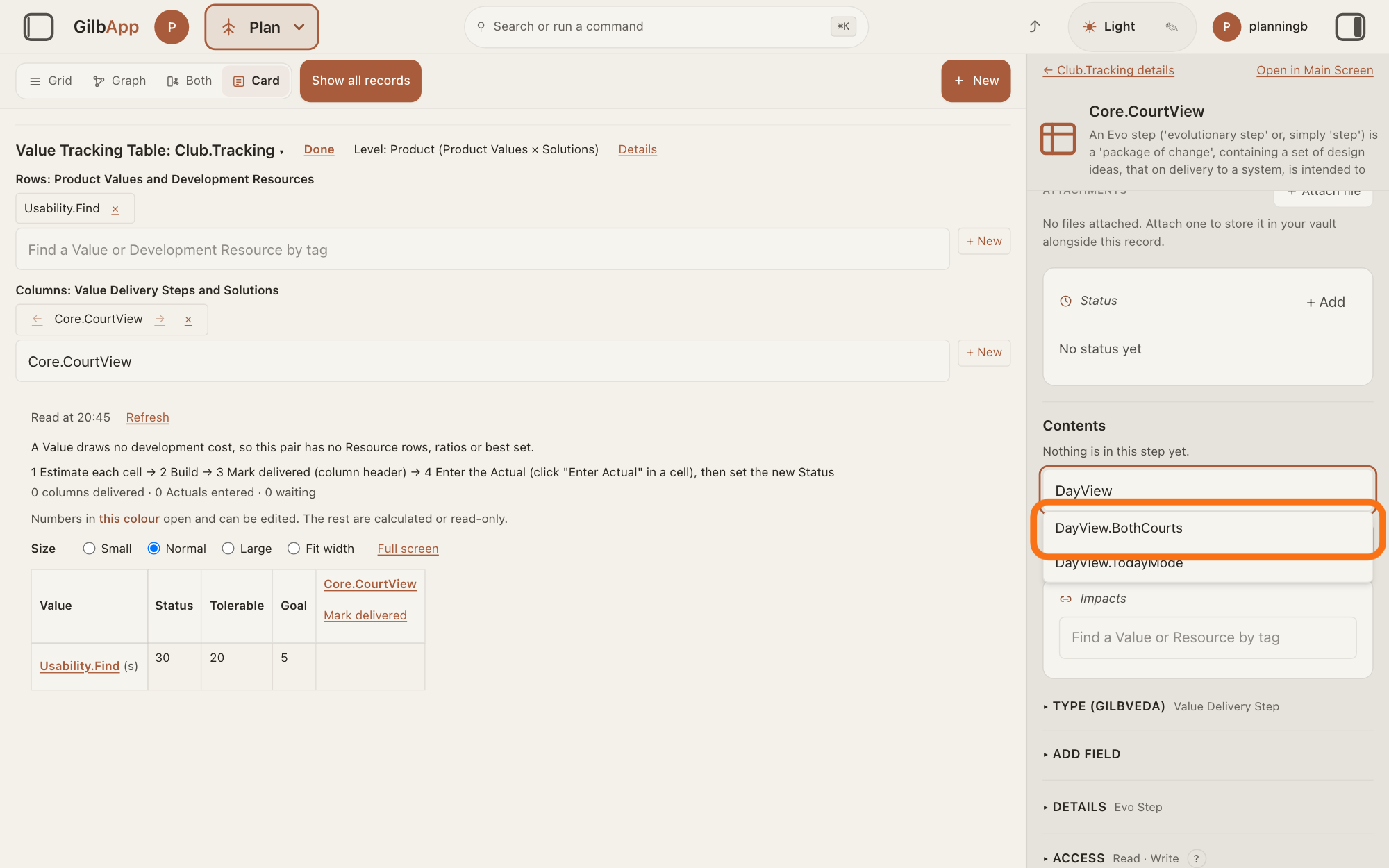
Under Contents, press + Add content, then search and select a Solution.
Under Contents on the step's card, press + Add content, type part of a Solution's tag in the box that shows Find a Solution by tag, and select it. A Solution is how a Function (what a system does) gets done; the step's Contents are what it delivers together.
Show as text
Lower on the step's card, under "Contents" ("Nothing is in this step yet."), the search box holds the start of the Solution's tag and a list opens below it. The outlined row is the Solution you want. Click it.
More about this
Until something is added, Contents says Nothing is in this step yet. Only Solutions are offered, not Solution Constraints, and only from this vault. Done closes the box without adding anything.
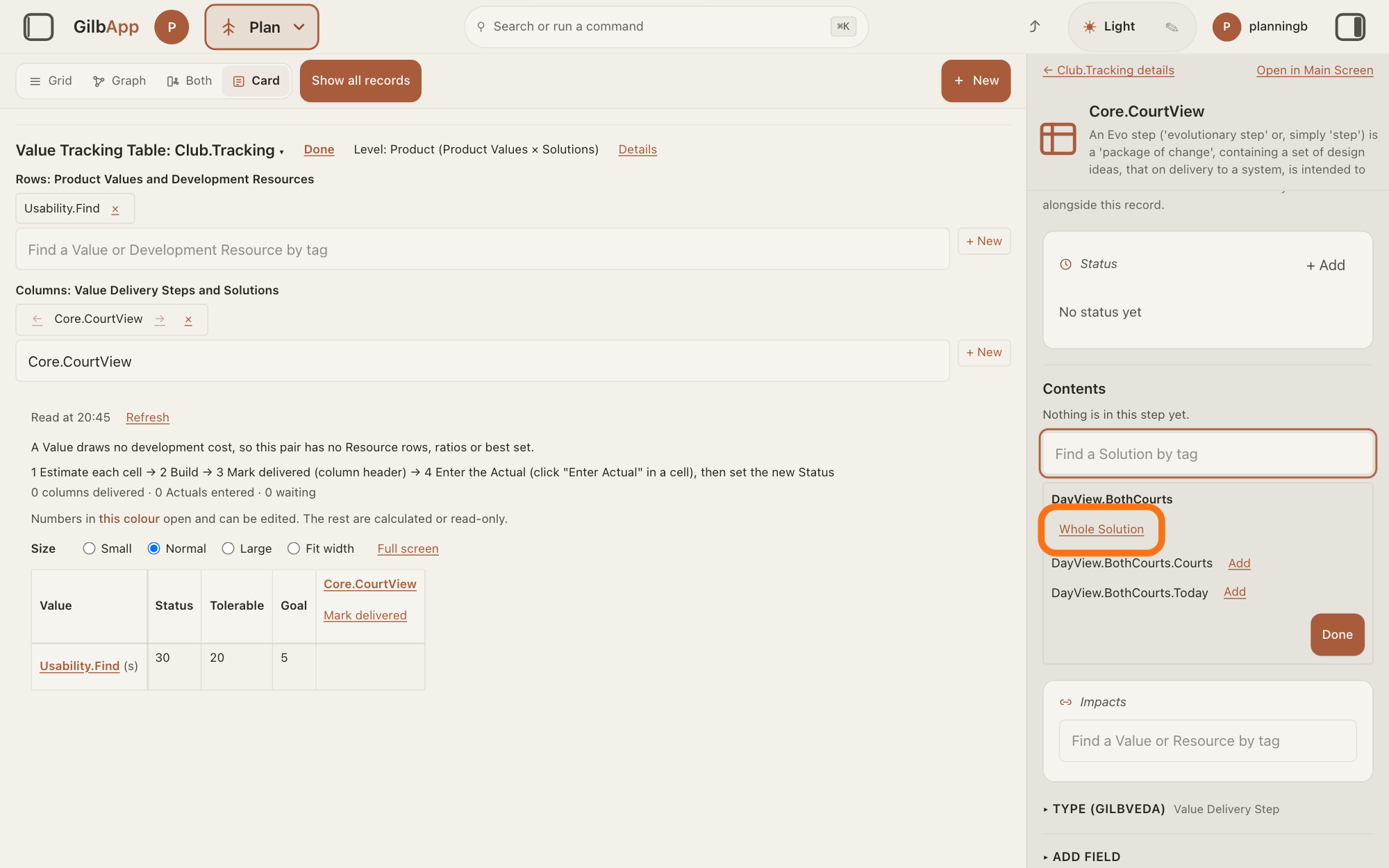
Press Whole Solution, or Add beside one of its parts, and press Done.
Under the Solution's tag, press Whole Solution to put all of it in the step, or Add beside one part of its Description to put in only that part; then press Done. Each one added shows under Contents with its tag and Solution, or Part of and the Solution's tag.
Show as text
Under "Contents", the chooser shows the Solution's tag, then "Whole Solution", then each of its parts with "Add", and "Done" at the bottom right. Press the outlined "Whole Solution", or "Add" beside one part, then "Done".
More about this
The parts are the Solution's Description parts, nested parts indented; This Solution has no Description parts. shows when it has none. Adding the same one twice says Already in this step. × beside a line takes it out of the step; the Solution itself does not change. If another step holds the same Solution or part, the line says Also in that step's tag and its effect and cost may be counted twice., and the column shows ⚠. Escape also closes the box.
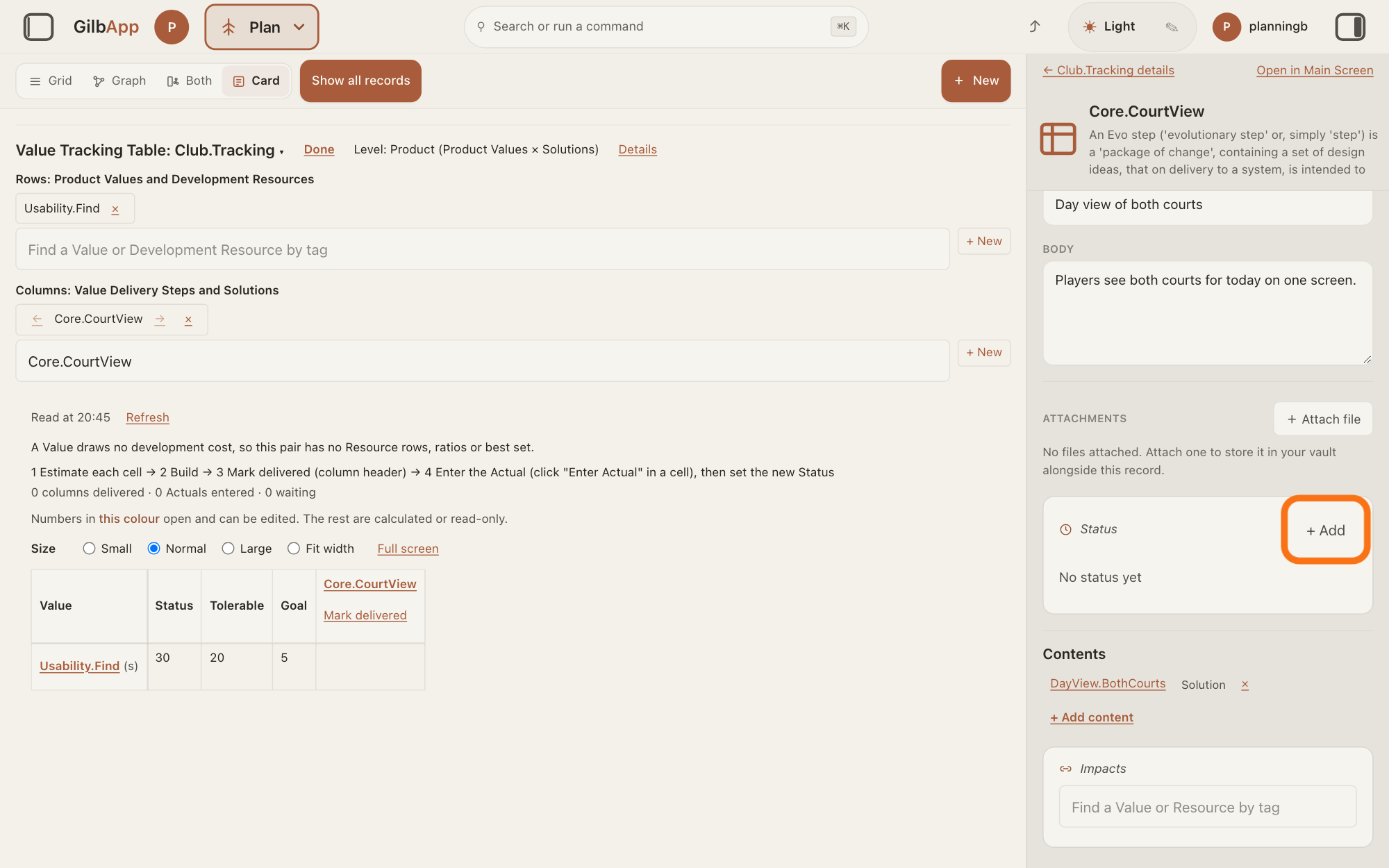
Under Status, press + Add.
Beside Status on the step's card, press + Add. The card then shows Status, today's date in brackets and Planned, with a date box and a list to change them.
Show as text
The Solution now shows under "Contents", marked "Solution". Higher on the card, the "Status" part reads "No status yet". The outlined "+ Add" is at the right of the word "Status". Press it.
More about this
Until then it says No status yet. The list holds Planned, Building, Developed, Production and Retired. Each later press of + Add adds the next word, dated today, and keeps the one before as a Past line, as the line To keep the old status as Past, use + Add says; choosing from the list changes the current line instead. A Source box can name who said it; you do not need it. The Kai-Zen method names a step's stages differently: Planned, Building, Measured or Done.
Deeper
GilbApp makes a step only from a Value Tracking Table: the list under TYPE in + New has no step. A step holds its tag, title, description, Status, Contents and Impacts. Only the tag is needed; every other part is optional.
Kai-Zen writes each step it picks from a template with these lines, each with its source: Why now (why this step gives the most value for the least effort today), Current (the starting point), Change (what the step changes), What not to do (what is left out on purpose), Solutions, Builder, Dates (start and target), Done when (every Estimate in its VTT column has an Actual, and Agent.Scaling's check passed), VTT (the table and the column), Status, and Learned (what worked, what did not, how to deliver the Values, and what the stakeholders actually want). An Estimate is how far the step is expected to move a Value; an Actual is how far it was measured to move it. A stakeholder is a person, group or system that cares whether a Value goes up or down. Agent.Scaling is the agent that checks what was built, and an agent is your AI following one written procedure, its standing instructions, for one kind of work. Kai-Zen writes a step's tag by its tag rules, such as Core.DayView: the keyword after the dot has each word starting with a capital, no spaces and no numbers, and the tag never changes once it is written.
In the Kai-Zen method a step's status is Planned, Building, Measured or Done. GilbApp's step card offers Planned, Building, Developed, Production and Retired, the words a Solution's Status uses, and Mark delivered in the table writes Developed. In GilbApp today the method's words Building, Measured and Done are not in the list.
In the Kai-Zen method a step's Estimates and Actuals live in its column of the VTT, not in the step. GilbApp keeps each Estimate once and shows it in two places: in the step's column and under Impacts on its card, where + Add writes one the same way as on a Solution's card. It leaves a step's Estimates out wherever it adds up the Estimates on a Value, so they count once. An Actual is entered only in the table. The answer on tracking estimates and actuals shows both.
Kai-Zen picks a step for real just before the round of delivery that builds it; the answer on picking the next step shows how to ask it to, and the rules it picks by.
This answer is written for a computer screen.
Source: GilbApp af0f04ee838a4d55887d2ff1f72edd49a4ff7ca0 (https://gilb.com/app/version.json read 2026-11-09, buildTime 2026-11-09.522Z, dirty false); code read from the archive (no checkout). Step 2: RegisterScopedSearch.tsx:73-74 (search placeholders), planFilterRows.ts:28 (VTT), recordsView.ts paramsForListRowOpen (Grid becomes Card on a row open), TableCard.tsx:630-700 (heading via tableMembership.ts:44-53 Value Tracking Table, + Add Ends & Means/Done, levelText Level: <upper> (<pairWords>) planLevelPair.ts:153-155, Details), :776-803 (Open the table). Step 3: TableCard.tsx:641-651, :705-709, :109-111 (rowsHeading). Step 4: TableCard.tsx:105-106 (VTT_COLUMNS_HEADING Columns: Value Delivery Steps and Solutions), :708 (placeholder Find a delivery step or a Solution by tag), :615-619 (choices New value delivery step, New Solution), :531-576 (makeCard: tag checked in the vault, duplicateTagSentence planLinks.ts:212-213; step made with Tag and Title = Tag, :549-550; column number = last, :501-503), :164-216 (chips with ←, →, ×; drag), :41-43 (VTT columns: steps and whole Solutions); PlanPickerNew.tsx:19-100 (+ New, box Tag, e.g. Usability.Learn, choices disabled until a tag, tagDraftProblem sentence and Use <tag>, Cancel). Step 5: PlanTable.tsx:840-862 (column header: tag as RecordLink, ⚠ overlap, Status line, Mark delivered via ColumnMark :547-551), :553-561 (a plain click opens the card in the right pane, the table stays); MarkDelivered.tsx:1-4, :76-92 (writes Developed); planKinds.ts:296-301 (delivered lock). Step 6: TablePaneRecord.tsx:10-28 (RecordDetail placementMode full); RecordDetail.tsx:1645-1666 (FieldEditor, onBlur flushSave), :3045-3130 (FieldEditor: label, textarea placeholder = field placeholder; no card-mode provider for a non-stakeholder card, so always editable); recordTypes.ts:488-502 (EvoStep fields Tag, Title What this step delivers together., Description Why these parts together move the Values, in one short cycle.). Labels of these boxes: RecordDetail.tsx:934-956 overlays the live a:label of each attribute for a non-Plan type (gilb.com/base/a/unitTag unitTag, /a/title Title, /a/body Body, read 2026-11-09), so the page names the boxes by role and placeholder, not by label (UNPROVEN, app fault candidate). Steps 7-8: StepContents.tsx:27-28, :150-245 (Contents, Nothing is in this step yet., + Add content, picker Find a Solution by tag over Solutions of this vault only, Done, Escape), :86-130 (chooser: tag, Whole Solution, Description parts tree with Add, Reading the Description parts…, This Solution has no Description parts.), :40-80 (line: tag, kind Solution/Part of <tag>, ×, overlap words); stepContents.ts:27-34 (Already in this step.); stepOverlap.ts:20-21 (Also in <tag>: its effect and cost may be counted twice.). Step 9: RecordDetail.tsx:2212-2219 (the step card draws the Solution card's Status line); PlanFunctionForm.tsx:1871-2010 (group Status, + Add via AddAside :521-529, No status yet, Status [date] word via LineWords, date box, list, To keep the old status as Past, use + Add, Past lines, Source), :836-847 (addStatus), :382-388 (nextStatusWord: none -> Planned, then the next word); planCard.ts:31 (PLAN_STATUS_WORDS Planned, Building, Developed, Production, Retired). Deeper: planKinds.ts:5-19 (no step in the create list), :35-36, :353-367 (a step is made from a Value Tracking Table); StepImpacts.tsx:1-61 (step's Estimates under Impacts, + Add, locked when delivered); planKinds.ts:289-295 (isStepEstimate: counted once). Standards (2026-11-09, all 200): Kai-Zen.WriteStep (Planguage, Rules, Estimate), Kai-Zen.ValueDeliveryStepTemplate (Blank: Why now, Current, Change, What not to do, Solutions, Builder, Dates, Done when, VTT, Status, Learned; Example Core.DayView, Solutions SignIn.GuestLight, DayView.TodayMode), Kai-Zen.ValueDeliveryStepRules (Numbers, Status Planned, Building, Measured or Done, Tag, Forecast), Kai-Zen.TagRules (Form PascalCase. No numbers, no space; Frozen), Agent.ValueDeliveryStep (Role). GilbVeda public read 2026-11-09: t:EvoStep (fields a:unitTag, a:title, a:body, a:levelStatements; status from t:DeliveryState; A whole Solution that is small and complete enough is a step on its own), t:StepContentOf, t:DeliveryState (Planned, Building, Developed, Production, Retired). tag gloss and is already used in this vault. Pick another. agreed wordings; stakeholder and agent glosses (published); step 3 empty-table sentences PlanTable.tsx:1051-1053 (EMPTY_TABLE_SENTENCE, NO_COLUMNS_SENTENCE), :1556 (emptyCard only when no rows and no columns), :1847-1852 (emptyCard tested first; a table with one row and no column shows the NO_COLUMNS message); step 6 right pane chrome in the full placement TablePaneRecord.tsx:23 (placementMode full), RecordDetail.tsx:548-549, :1923-1929 (RecordTagsSection first), RecordTagsSection.tsx:29 (LABEL uppercase), :98 (Tag), :180-181 (Add tag placeholder), RecordDetail.tsx:2226-2237 (▸ Type (GilbVeda), uppercase, writers only), :2432-2439 (▸ Add field, uppercase), :2806-2813 (▸ Details, uppercase), AccessPanel.tsx:34, :253 (▸ Access), ShareEntityPanel.tsx:147-149 (▸ Share this item), AddToFolderPanel.tsx:65-68 (▸ Add to folder), RecordDetail.tsx:2526-2531 (Delete record, writers only; genericDeleteRefusal :2633-2638 refuses only Process and ProcessStep) Also: Kai-Zen.ValueDeliveryStepRules.Learning.
Checked against GilbApp d529620.